The Hidden Thermometer: Why Your Transmission's Temperature Matters
If you have ever experienced your vehicle suddenly refusing to shift out of second gear, or noticed the torque converter clutch failing to lock up on the highway, you have likely encountered a thermal management failure. As of 2026, modern automatic transmissions are essentially hydraulic computers. They rely on a network of electronic sensors to dictate shift timing, line pressure, and clutch apply rates. Among the most critical—and most misunderstood—are transmission temperature sensors.
For beginners entering the world of drivetrain diagnostics, understanding how thermal data influences hydraulic behavior is crucial. But thermal management does not exist in a vacuum. To fully grasp modern transmission protection strategies, we must also explore differential pressure sensor applications and how these two distinct sensor types work in tandem to prevent catastrophic gearbox failure.
How Transmission Temperature Sensors (TTS) Actually Work
Most transmission temperature sensors utilize a Negative Temperature Coefficient (NTC) thermistor. In plain English, this means the sensor's electrical resistance decreases as the transmission fluid gets hotter. The Transmission Control Module (TCM) sends a standard 5-volt reference signal to the sensor. By measuring the voltage drop across the circuit, the TCM calculates the exact fluid temperature.
Why does this matter? Automatic transmission fluid (ATF) changes viscosity based on heat. If the fluid is cold and thick, the TCM commands lower line pressure and delays upshifts to prevent clutch chatter. If the fluid exceeds 260°F (126°C), the TCM will trigger a "limp-home" mode, disable overdrive gears, and unlock the torque converter to maximize cooling through the radiator.
Top 3 Transmission Temperature Sensor Issues (And How to Spot Them)
When the TCM receives illogical data from the NTC thermistor, it sets a Diagnostic Trouble Code (DTC) and alters shift strategies. Here are the most common culprits:
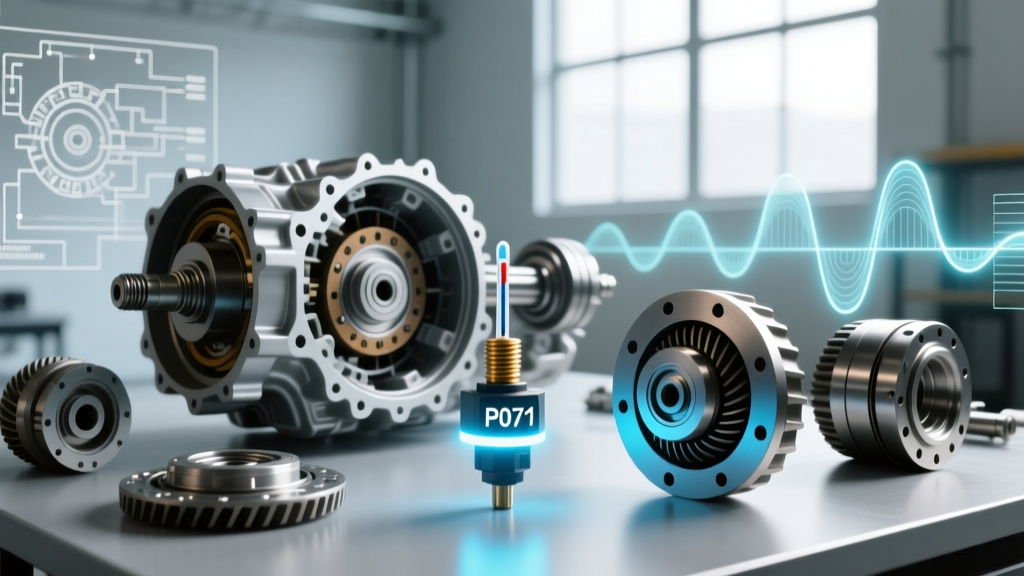
- P0711 (Transmission Fluid Temperature Sensor 'A' Circuit Range/Performance): The TCM sees a temperature reading that defies physics. For example, the sensor reports 150°F at a cold startup, or the fluid temp drops 50 degrees in three seconds while driving. This usually indicates a failing internal resistor or a chafed wire harness.
- P0712 (Circuit Low Input): The TCM reads near 0 volts, which translates to an impossibly high temperature (often over 300°F). This is typically caused by a dead short to ground in the wiring harness or an internally shorted sensor.
- P0713 (Circuit High Input): The TCM reads near 5 volts, translating to an impossibly low temperature (e.g., -40°F). This indicates an open circuit, a broken wire, or a corroded connector pin.
For a deeper dive into standard OBD-II powertrain codes, you can reference the comprehensive P0711 code guide on OBD-Codes.com.
Real-World Repair: GM 6L80 & ZF 8HP Case Studies
Beginners often assume replacing a transmission temp sensor is a simple $20 plug-and-play job. In modern vehicles, this is rarely the case. Let us look at two of the most common transmissions on the road today.
The GM 6L80 / 6L90 Series
In GM's ubiquitous 6-speed rear-wheel-drive transmissions, the temperature sensor is not a standalone component. It is permanently integrated into the Transmission Electronic Hydraulic Control Module (TEHCM). If the thermistor fails, you must replace the entire TEHCM assembly (Part # 24238298 or updated variants).
Repair Specs & Costs:
- Part Cost: $450 - $850 (OEM or Remanufactured TEHCM)
- Fluid Required: 6 to 8 quarts of Dexron VI or Dexron ULV ($10-$18/quart)
- Torque Spec: TEHCM to case bolts must be tightened to exactly 11 Nm (97 lb-in). Over-torquing will crack the plastic housing and cause internal hydraulic leaks.
- Programming: A J2534 pass-through device (like an MDI2) is mandatory to flash the new TEHCM with the vehicle's specific VIN and calibration files.
The ZF 8HP (BMW, FCA, Audi)
The legendary ZF 8-speed utilizes a "Mechatronic" unit, which combines the valve body and TCM into one sealed module. The temperature sensor is embedded directly into the Mechatronic's circuit board. While aftermarket companies like Sonnax offer specialized repair kits and valve body upgrades, a failed internal temp sensor usually requires a complete Mechatronic replacement (Part # 24117533912 for select BMW applications), costing upwards of $1,200 to $1,800 before programming and ZF Lifeguard 8 fluid.
Expanding Your Knowledge: Differential Pressure Sensor Applications
While temperature sensors monitor thermal health, modern heavy-duty and advanced 10-speed transmissions (like the Ford 10R80 or Allison 1000 series) rely on differential pressure sensor applications to monitor hydraulic and mechanical health.
A differential pressure sensor measures the pressure drop (delta-P) between two points in a hydraulic circuit. In transmission applications, this is primarily used for filter restriction monitoring and clutch apply verification.
| Feature | Transmission Temp Sensor (NTC) | Differential Pressure Sensor (DPS) |
|---|---|---|
| Primary Function | Measures ATF heat to adjust shift firmness and cooling. | Measures pressure drop across filters or clutch accumulators. |
| Typical Location | Integrated into TEHCM, Mechatronic, or Valve Body. | Threaded into the transmission case near the filter housing. |
| Failure Symptom | Limp mode, disabled TCC lockup, erratic shift timing. | False "Filter Clogged" warnings, clutch slip codes (P073x). |
| Diagnostic Tool | Multimeter (Ohms/Resistance test). | High-PSI Hydraulic Manifold Gauge set. |
How Differential Pressure Sensor Applications Prevent Starvation
Imagine a scenario where debris begins to clog the main transmission filter. A standard single-point pressure switch might not detect the issue until the pump completely cavitates, starving the clutch packs and burning them up in seconds.
By utilizing differential pressure sensor applications, the TCM measures the pressure before the filter and after the filter. If the pressure differential exceeds a programmed threshold (e.g., a 15-20 PSI delta), the TCM instantly flags a clogged filter code and limits engine torque, saving the clutch packs from catastrophic friction material loss. This technology has become a cornerstone of predictive maintenance in 2026 commercial fleet vehicles.
Step-by-Step Diagnostic Framework for Beginners
If you suspect a transmission temperature sensor issue, do not immediately throw parts at the vehicle. Follow this logical diagnostic sequence:
- Verify the Baseline: Use an advanced bi-directional scan tool to read the live Transmission Fluid Temperature (TFT) PID. Compare it to the Engine Coolant Temperature (ECT) after the vehicle has sat overnight. They should be within 5°F of each other. If the TFT reads 180°F while the engine is cold, you have a circuit fault.
- Test the Thermistor (If Accessible): If your vehicle has a standalone, externally accessible temp sensor, unplug it and test it with a multimeter set to Ohms. At room temperature (68°F / 20°C), a standard NTC sensor should read approximately 10,000 ohms (10kΩ). If you heat the sensor tip with a heat gun to 212°F (100°C), the resistance should smoothly drop to roughly 1,200 ohms. Any erratic jumping or infinite resistance means the sensor is dead.
- Inspect the Harness: Look for chafing near the transmission case pass-through connector. Heat cycles and vibration often cause the insulation to melt against the hot aluminum case, causing a short to ground (P0712).
- Evaluate the Fluid Condition:Pull the dipstick or check the overflow plug. If the ATF smells burnt and is dark brown/black, the transmission has been running hot. The sensor may be perfectly fine, but accurately reporting a genuine over-temperature condition caused by a failed radiator cooler or slipping clutches.
When to Replace vs. Reprogram
Before purchasing a new TEHCM or Mechatronic unit, ensure your diagnostic tool supports TCM reflashing. In many late-model vehicles, a simple software update from the OEM can recalibrate the thermal thresholds and eliminate phantom P0711 codes caused by aggressive factory programming. Always check for Technical Service Bulletins (TSBs) related to your specific VIN before authorizing a $1,000+ hardware replacement.
Understanding the delicate balance between thermal management and hydraulic pressure is what separates a parts-changer from a true drivetrain diagnostician. Whether you are troubleshooting a simple NTC thermistor or analyzing complex differential pressure sensor applications, relying on live data, precise electrical testing, and factory torque specs will ensure your repairs stand the test of time.