The Anchor of the Shop: Selecting a Transmission Rebuild Stand
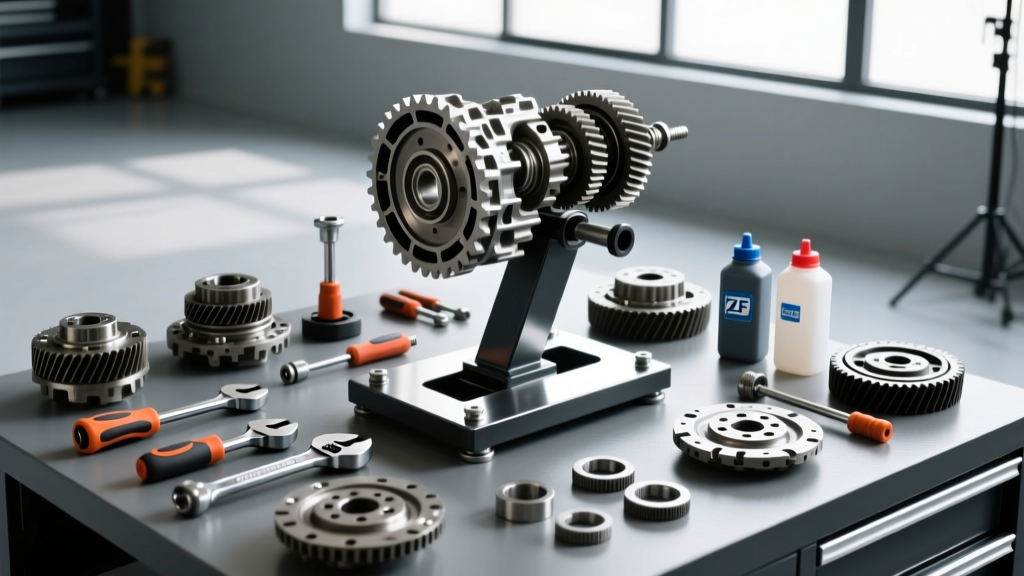
When approaching a modern automatic transmission rebuild, the workspace environment is just as critical as the mechanical knowledge required to execute the repair. The absolute centerpiece of this environment is a dedicated transmission rebuild stand. Unlike a standard engine hoist or a makeshift workbench, a professional-grade transmission stand allows the technician to securely mount the unit, rotate it 360 degrees, and lock it into precise angles. This is non-negotiable for measuring endplay, installing clutch packs, and aligning valve bodies without risking catastrophic cross-threading or component damage.
For modern, heavy-duty units like the GM 6L80E (dry weight approximately 235 lbs) or the Ford 6R80, a stand with a minimum 1,000-lb capacity is required. The rotational mechanism must utilize a worm-gear drive with a positive locking pin. If the gear slips while you are applying downward pressure to compress a heavy clutch pack return spring, the resulting sudden rotation can cause severe injury or destroy the internal snap rings. Brands like OTC Tools manufacture heavy-duty transmission stands that feature adjustable mounting arms and integrated fluid catch trays, which are essential for draining residual torque converter fluid before teardown.
Mounting Adapter Plates and Bellhousing Patterns
A universal flat mounting plate is insufficient for precision rebuilds. To ensure the stator support, input shafts, and pump remain perfectly concentric during assembly, you must use model-specific adapter plates that mate the transmission bellhousing directly to the stand's rotational hub. For example, the ZF 8HP series features a highly unique, asymmetrical bellhousing bolt pattern. Attempting to mount a ZF 8HP70 to a standard GM-metric adapter plate will result in a cantilevered load that throws off your dial indicator readings by up to 0.005 inches when checking output shaft endplay.
Model-Specific Teardown and Assembly Tooling
Beyond the stand, the specific transmission family dictates the specialty tools required. Modern automatics rely on tightly packed clutch modules and complex mechatronic units that cannot be serviced with standard hand tools.
GM 6L80 and 6L90 Applications
The GM 6L80 and 6L90 transmissions require specialized clutch compression tools. The 3-5-R clutch pack, for instance, requires a stepped, cylindrical compressor to safely collapse the heavy return springs and expose the internal snap ring. Using improvised C-clamps or universal strap wrenches will inevitably warp the clutch retainer. Furthermore, checking the 1-2-3-4 clutch pack clearance requires precise measurement; OEM specifications demand a clearance of 0.040" to 0.060". To achieve this, you need a comprehensive selective snap ring and backing plate kit, alongside a high-quality set of internal snap ring pliers with 1.3mm tips (such as the Knipex 46 series) to navigate the tight clearances of the 6L80 drum.
ZF 8HP (8HP45 / 8HP70 / 8HP90) Precision Requirements
ZF 8-speed units are notoriously sensitive to debris, static electricity, and torque sequence deviations. Rebuilding a ZF 8HP requires a mechatronic sealing sleeve replacement tool to prevent tearing the delicate ribbon cable connections during valve body removal. The valve body and mechatronic unit utilize specialized Torx fasteners (typically T25 and T30). These must be torqued to exact specifications—usually 8 Nm to 10 Nm—following a strict, documented crisscross sequence. Referencing technical data and acquiring proprietary software access from organizations like ATSG is mandatory before attempting a ZF teardown, as the adaptation values must be reset via an OEM-level bidirectional scan tool upon reassembly.
Precision Measurement Instrumentation
The difference between a transmission that shifts flawlessly for 200,000 miles and one that fails in 500 miles often comes down to thousandths of an inch. Your measurement toolkit must include:
- Dial Indicators: A 1-inch travel dial indicator with 0.001" resolution is required for checking endplay and clutch pack travel. For a classic GM 4L60E, the ideal total endplay is between 0.010" and 0.025", adjusted via selective thrust washers.
- Digital Calipers and Micrometers: A 6-inch digital caliper (e.g., Mitutoyo 500-196-30) is essential for measuring the thickness of friction discs, steel separator plates, and backing plates to calculate exact clutch pack clearances.
- Stepped Feeler Gauges: Standard flat feeler gauges cannot accurately measure the clearance inside a deep clutch drum. Stepped or bent-tip feeler gauges allow you to measure the gap between the snap ring and the backing plate without binding.
- Valve Body Reamers: For units suffering from bore wear (such as the 4L60E TCC apply valve bore or the 6L80 pressure regulator), you will need specialized valve body reamers and oversized replacement valves, heavily supplied by industry leaders like Sonnax.
Tooling Investment vs. Professional Rebuild Costs
Understanding the financial barrier to entry is crucial for DIY enthusiasts and independent shop owners alike. While the initial tooling investment is significant, it pays for itself rapidly when compared to the rising costs of remanufactured units and professional labor in the current market.
| Equipment / Service Category | Estimated Cost Range (USD) | Notes & Application |
|---|---|---|
| 1,000-lb Transmission Rebuild Stand | $450 - $850 | Includes universal flat plate; adapter plates sold separately ($80-$150 each). |
| Model-Specific Clutch Compressors | $150 - $400 per unit | OTC or Kent Moore equivalents for 6L80, 6R80, or ZF 8HP clutch modules. |
| Precision Measurement Suite | $250 - $600 | Includes dial indicator, magnetic base, digital calipers, and stepped feeler gauges. |
| Valve Body Reaming Kits | $120 - $300 per circuit | Sonnax or Superior reamer and oversized valve kits for bore wear repair. |
| Professional Shop Rebuild Labor | $1,800 - $3,500+ | Excludes hard parts, torque converter, and core charge; varies by region. |
| Remanufactured Transmission | $2,500 - $5,000+ | Plus core deposit (often $500-$1,000) and freight shipping for heavy units. |
Expert Insight: If you are rebuilding a single personal vehicle (e.g., a 4L60E in a Chevy Silverado), purchasing the heavy stand and specialty compressors may not yield a positive ROI compared to buying a remanufactured unit. However, if you are an independent mechanic or a serious enthusiast tackling multiple ZF 8HP or GM 8-speed units, owning the tooling reduces your per-unit overhead by over 60% after the third rebuild.
Assembly Consumables and Lubricants
The final tier of your tooling setup involves the chemical consumables required during assembly. Never assemble a transmission dry. You must use a high-tack, non-foaming transmission assembly lubricant (such as Trans-Jel or Petrogel) to coat all friction surfaces, O-rings, and lip seals. This prevents dry-start scoring during the initial 15 seconds of operation before line pressure builds.
Furthermore, pre-filling the torque converter is a step often skipped by amateurs. A 6L80E torque converter holds roughly 3 to 4 quarts of fluid alone. If installed dry, the transmission pump will suffer from cavitation, and the TCC clutch material can glaze instantly. Always pre-fill the converter with the exact OEM-specified fluid—such as Dexron VI for GM applications or ZF LifeguardFluid 8 for ZF units—before mating it to the flexplate. Total system dry capacity for a 6L80E is approximately 11.2 quarts, while a ZF 8HP70 requires between 9 and 10 quarts depending on the specific cooler circuit volume. Having a dedicated, lint-free fluid transfer pump and a calibrated bench-scale to measure exact fluid volumes ensures your post-rebuild fill process is mathematically perfect.