The Power Bottleneck: Why Ford Owners Look Beyond the OEM
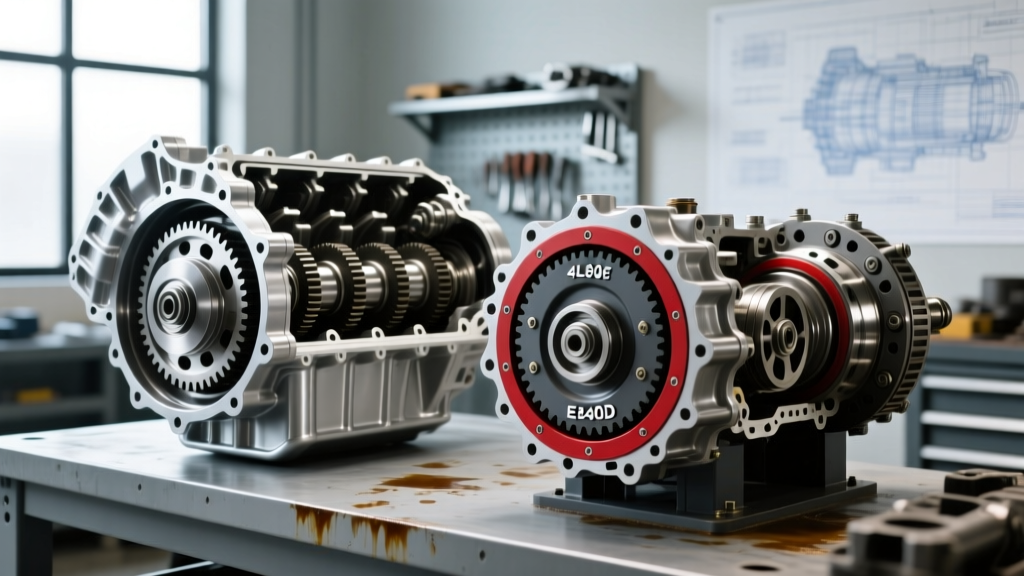
When building a high-horsepower 7.3L Powerstroke or a big-block 460 Ford truck, enthusiasts quickly encounter a harsh reality: the factory transmission cannot handle the torque. For decades, the standard solution was to perform an E4OD transmission rebuild, hoping that upgraded clutches and bands would hold up to the added stress. However, as torque figures push past 600 lb-ft, the E4OD's architectural limitations become glaringly obvious. As of 2026, the most reliable path forward for serious performance applications is abandoning the E4OD entirely in favor of a GM 4L80E swap. This guide breaks down the performance rebuild blueprint for the 4L80E, contrasting its inherent strength against the E4OD, and provides a comprehensive cost and assembly analysis.
Architectural Flaws of the E4OD vs. 4L80E Strength
The E4OD is essentially a C6 with an overdrive unit and electronic controls bolted on. While revolutionary in the late 1980s, its internal hard parts were never designed for modern, high-torque diesel tuning. The most notorious failure point during any heavy-duty E4OD transmission rebuild is the forward clutch hub. Under high load, the stamped steel hub shears, resulting in an immediate loss of forward gears. Additionally, the E4OD relies on a single overdrive band that is highly susceptible to burning or snapping when subjected to aggressive tuning or heavy towing.
Conversely, the 4L80E is the electronic evolution of the legendary Turbo Hydra-Matic 400. It features a robust cast-iron case, a massive center support, and a gearset that can handle immense shock loads. Where the E4OD uses a fragile band for overdrive, the 4L80E utilizes a dedicated overdrive clutch pack, distributing the load across multiple friction surfaces. This fundamental difference is why top-tier diesel builders consistently recommend a 4L80E build over repeated OEM repairs.
The 4L80E Performance Rebuild Blueprint
To survive behind a modified diesel or a blown big-block, a stock 4L80E will not suffice. A true performance build requires targeted upgrades to the rotating assembly, hydraulics, and clutch packs. Below is the definitive parts list and strategy for a 4L80E capable of handling 1,000+ horsepower and 1,200 lb-ft of torque.
Hard Parts & Rotating Assembly
- Billet Input Shaft: The factory input shaft will twist and snap under aggressive line pressure and high torque. Upgrade to a 300M billet input shaft (such as the IPT Part # 34100-01K or equivalent from PPE). This is non-negotiable for builds exceeding 600 lb-ft.
- 34-Element Sprag: The intermediate sprag is a known weak link. Replace the OEM unit with a heavy-duty 34-element sprag assembly. This provides significantly more surface area for torque transfer and prevents the catastrophic case-busting failure associated with sprag explosion.
- Billet Forward Hub: While the 4L80E forward hub is stronger than the E4OD's, extreme torque converter multiplication can still fracture it. A billet steel forward hub ensures the direct and forward clutch drums remain perfectly concentric under load.
- Deep Pan & Center Lube Modification: The 4L80E suffers from poor center lube flow at high RPMs. Drilling the center support lube hole to 0.090 inches and installing a deep cast aluminum pan ensures the planetary gearsets receive adequate oiling, preventing thermal failure.
Hydraulics & Valve Body Upgrades
Shift speed and line pressure dictate clutch longevity. A sluggish shift under high torque will glaze clutches in seconds. We recommend the TransGo SK-4L80E-HD2 shift kit. This kit recalibrates the valve body to deliver firm, immediate shifts and increases line pressure to safely clamp the clutch packs.
Furthermore, the overrun clutch valve is prone to bore wear, leading to delayed engagements and burnt bands. Installing a Sonnax Smart-Tech overrun clutch valve kit (Part # 77490-03K) restores hydraulic integrity and ensures crisp manual low gear engagement, which is critical for engine braking on steep grades.
Cost Analysis: E4OD Rebuild vs. 4L80E Performance Swap
Many enthusiasts hesitate at the upfront cost of a transmission swap. However, when factoring in the labor of pulling the transmission multiple times, the financial argument shifts heavily in favor of the GM swap. Below is a realistic 2026 cost breakdown comparing a high-end E4OD transmission rebuild against a complete 4L80E performance swap.
| Cost Category | E4OD Performance Rebuild | 4L80E Swap & Build |
|---|---|---|
| Core Transmission & Rebuild Kit | $1,200 - $1,500 | $800 (Used Core) + $1,400 (Master Kit) |
| Billet Hard Parts & Upgrades | $1,800 (Limited Options) | $2,200 (Shafts, Sprag, Hubs) |
| High-Stall Torque Converter | $1,100 | $1,300 (Billet, Triple Disc) |
| Standalone TCU & Wiring Harness | $0 (Uses OEM) | $900 - $1,200 (TCI or PCS) |
| Crossmember & Driveshaft Mods | $0 | $450 |
| Estimated Labor (R&R & Build) | $2,500 | $3,500 (Includes Swap Fab) |
| Total Estimated Investment | $6,600 - $6,900 | $10,550 - $10,850 |
Expert Insight: While the 4L80E swap costs roughly 50% more upfront, its lifespan under 800+ horsepower is measured in years, whereas a heavily loaded E4OD may require annual teardowns. The ROI on reliability makes the 4L80E the undisputed king of heavy-duty performance swaps.
Precision Assembly & Torque Specifications
A successful rebuild relies on meticulous clearances and exact torque values. The 4L80E is unforgiving if assembled incorrectly. Adhere strictly to the following specifications during your build:
- Direct Clutch Pack Clearance: 0.040" to 0.060". Use a 0.125" selective snap ring to dial in the exact clearance. Too tight, and the clutches will drag and burn; too loose, and shift times will be dangerously long.
- Endplay Measurement: Target 0.010" to 0.025" of total endplay. Use the #13 selective thrust washer (0.153" thick) or equivalent to achieve this. Excessive endplay will destroy the thrust bearings under heavy acceleration.
- Oil Pump Bolts: Torque to 13 lb-ft. Ensure the pump gears are primed with assembly lube or petroleum jelly before installation to prevent dry-start cavitation.
- Valve Body Bolts: Torque to 97 in-lbs (approx. 8 lb-ft). Over-torquing will warp the aluminum valve body, causing cross-leaks and binding valves.
- Bellhousing to Block: Torque to 35 lb-ft using the correct GM-to-Ford adapter plate hardware.
- Fluid Capacity & Type: A dry 4L80E with a deep pan requires approximately 13.5 to 14 quarts. Fill with a high-quality synthetic Dexron VI or dedicated racing ATF to handle the extreme shear forces of a high-stall converter.
Electronic Integration & Standalone Control
The final hurdle in a Ford-to-GM swap is electronic communication. The 4L80E requires precise PWM (Pulse Width Modulation) line pressure control; without it, line pressure defaults to maximum, resulting in harsh, drivetrain-shocking shifts. In 2026, standalone transmission controllers have become incredibly sophisticated. Units like the TCI Automotive EZ-TCU or the PCS TCM-2800 allow you to tune shift points, line pressure curves, and torque converter clutch lockup directly from a laptop or smartphone. By feeding the controller a TPS (Throttle Position Sensor) signal and RPM input from your Ford's aftermarket EFI system, the 4L80E will shift seamlessly, completely masking its OEM origins.
Final Verdict
Performing an E4OD transmission rebuild is a viable path for stock or mildly modified trucks. But for dedicated performance builds, towing rigs, and high-horsepower street trucks, the E4OD is a financial and mechanical dead end. Investing in a properly built 4L80E with billet internals, upgraded hydraulics, and a standalone controller provides the ultimate peace of mind. Stop rebuilding the past, and upgrade to a drivetrain that can actually handle your engine's output.