The Hydraulic Network: Where Transmission Fluid Actually Lives
When novice DIYers and new technicians ask, "where does the transmission fluid go in a car?" they often picture a single, easily accessible reservoir similar to a windshield washer tank. In reality, automatic transmission fluid (ATF) is distributed across a complex, pressurized hydraulic network. Understanding this network is critical because it dictates the difference between a "dry fill" capacity and a "service drain-and-fill" capacity. If you misjudge where the fluid lives, you risk severe under-filling, leading to torque converter cavitation and immediate clutch pack failure.
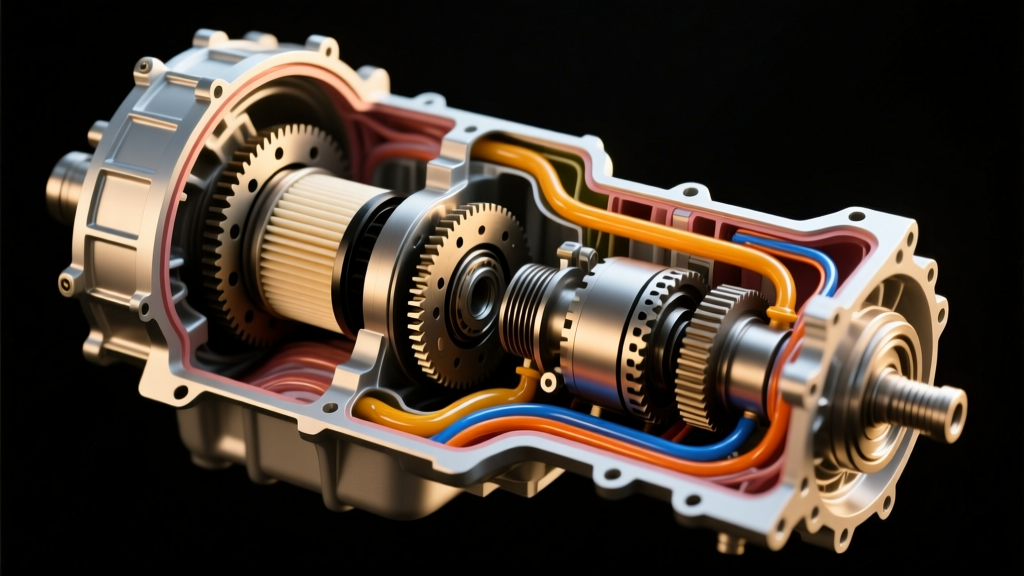
According to Sonnax Technical Resources, the hydraulic circuit of a modern automatic transmission routes fluid through four primary zones:
- The Torque Converter: This fluid coupling acts as a centrifugal pump and typically holds 30% to 50% of the total system capacity. During a standard pan drop, this fluid remains trapped inside the converter.
- The Valve Body & Solenoid Galleries: A maze of narrow hydraulic passages and accumulator bores that require pristine fluid to prevent solenoid sticking and harsh shift events.
- The Cooler Circuit & Heat Exchanger: Fluid is pushed through lines to the radiator or an auxiliary cooler. These lines can trap up to 1.5 quarts of degraded fluid during a standard service.
- The Oil Pan (Sump): The lowest point in the system, acting as a reservoir for the pickup tube. This is the only area you can easily drain without specialized flushing equipment.
Service Capacity vs. Dry Fill Capacity: The Critical Distinction
Automotive service manuals list two distinct fluid capacities. The Dry Fill Capacity is the total volume required to fill a completely dry, newly rebuilt transmission (including the torque converter and cooler lines). The Service Capacity (or drain-and-fill capacity) is the amount of fluid you will actually need when dropping the pan and replacing the filter. Pouring a "dry fill" amount into a transmission that already has fluid trapped in the torque converter will result in catastrophic overfilling, causing the fluid to aerate, foam, and lose hydraulic pressure.
Model-Specific Capacity & Fill Guides
To answer exactly where the fluid goes and how much is required, we must look at specific transmission models. Below is a deep dive into three of the most common transmissions on the road today.
1. GM 6L80 / 6L90 (Silverado, Tahoe, Camaro, Corvette)
The GM 6L80 and 6L90 are ubiquitous in GM trucks and performance cars. A unique feature of the 6L80 is the TEHCM (Transmission Electro-Hydraulic Control Module), which houses the TCM and solenoids directly inside the transmission pan. Because the electronics are submerged, maintaining the exact fluid level and using the correct dielectric fluid is paramount.
- OEM Fluid Spec: ACDelco DEXRON VI (Part # 10-9395 for 1qt, 10-9243 for 1gal)
- Dry Fill Capacity: 11.2 Liters (11.9 Quarts)
- Service Capacity (Pan Drop): 5.7 Liters (6.0 Quarts)
- Where it Goes In: Early models (pre-2014) feature a traditional dipstick tube under the hood. Later "sealed" models require you to locate the side-fill plug on the passenger side of the transmission case, necessitating a hand-operated fluid transfer pump to push fluid upward into the case.
- Torque Spec: Pan bolts are M6x1.0 and must be torqued to 9 Nm (80 lb-in) in a crisscross pattern to prevent warping the TEHCM sealing surface.
2. ZF 8HP45 / 8HP70 (Dodge Charger/Challenger, BMW F/G-Series, Audi)
The ZF 8-speed is an engineering marvel, but it completely eliminated the traditional dipstick and external serviceable filter. The filter is molded directly into a composite plastic oil pan. When replacing the fluid, you must replace the entire pan assembly.
- OEM Fluid Spec: ZF LifeguardFluid 8 (Part # S671 090 312)
- Dry Fill Capacity: 9.5 Liters (10.0 Quarts)
- Service Capacity (Pan Drop): 5.5 Liters (5.8 Quarts)
- Where it Goes In: There is no top-fill tube. Fluid is pumped into the bottom fill plug located on the lower rear corner of the plastic pan while the engine is running and the transmission is in Park. Once fluid drips out of the fill hole, the level is checked via the internal overflow tube.
- Torque Spec: The plastic pan uses specialized one-time-use stretch bolts. Torque to exactly 10 Nm. Over-torquing will crack the composite boss.
3. Toyota A750E / A750F (Tacoma, 4Runner, FJ Cruiser)
Toyota's A750 series is legendary for its durability, provided it is fed the correct low-viscosity fluid. This transmission uses a temperature-dependent overflow tube to set the final fluid level.
- OEM Fluid Spec: Toyota ATF WS (World Standard - Part # 00289-ATPWS)
- Dry Fill Capacity: 11.0 Liters (11.6 Quarts)
- Service Capacity (Pan Drop): 3.0 Liters (3.2 Quarts)
- Where it Goes In: Fluid is added via the dipstick tube in the engine bay. However, the final level is verified underneath the vehicle by removing the overflow check plug on the transmission pan while the fluid temperature is strictly between 104°F and 113°F (40°C - 45°C).
- Torque Spec: Pan bolts are 7.5 Nm (66 lb-in); Drain plug is 20 Nm (15 lb-ft).
Transmission Capacity & Fill Data Matrix
| Transmission Model | Dry Fill Capacity | Service Capacity | OEM Fluid Spec | Pan Bolt Torque |
|---|---|---|---|---|
| GM 6L80 / 6L90 | 11.9 Quarts | 6.0 Quarts | DEXRON VI | 9 Nm (80 lb-in) |
| ZF 8HP45 / 8HP70 | 10.0 Quarts | 5.8 Quarts | ZF Lifeguard 8 | 10 Nm (Replace Bolts) |
| Toyota A750E / A750F | 11.6 Quarts | 3.2 Quarts | Toyota WS | 7.5 Nm (66 lb-in) |
Common Fill Mistakes & Cavitation Risks
Knowing where the fluid goes is only half the battle; knowing how to verify the level is where most DIYers fail. Modern "sealed" transmissions do not have a dipstick. Relying on visual estimation or assuming that "if it drips out, it's full" without monitoring the internal fluid temperature will lead to an incorrect fill.
Expert Warning: ATF expands significantly as it heats up. If you check the overflow plug on a ZF 8HP or Toyota A750E when the fluid is cold (below 80°F), you will underfill the system. When the transmission reaches operating temperature (180°F+), the fluid will contract relative to the overflow tube, starving the oil pickup and causing immediate clutch slip and burnout. Always use an OBD2 scanner with live data to monitor the Transmission Fluid Temperature (TFT) PID during the fill procedure.
Furthermore, failing to prime the torque converter after a rebuild or cooler replacement will result in dry-start cavitation. The transmission oil pump will draw air instead of fluid, leading to a whining noise and zero hydraulic line pressure. For dry fills, it is highly recommended to pre-fill the torque converter through the stator hub with 2 to 3 quarts of fluid before installing the transmission to the engine block.
Sourcing Quality Parts and Fluids
Never substitute fluid specifications to save money. Using standard DEXRON III in a transmission requiring Toyota WS or ZF Lifeguard 8 will alter the friction coefficients of the clutch packs, resulting in shudder and premature failure. Always source OEM fluids or licensed equivalents from reputable suppliers. For ZF-specific service kits, which include the composite pan, filter, and sealing sleeve, consult the ZF Aftermarket catalog to ensure you are receiving the updated part numbers with reinforced mechatronic sealing sleeves. For Toyota applications, the Toyota Owners Portal provides verified fluid capacities and service intervals tailored to your exact VIN.
Ultimately, understanding where transmission fluid goes in a car transforms a messy, guesswork-heavy chore into a precise, data-driven maintenance procedure. By respecting the service capacities, utilizing the correct fill locations, and adhering to strict torque and temperature specifications, you can easily extend the life of your drivetrain well past the 200,000-mile mark.