The Drivetrain Chain: Where Power Meets the Pavement
For newcomers to the world of off-roading, heavy towing, and four-wheel-drive (4WD) trucks, the terminology surrounding the drivetrain can feel like a foreign language. You hear terms like 'part-time 4WD,' 'locking differentials,' and 'drivetrain bind,' but understanding how these components interact is the difference between conquering a trail and snapping an axle shaft in your driveway. In this beginner-friendly explainer, we are going to demystify the transfer case and differential relationship, with a specific focus on how your transfer case interacts with the rear differential lock.
Whether you are driving a modern 2026 Ford Super Duty equipped with a BorgWarner transfer case or a classic GM 2500HD with a New Venture NV241HD, the fundamental physics of torque distribution remain exactly the same. Let us trace the power from your engine to the dirt.
What the Transfer Case Actually Does
Before we can understand the relationship between the transfer case and the axles, we must define the transfer case's primary job. Bolted directly to the back of your transmission (such as the popular 10R80 or the Allison 10-speed), the transfer case acts as a secondary gearbox and a torque splitter.
Torque Splitting and Gear Reduction
In two-wheel-drive (2WD) mode, the transfer case sends 100% of the engine's torque to the rear driveshaft. When you shift into 4-High (4HI), the transfer case engages a chain or gear-driven mechanism to split torque between the front and rear output shafts—typically a 50/50 split in part-time systems. Shift into 4-Low (4LO), and the transfer case engages a planetary gearset to multiply torque, often providing a 2.72:1 gear reduction. This reduction gives you immense crawling power but strictly limits your top speed.
However, the transfer case only manages the front-to-back torque split. It does not manage the left-to-right torque split at the wheels. That is the job of the differentials.
Demystifying the Rear Differential Lock
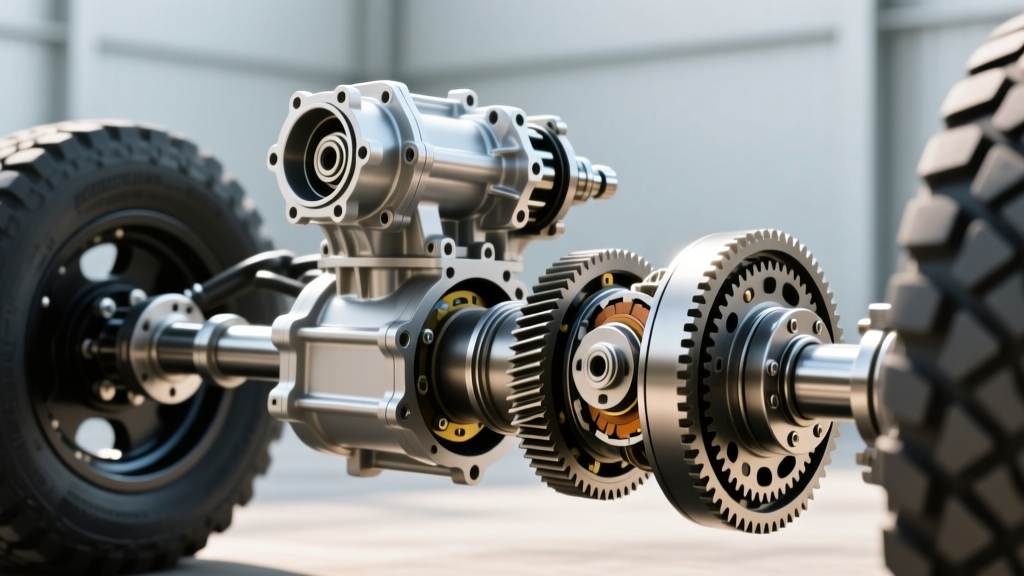
Mounted between the rear axle shafts, the rear differential allows your left and right wheels to spin at different speeds. This is absolutely mandatory for turning corners on the street; the outside wheel must travel a larger circle and therefore must spin faster than the inside wheel.
The problem with a standard 'open' differential is that it always sends power to the path of least resistance. If your left rear tire is on solid rock and your right rear tire is in deep mud, an open diff will send 100% of the torque to the spinning mud tire, leaving you stranded.
This is where the rear differential lock comes into play. Whether you have a factory electronic locker (like the Eaton ELocker found in modern GM HD trucks), an ARB Air Locker, or a manual cable-operated Detroit-style locker, engaging the rear differential lock physically couples the left and right axle shafts together. Both wheels are now forced to spin at the exact same speed, guaranteeing a 50/50 torque split across the rear axle regardless of traction.
The Crucial Relationship: Transfer Case and Differential Lock
Now we arrive at the core of our topic: the transfer case and differential relationship. Why does it matter how these two systems interact? Because engaging them incorrectly can cause catastrophic mechanical failure.
The Danger of Drivetrain Wind-Up
Imagine you are driving on dry, high-traction pavement. You shift your transfer case into 4HI (locking the front and rear driveshafts together) and you engage your rear differential lock (locking the left and right rear wheels together). As you approach a corner, the vehicle's physics demand that the wheels spin at different speeds to accommodate the turning radius. But you have eliminated the mechanical slip points in the transfer case and the rear axle.
The resulting energy has nowhere to go. This phenomenon is known as drivetrain wind-up or 'binding.' The stress builds up in the driveline until the tires chirp and skip across the pavement, or worse, the metal yields. According to engineering data from Spicer Parts, excessive binding can easily twist and snap a standard 30-spline or even a heavy-duty 33-spline chromoly axle shaft, or shatter the teeth off your ring and pinion gears.
Golden Rule of 4WD: Never engage a part-time 4WD transfer case or a rear differential lock on dry, high-traction pavement. These systems are strictly for loose, slippery surfaces like mud, snow, sand, or wet rocks where the tires can slip to relieve drivetrain stress.
Full-Time 4WD and Center Differentials
Some modern SUVs and trucks feature a 'Full-Time' 4WD transfer case (like the BorgWarner 4484 or similar AWD/4WD systems). These transfer cases contain a center differential, which allows the front and rear driveshafts to spin at different speeds. In this scenario, you can drive in 4HI on dry pavement. However, if you lock the center differential AND engage the rear differential lock, you are once again back to a fully bound drivetrain. Always consult your owner's manual regarding center diff lock parameters.
Fluid Specifications and Maintenance Realities
Understanding the mechanical relationship is only half the battle; maintaining the lubrication that keeps these components alive is equally critical. As of 2026, synthetic fluids are the undisputed standard for both transfer cases and heavy-duty differentials, offering superior thermal stability under high-torque towing and low-speed crawling.
Transfer Case Fluids
Transfer cases generally do not use thick gear oil. They rely on Automatic Transmission Fluid (ATF) or specialized proprietary fluids to lubricate the chain, bearings, and planetary gears. For example, GM's AutoTrak II (Part # 88900401) is required for many of their active AWD/4WD transfer cases to prevent clutch pack chatter. Ford's BorgWarner cases often specify Mercon V or Mercon ULV ATF. Capacities typically range from 1.5 to 2.5 quarts.
Rear Differential Fluids
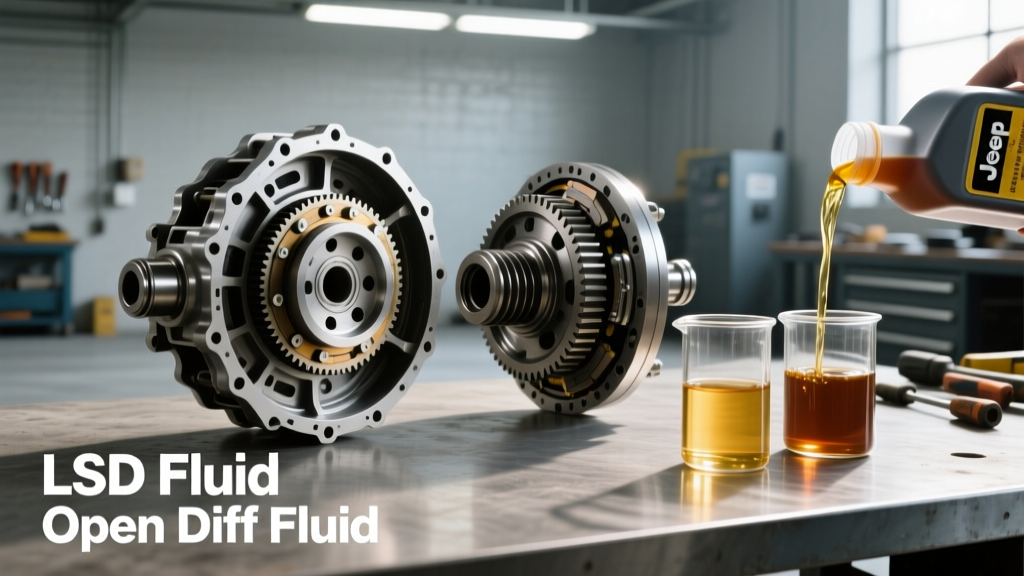
The rear differential requires a high-viscosity Extreme Pressure (EP) gear oil, almost universally a 75W-90 or 75W-140 GL-5 rated synthetic. A critical beginner mistake is adding 'friction modifier' to a rear differential equipped with a true locking differential. Friction modifiers are designed for Limited Slip Differentials (LSDs) with clutch packs. A true mechanical rear differential lock (like an Eaton ELocker or ARB) does not have clutch packs and requires standard GL-5 gear oil without modifiers. Capacities for light-duty axles (like a Dana 44 or GM 9.5-inch) are around 2.0 to 2.5 quarts, while heavy-duty axles (GM 14-bolt 10.5-inch or Ford 10.5-inch) hold 3.0 to 3.75 quarts.
| Component | Common Fluid Spec | Typical Capacity | Drain/Fill Plug Torque | Est. DIY Cost (2026) |
|---|---|---|---|---|
| Transfer Case (e.g., NV241HD) | ATF (Dexron VI / AutoTrak II) | 2.0 Quarts | 15 - 20 lb-ft | $35 - $55 |
| Rear Diff (Semi-Floating HD) | 75W-90 Synthetic GL-5 | 2.5 Quarts | 25 lb-ft (Plug) / 35 lb-ft (Cover) | $50 - $70 |
| Rear Diff (Full-Floating 14-Bolt) | 75W-90 Synthetic GL-5 | 3.5 Quarts | 25 lb-ft (Plug) | $75 - $95 |
Operational Matrix: When to Engage What
To help beginners visualize the transfer case and differential relationship, refer to the operational matrix below. This guide assumes a traditional part-time 4WD system with a selectable rear differential lock.
| Surface Condition | Transfer Case Mode | Rear Differential Lock | System Result & Notes |
|---|---|---|---|
| Dry Pavement / Highway | 2WD (2HI) | OFF | Normal driving. Prevents drivetrain bind and tire wear. |
| Wet Grass / Gravel Road | 4HI (Part-Time) | OFF | Front axle pulls the vehicle. Rear open diff allows cornering. |
| Deep Snow / Mud (Straight Line) | 4LO | ON | Maximum traction. All four wheels forced to spin. Keep speeds under 15 MPH. |
| Rock Crawling / Steep Off-Camber | 4LO | ON (Front & Rear if equipped) | Maximum articulation and torque multiplication. Essential for severe obstacles. |
| Dry Pavement (Accidental 4HI + Locker) | 4HI | ON | DANGER: Severe drivetrain wind-up. Shift to 2WD and unlock diff immediately. |
Summary for the Trail and the Street
Mastering the transfer case and differential relationship is a rite of passage for every truck and SUV owner. The transfer case dictates how power is divided between the front and rear of the vehicle, while the rear differential lock ensures that power is equally distributed to both rear wheels. Used correctly on loose surfaces, this combination makes your vehicle virtually unstoppable. Used incorrectly on dry pavement, it turns your drivetrain into a ticking time bomb of twisted metal.
By adhering to proper engagement protocols, utilizing the correct synthetic GL-5 gear oils and specialized transfer case fluids, and respecting torque specifications during your DIY maintenance, you will ensure your rig is ready for whatever the trail demands. For further technical reading on axle and differential engineering, resources provided by BorgWarner and major axle manufacturers remain excellent references for understanding the limits of your specific drivetrain components.