If you drive a modern 4WD truck or SUV, you have likely experienced this scenario: you press the locking differential button on your dash, and instead of a solid indicator, your differential lock light flashes endlessly. For beginners, this blinking light feels like an expensive electrical mystery. However, as automotive drivetrain experts, we can tell you that this issue is deeply rooted in the mechanical relationship between your transfer case, your axles, and the gear oil that lubricates them.
In this guide, we will break down exactly how your transfer case and differentials work together, why that lock light refuses to stop blinking, and how specific fluid viscosities and maintenance intervals dictate the health of your locking mechanisms.
The Drivetrain Duo: Transfer Cases and Differentials
To understand why a warning light behaves a certain way, you must first understand the path of torque. In a traditional part-time or full-time 4WD system, power flows from the engine into the transmission, then into the transfer case, and finally out through the driveshafts to the front and rear differentials.
The Center Differential vs. The Axle Differential
Many beginners confuse the center differential (housed inside the transfer case) with the axle differentials (housed in the pumpkin-shaped axles at the ends of the vehicle). Both manage wheel speed differences, but they do so on different axes:
- The Center Differential (Transfer Case): Allows the front and rear driveshafts to spin at different speeds. This is mandatory for driving on dry pavement in AWD or full-time 4WD modes to prevent driveline binding.
- The Axle Differentials (Front/Rear Axles): Allow the left and right wheels to spin at different speeds when cornering.
When you engage a "lock," you are physically forcing a mechanical collar to bridge two rotating components, locking them together at a 1:1 ratio. If your dashboard features a Center Diff Lock light (common on the Toyota Land Cruiser, 4Runner, or Subaru WRX), the locking mechanism is inside the transfer case. If it features a Rear Diff Lock light (common on the Tacoma, Colorado, or Wrangler), the mechanism is inside the rear axle housing.
Why Is Your Differential Lock Light Flashing?
A blinking differential lock light is the vehicle's ECU telling you: "I sent the electrical signal to the actuator to lock the differential, but the internal position sensor did not confirm mechanical engagement within the 3-to-5 second timeout window."
While a failed electronic actuator or a corroded wiring harness are common culprits, the most overlooked cause by novice mechanics is fluid degradation and mechanical binding. Locking differentials utilize dog clutches or sliding collars that must physically slide across splined shafts to engage. If the gear oil is contaminated with metallic shearing, moisture, or has suffered severe viscosity breakdown, the collar will bind, preventing the actuator from completing its stroke.
Common Causes for Lock Engagement Failure
| Component | Failure Mode | Beginner Diagnostic Check |
|---|---|---|
| Axle Gear Oil | Sludge or incorrect viscosity causing sliding collar bind | Drain fluid into a clear pan; check for metallic glitter or milky water contamination. |
| Transfer Case Fluid | Degraded synchros or ATF failing to lubricate center diff shift forks | Verify fluid level at the fill plug; smell for burnt clutch material. |
| Electronic Actuator | Internal motor burnout or moisture ingress (common on Toyota Tacomas) | Listen for a distinct 'click' or 'whir' from the axle/transfer case when pressing the button. |
| Position Sensor | Corroded contacts preventing the ECU from reading the 'locked' state | Inspect the sensor wiring pigtail near the diff housing for chafing or oil soaking. |
The Hidden Culprit: Gear Oil Viscosity and Actuator Bind
Because the locking mechanism operates partially submerged in or splash-lubricated by differential fluid, the exact specification of your gear oil is non-negotiable. Using the wrong fluid can directly cause your differential lock light to flash.
For example, many modern locking differentials require a specific GL-5 75W-85 or 75W-140 synthetic gear oil. If a previous owner topped off the axle with a thicker, conventional 80W-90 mineral oil, the fluid's poor cold-flow characteristics can create hydraulic resistance against the sliding locking collar. In freezing temperatures, the actuator's small electric motor simply lacks the torque to push the collar through the thick, cold sludge, resulting in a timeout and a flashing dash light.
Furthermore, adding unauthorized friction modifiers to a locking differential that does not require them can alter the coefficient of friction on the dog clutches, causing them to slip or bind rather than snap cleanly into place. Always consult your owner's manual or the manufacturer's official maintenance guides before adding aftermarket additives.
Real-World Specifications: Fluids, Torques, and Capacities
To help you service your drivetrain correctly and eliminate fluid-related binding issues, we have compiled exact factory specifications for three of the most popular locked 4WD vehicles on the road today. Proper maintenance is the cheapest way to cure a blinking lock light.
| Vehicle Application | Component | Factory Fluid Spec & Part Number | Capacity | Drain/Fill Torque |
|---|---|---|---|---|
| Toyota Tacoma (2016-2026) | Rear Locking Diff | Toyota Hypoid SX 75W-85 GL-5 (08885-02106) | 3.2 L (3.4 qt) | 39 N·m (29 ft-lb) |
| Toyota Tacoma (2016-2026) | Transfer Case (VF4B) | Toyota Transfer Case Oil 75W-85 GL-4 (08885-02106) | 1.4 L (1.5 qt) | 39 N·m (29 ft-lb) |
| Jeep Wrangler JL Rubicon | Front/Rear Dana 44 Diffs | Mopar 75W-140 Synthetic GL-5 (68218655AB) | 1.7 L (1.8 qt) | 34 N·m (25 ft-lb) |
| Jeep Wrangler JL Rubicon | Transfer Case (NV241OR) | Mopar ATF+4 (05013457AA) | 2.0 L (2.1 qt) | 27 N·m (20 ft-lb) |
| Ford F-150 Tremor / Raptor | Rear Electronic Locking Diff | Motorcraft SAE 75W-85 Premium (XY-75W85-QL) | 2.0 L (2.1 qt) | 48 N·m (35 ft-lb) |
Step-by-Step Troubleshooting for Beginners
Before you spend $400+ on a replacement electronic actuator or dealer diagnostics, perform this systematic mechanical check to rule out fluid and binding issues.
Step 1: The 'Roll and Engage' Test
Locking differentials and transfer case center locks often require slight driveline movement to align the dog clutch teeth. If you press the button while completely stationary on a bind (like dry pavement), the teeth will clash, the collar won't slide, and the light will flash. The Fix: Put the vehicle in 4-Low, roll forward at 2-3 MPH on a loose surface (dirt or gravel), and press the lock button. If the light turns solid, your actuator is fine; you were simply experiencing tooth-clash bind.
Step 2: Drain and Inspect the Differential Fluid
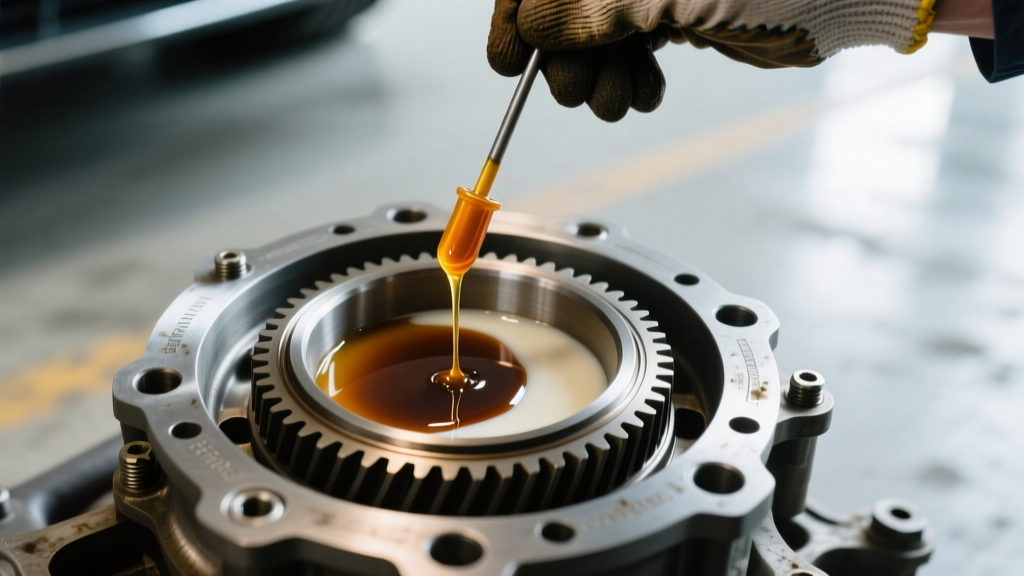
Place a drain pan under the differential. Remove the fill plug first (always ensure you can get the fill plug out before draining the fluid). Then, remove the drain plug. What to look for: According to industry fluid analysis standards, a small amount of fine metallic paste on the magnetic drain plug is normal wear. However, if you find chunks of metal, or if the fluid smells like burnt sulfur and looks like black sludge, the internal shift collar is likely hanging up on debris. Flush the housing and refill with the exact OEM synthetic fluid listed in our table above.
Step 3: Transfer Case Fluid Verification
If your flashing light is specifically a Center Diff Lock light, the issue lies in the transfer case. Many modern transfer cases use automatic transmission fluid (ATF) rather than heavy gear oil. If the ATF has overheated and lost its shear stability, the internal shift rails that command the center diff lock will stick. Drain the transfer case, inspect for chain wear debris (which looks like fine silver glitter), and refill with the correct ATF+4 or specific transfer case gear oil.
Step 4: Actuator Physical Inspection
If the fluid is clean, the correct viscosity, and the rolling test failed, locate the physical actuator. On a Toyota Tacoma rear axle, it is a black plastic/metal cylinder bolted to the right side of the differential housing. Unplug the wiring harness and check for green corrosion. Tap the actuator lightly with a rubber mallet while an assistant presses the lock button; sometimes, a stuck internal limit switch just needs mechanical persuasion to free up.
Final Thoughts on Drivetrain Maintenance
Your transfer case and differentials operate as a synchronized team, relying on precise tolerances and specific hydrodynamic lubrication to function. A flashing differential lock light is rarely a sign of a catastrophic internal failure; more often, it is a symptom of neglected fluid maintenance, incorrect viscosity, or simple tooth-clash alignment issues. By adhering to strict OEM fluid specifications, utilizing a torque wrench on your drain and fill plugs, and understanding the mechanical relationship between your drivetrain components, you can keep your 4WD system engaging reliably for hundreds of thousands of miles. For more detailed maintenance schedules, always refer to the official manufacturer maintenance portals or your specific vehicle's service manual.