The Critical Link Between Fluid Capacity and Dipstick Readings
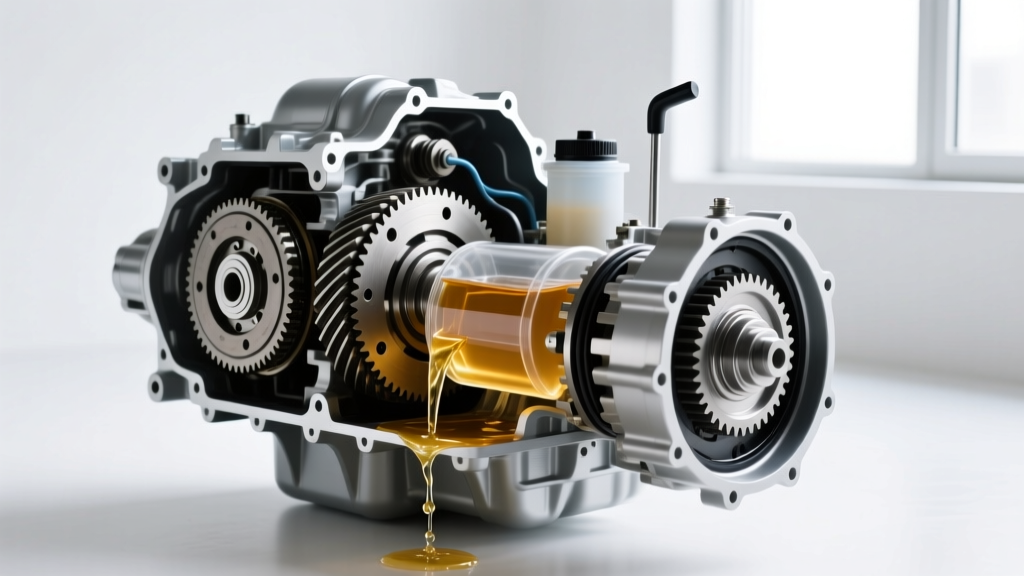
Knowing the exact fluid capacity of your vehicle's automatic transmission is the foundational step in drivetrain maintenance. Many DIY mechanics and general repair shops make the critical error of assuming all transmission pan drops require a standard 4-quart top-off. In reality, modern automatic transmissions feature complex torque converters, auxiliary cooler lines, and remote thermal bypass valves that drastically alter total system volume. Before you can accurately execute the procedure for how to check your automatic transmission fluid, you must understand the difference between a 'dry fill' and a 'service fill' capacity.
A dry fill refers to the total volume of the transmission system when completely empty, such as after a full teardown, rebuild, or replacement. A service fill refers to the amount of fluid required after dropping the transmission pan and replacing the filter. Because the torque converter and cooler circuits retain a significant amount of fluid during a standard drain, the service fill is typically 40% to 60% of the total dry fill capacity. Overfilling based on dry-fill numbers will result in catastrophic aerated fluid, while underfilling will starve the oil pump and burn up the clutch packs.
Master Transmission Fluid Capacity Chart (Popular Models)
The following data table outlines the precise capacities, fluid specifications, and pan bolt torque requirements for some of the most common automatic transmissions on the road today. Always verify with your specific OEM service manual, as auxiliary coolers can add 0.5 to 1.5 quarts to the service fill.
| Transmission Model | Common Applications | Dry Fill Capacity | Service Fill (Pan Drop) | OEM Fluid Spec | Pan Bolt Torque |
|---|---|---|---|---|---|
| GM 4L60E | 1993-2013 GM Trucks/RWD | 11.2 Quarts | 4.5 - 5.0 Quarts | ACDelco Dexron VI | 97 lb-in (11 Nm) |
| GM 6L80 / 6L90 | 2006-2020 GM HD Trucks/Corvette | 12.9 Quarts | 6.0 - 6.5 Quarts | ACDelco Dexron ULV / VI | 97 lb-in (11 Nm) |
| ZF 8HP45 / 8HP70 | Chrysler, BMW, Audi, Jaguar | 9.5 - 10.5 Quarts | 4.5 - 5.5 Quarts | ZF LifeguardFluid 8 | Fill Plug: 35 Nm |
| Aisin TF-80SC | Volvo, Ford, GM FWD/AWD | 8.5 Quarts | 3.5 - 4.5 Quarts | Aisin AW-1 / T-IV | Check Level Plug |
Deep Dive: GM 6L80 / 6L90 Service Procedures
The GM 6L80 and 6L90 transmissions are ubiquitous in Silverado, Sierra, and Tahoe platforms. A common failure point during a fluid service is stripping the oil pan bolts. The 6L80 uses a shallow stamped steel pan with 6mm bolts. According to Sonnax engineering guidelines and GM service documentation, the pan bolt torque specification is strictly 97 lb-in (11 Nm). Mechanics who mistakenly apply 97 lb-ft will instantly snap the bolts or warp the pan, leading to immediate leaks.
When performing a service fill on a 6L80, you will typically drain about 6 quarts. However, the 6L80 features a thermal bypass valve in the cooler circuit. If the transmission is cold, the bypass valve remains closed, trapping fluid in the cooler lines. To ensure an accurate fluid level check, the transmission must be warmed up to at least 140°F (60°C) to force the bypass valve open, allowing the cooler lines to drain back into the pan during the idle-check procedure.
Deep Dive: ZF 8HP Series (No Dipstick Protocol)
The ZF 8HP series revolutionized the industry with its 8-speed layout, but it eliminated the traditional dipstick. Vehicles equipped with the ZF 8HP (found in Ram 1500s, BMW 3-Series, and Audi Q5s) rely on a temperature-dependent overflow plug located on the bottom of the transmission pan. ZF Aftermarket explicitly states that the fluid level check must be performed with the transmission fluid temperature strictly between 30°C and 50°C (86°F - 122°F). You can monitor this via an OBD2 bi-directional scan tool reading the Transmission Fluid Temperature (TFT) PID.
The ZF 8HP uses a specialized plastic oil pan with an integrated filter. You cannot simply drop the pan and reuse it; the entire pan and filter assembly must be replaced as a single unit (Part # ZF 0501 216 243 for many applications). The fill plug torque spec is 35 Nm. Using the correct ZF LifeguardFluid 8 is non-negotiable, as the friction modifiers are specifically calibrated for the ZF mechatronic sleeve and clutch pack clearances.
The Right Way: How to Check Your Automatic Transmission Fluid Against Capacity Specs
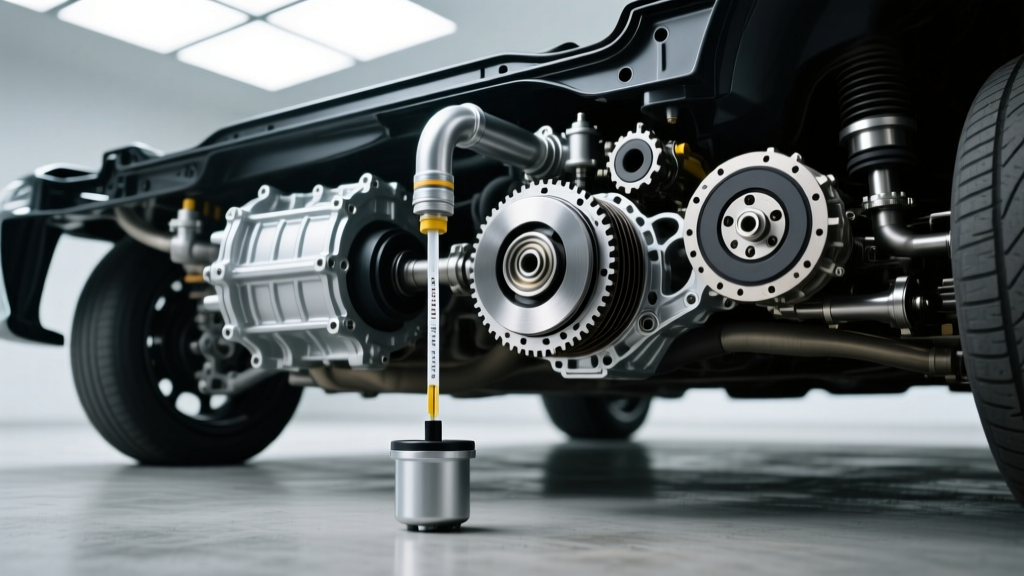
Understanding capacity charts is only useful if you apply them correctly during the physical inspection. When learning how to check your automatic transmission fluid on a traditional dipstick-equipped vehicle (like the 4L60E or early Aisin units), follow this exact sequence to prevent false readings:
- Step 1: Level Ground & Cycle Gears. Park on a perfectly level surface. With the engine running and the parking brake engaged, slowly shift through every gear (P-R-N-D-L), pausing for 2 seconds in each. This fills the clutch apply pistons and valve body circuits, dropping the pan level to its true operating state.
- Step 2: Verify Temperature. Fluid expands as it heats. A cold dipstick reading will show 'low' even if the capacity is correct. Most OEM dipsticks feature a 'HOT' and 'COLD' crosshatch zone. Aim for the HOT zone after 20 minutes of mixed driving.
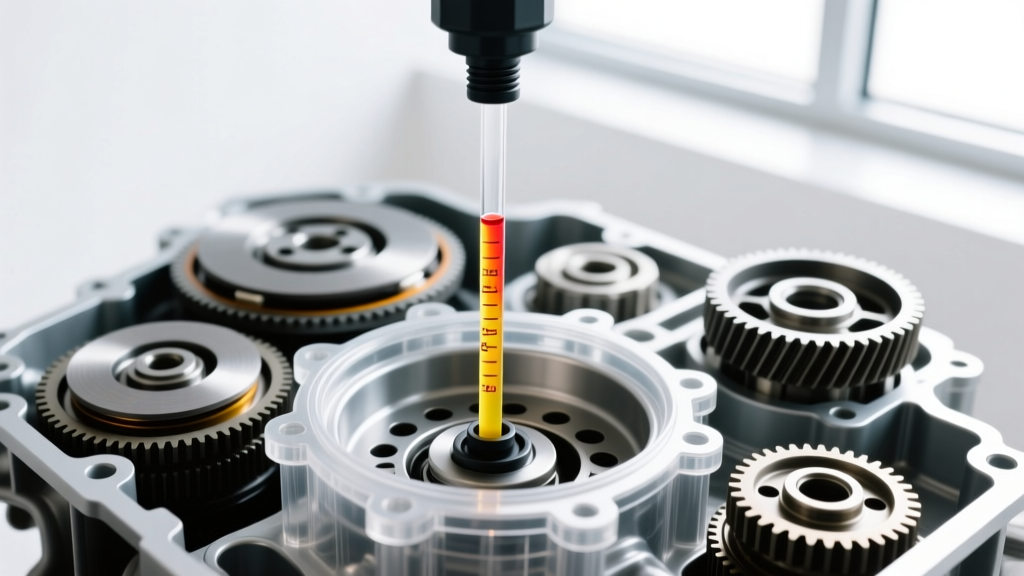
- Step 3: The Wipe-and-Read. Pull the dipstick, wipe it with a lint-free shop towel (never paper, which leaves debris in the tube), reinsert fully, and pull again. Read the lowest point of the fluid meniscus.
- Step 4: Cross-Reference Capacity. If the dipstick reads 1 inch low, calculate the addition carefully. On a 4L60E, the distance between the 'ADD' and 'FULL' marks typically represents exactly 0.5 quarts (1 pint). Add fluid in 0.25-quart increments via the dipstick tube using a long-neck funnel to prevent overflow spills onto the exhaust.
Common Overfill and Underfill Failure Modes
Ignoring the precise service fill capacities outlined above leads to distinct mechanical failure modes that are often misdiagnosed as internal hard-part failures.
Overfilling: The Aeration Effect
If you exceed the maximum capacity, the rotating transmission components (specifically the planetary gearsets and torque converter clutch) will physically whip the fluid in the pan. This introduces microscopic air bubbles into the hydraulic circuit. Because air is compressible and ATF is not, the valve body solenoids cannot maintain precise line pressure. The result is delayed, slipping shifts, and a condition known as torque converter shudder. In severe cases, the aerated fluid will push past the output shaft seals and vent tube, creating a massive external leak that mimics a blown seal.
Underfilling: Pump Cavitation
Conversely, if you rely solely on a cold dipstick reading and underfill the unit by 1.5 to 2 quarts, the transmission oil pump will begin to draw in air from the bottom of the pan pickup tube. This causes pump cavitation, characterized by a high-pitched whining noise that increases with engine RPM. More critically, the lack of hydraulic volume means the clutch packs cannot be applied with sufficient force, leading to immediate friction material glazing and burnt ATF. According to ACDelco technical bulletins, operating a GM transmission with low fluid for even a few hundred miles can permanently degrade the clutch friction coefficients, requiring a full rebuild.
Final Pro-Tips for 2026 Drivetrain Maintenance
As vehicles age and manufacturers continue to seal transmission systems for 'lifetime' use, the responsibility of verifying fluid capacity and condition falls on the owner or independent specialist. Always invest in a high-quality bi-directional scan tool to monitor transmission fluid temperatures during your fill procedures. Furthermore, when purchasing replacement fluid, buy one extra quart beyond the listed service fill capacity. This ensures you have enough fluid to prime the new filter and account for any residual fluid trapped in the cooler lines, guaranteeing a mathematically perfect fill every time.