The High-Mileage Dilemma: How Long Does Automatic Transmission Fluid Last?
When owners of vehicles with over 100,000 miles on the odometer ask, how long does automatic transmission fluid last, the answer shifts drastically from manufacturer marketing brochures to mechanical reality. As of 2026, the average age of vehicles on the road exceeds 12.5 years. This means millions of 6-speed, 8-speed, and 10-speed automatic transmissions are operating well past their original factory warranty windows, relying entirely on the chemical integrity of their hydraulic fluid.
While some European and domestic automakers have historically labeled their factory-fill ATF as a 'lifetime' fluid, tribologists and transmission rebuilders universally reject this premise. Under severe driving conditions—towing, stop-and-go traffic, and extreme thermal cycling—standard ATF begins to lose its shear stability and friction-modifying capabilities between 60,000 and 80,000 miles. For high-mileage vehicles, the formulation of the fluid you choose for your first or second major service is critical to preventing slip, shudder, and catastrophic clutch pack failure.
High-Mileage ATF vs. Standard Synthetic: The Chemistry
Before diving into specific product comparisons, it is vital to understand what separates a high-mileage automatic transmission fluid from a standard OEM-equivalent synthetic. High-mileage ATFs are engineered with a specific additive package designed to compensate for the physical wear of aging transmission components.
- Seal Conditioners (Ester-based): Aging nitrile and polyacrylate seals shrink and harden over time, leading to internal pressure drops and external leaks. High-mileage fluids contain organic esters that cause these seals to swell slightly, restoring hydraulic pressure and stopping minor weeps.
- Enhanced Friction Modifiers: As clutch material wears, the friction coefficient changes. Extra friction modifiers prevent torque converter shudder and ensure crisp shift events in worn clutch packs.
- Higher Viscosity Index (VI) Improvers: High-mileage fluids often feature a slightly thicker baseline viscosity to maintain oil film strength across worn bearings and bushings, preventing metal-on-metal contact.
- Increased Dispersants and Detergents: These keep varnish and microscopic clutch debris suspended in the fluid rather than allowing it to clog the valve body solenoids.
Expert Warning: If your transmission is already exhibiting severe slip or mechanical failure, a high-mileage fluid with aggressive seal swell agents can sometimes dislodge large varnish deposits that were temporarily 'sealing' worn clutch packs. Always assess the mechanical health of the transmission before switching fluid profiles.
2026 High-Mileage Transmission Fluid Comparison Matrix
Not all multi-vehicle or high-mileage fluids are created equal. Below is a technical comparison of the top-performing ATFs for aging drivetrains, based on shear stability testing, OEM licensing, and real-world pricing.
| Brand / Product | Base Chemistry | Key Additive Focus | Approx. Price (Qt) | Best High-Mileage Application |
|---|---|---|---|---|
| Valvoline MaxLife Multi-Vehicle | Synthetic Blend | Seal conditioners, anti-wear | $8.50 - $10.00 | GM 4L60E/6L80, Ford 6R80 (Budget-friendly daily drivers) |
| Castrol Transmax High Mileage | Conventional/Syn Blend | Friction modifiers, dispersants | $7.00 - $8.50 | Older Asian imports (Aisin Warner units), Chrysler 45RFE |
| Mobil 1 Synthetic ATF | Full Synthetic (PAO) | Thermal stability, oxidation resistance | $11.00 - $13.00 | High-performance V8s, towing applications, extreme heat |
| Red Line D4 ATF | Ester/PAO Full Synthetic | High-temp shear stability, rapid shifting | $18.00 - $22.00 | ZF 8HP, BMW, Audi, track-driven high-mileage vehicles |
Note: Always cross-reference your owner's manual or the Valvoline Global product lookup tool to ensure the chosen fluid meets your specific OEM standard (e.g., Dexron VI, Mercon LV, ATF+4).
Application Guide: Torque Specs, Capacities, and Procedures
Selecting the right fluid is only half the battle. Proper service procedures, exact fluid capacities, and precise torque specifications are what separate a successful high-mileage service from a leaking, failing transmission. Here is a deep dive into three of the most common high-mileage transmissions on the road today.
1. GM 6L80 / 6L90 (2006-2020 Trucks, Corvettes, Camaros)
The 6L80 is notorious for running hot, especially in pickup trucks. By 120,000 miles, the 3-5-R clutch wave plate is often prone to fatigue, and fluid degradation accelerates this wear.
- OEM Spec: Dexron VI (Ultra-low viscosity). High-Mileage Alternative: Valvoline MaxLife Multi-Vehicle or Mobil 1 Synthetic.
- Total Capacity: 11.2 to 12.8 quarts (depending on torque converter).
- Pan Drop Capacity: 6.0 quarts.
- Filter Note: The 6L80 uses a reusable metal mesh screen. However, at high mileage, replacing it with a new OEM ACDelco filter (Part #TF952) is highly recommended to ensure proper O-ring seating in the valve body.
- Pan Bolt Torque: 11 Nm (97 lb-in). Do not overtighten; the aluminum case threads strip easily.
2. ZF 8HP45 / 8HP70 / 8HP90 (Chrysler, BMW, Audi, Jaguar)
The ZF 8-speed is an engineering marvel, but it is highly sensitive to fluid viscosity. ZF officially states their fluid is a 'lifetime' fill for normal driving, but ZF Aftermarket Lubricants explicitly recommends changing the fluid at 60,000 to 75,000 miles under severe operating conditions.
- OEM Spec: ZF LifeguardFluid 8. High-Mileage Alternative: Red Line D4 or Shell M-1375.4 equivalents.
- Total Capacity: 9.0 to 10.5 liters.
- Pan Drop Capacity: 5.0 to 6.5 liters (requires a specialized fluid transfer pump to fill from below on many chassis).
- Filter Note: The filter is permanently integrated into the plastic transmission pan. You must replace the entire pan assembly (Part # ZF 0735.297.213 for many 8HP70 applications) which includes new pan bolts.
- Pan Bolt Torque: 10 Nm (88 lb-in) for the OEM plastic pan. Follow the specific ZF star-pattern sequence to prevent warping the plastic mating surface.
3. Ford 6R80 (2009-2020 F-150, Mustang, Explorer)
Based on the ZF 6HP26 design, the 6R80 is robust but suffers from thermal degradation when used for towing. High-mileage examples often develop torque converter shudder due to depleted friction modifiers.
- OEM Spec: Mercon LV. High-Mileage Alternative: Castrol Transmax High Mileage or Motorcraft Mercon LV.
- Total Capacity: 13.1 quarts.
- Pan Drop Capacity: 6.0 quarts.
- Filter Note: Uses a disposable felt/synthetic media filter. Replace with Motorcraft FT-188.
- Pan Bolt Torque: 8 Nm (71 lb-in). The stamped steel pan is prone to warping if bolts are over-torqued or tightened out of sequence.
The 'Flush vs. Drain-and-Fill' Debate for Aging Transmissions
When researching how long automatic transmission fluid lasts and how to replace it, you will inevitably encounter the flush versus drain-and-fill debate. For a vehicle with over 100,000 miles that has never had a fluid service, never use a pressurized power flush machine.
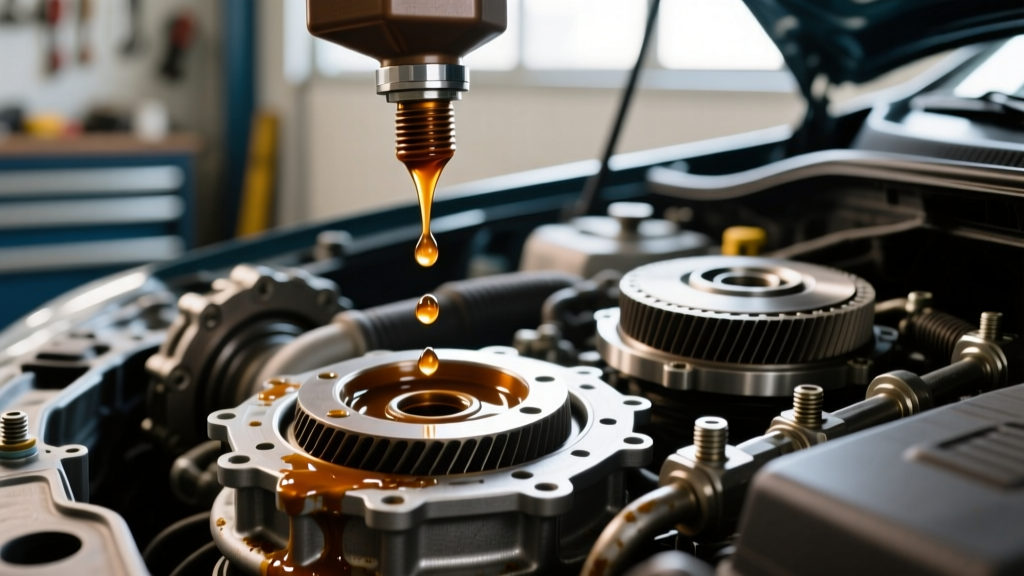
Pressurized flushes can force debris backward through the valve body, dislodge varnish that is acting as a makeshift seal on worn clutch drums, and cause immediate slipping. Instead, utilize the 3x Drain-and-Fill Method:
- Service 1 (Day 1): Drop the pan, replace the filter, clean the magnets, and refill with high-mileage ATF. This replaces roughly 40-50% of the total system volume.
- Service 2 (Day 7 or 500 miles): Perform a drain and fill via the dipstick tube or drain plug (if equipped). This brings new fluid concentration to ~75%.
- Service 3 (Day 14 or 1,000 miles): Final drain and fill. This achieves ~90%+ new fluid saturation, allowing the seal conditioners and friction modifiers to gradually and safely acclimate to the aging transmission components.
Final Verdict: Maximizing Drivetrain Longevity
So, how long does automatic transmission fluid last in a high-mileage vehicle? If you are running a full synthetic like Red Line D4 or Mobil 1, you can safely expect 60,000 to 80,000 miles of optimal protection before shear breakdown occurs. If you are using a conventional or synthetic-blend high-mileage fluid, that interval drops to 30,000 to 50,000 miles.
The key to keeping a 150,000-mile transmission shifting like new is not just the brand you buy, but the chemical profile that matches your transmission's wear state. Use seal conditioners for aging nitrile seals, prioritize high thermal stability for towing applications, and always adhere strictly to OEM torque specifications during reassembly. Your drivetrain will reward you with another 100,000 miles of reliable service.