The Great Vibration Debate: Engine Cooling vs. Drivetrain Lockup
When owners of the GMT360 platform experience violent shaking at highway speeds or a rhythmic chatter at idle, the blame is frequently misplaced. The 2005 Chevrolet Trailblazer, particularly those equipped with the 4.2L LL8 inline-6 and the ubiquitous 4L60-E automatic transmission, is notorious for two distinct vibration issues that mimic one another. Diagnosing the root cause requires separating engine-driven harmonic vibrations from drivetrain slip-rate anomalies.
In the performance and upgrade community, misdiagnosing these symptoms leads to wasted capital. You might end up rebuilding a valve body when your issue is actually a seized cooling fan bearing, or vice versa. This guide provides a definitive, expert-level diagnostic framework to isolate chatter and vibration, ensuring your repair or upgrade path is accurate.
Anatomy of the 4.2L LL8 Fan Clutch Failure
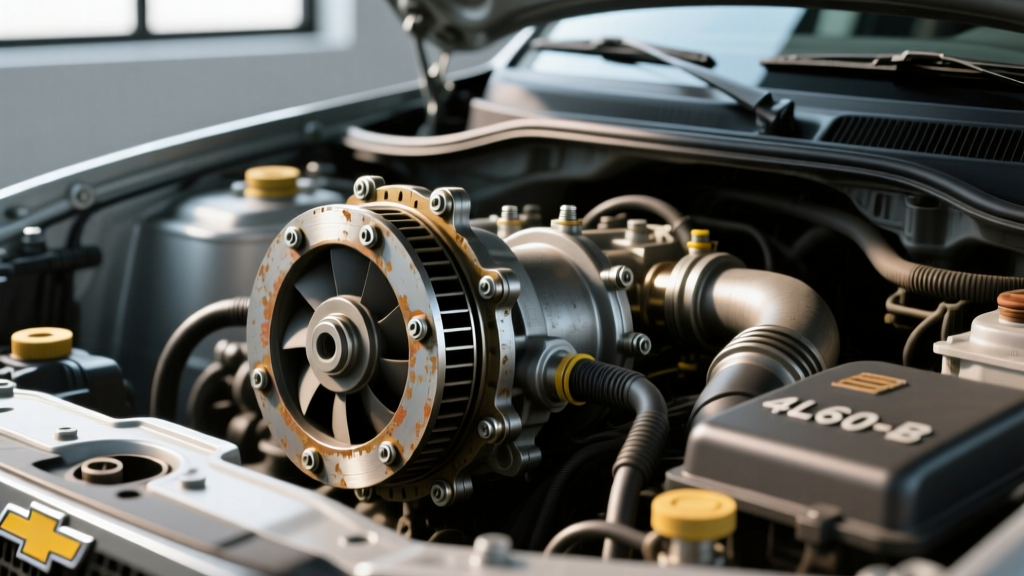
The mechanical cooling fan on the Atlas 4.2L engine is driven directly by the water pump shaft via a thermostatically controlled clutch. When evaluating a suspected 2005 chevrolet trailblazer fan clutch failure, you are dealing with a viscous shear coupling. Inside the clutch housing, a bimetallic coil strip reacts to ambient air temperatures passing through the radiator, opening a valve that allows silicone shear fluid to transfer rotational force from the water pump shaft to the fan blades.
Failure Modes and Vibration Signatures
- Bearing Seizure: The internal support bearing degrades, causing the fan assembly to wobble on the water pump shaft. This creates a violent, engine-speed-dependent vibration that shakes the entire front accessory drive (FAD), often mimicking a severe engine misfire or transmission input shaft chatter.
- Locked Clutch (Fluid Leak): If the internal seal fails, silicone fluid escapes, and the clutch defaults to a fully locked or semi-locked state. This results in a deafening roar at cold start and parasitic horsepower loss, but less severe physical vibration unless the fan blades become unbalanced from debris.
- Free-Wheeling (No Engagement): The bimetallic strip snaps or the internal valve clogs. The fan spins freely, leading to overheating in stop-and-go traffic, but zero vibration.
Technical Note: The fan clutch nut on the 4.2L LL8 is a reverse (left-hand) thread. To remove it, you must turn it clockwise (passenger side to driver side) while holding the water pump pulley with a specialized spanner tool (e.g., GM J-41240 or equivalent 36mm wrench set). Torque specification for reinstallation is typically 30-35 lb-ft, but always verify with the specific aftermarket manufacturer's insert, as thread pitches vary between OEM GM (Part # 15997828) and aftermarket equivalents like Hayden (Part # 2735).
4L60-E Torque Converter Clutch (TCC) Shudder: The Real Chatter
If the vibration occurs strictly between 35 and 50 mph under light throttle application (usually 10-15% TPS), you are likely experiencing Torque Converter Clutch (TCC) shudder. The 4L60-E uses a Pulse Width Modulated (PWM) solenoid to apply the TCC piston smoothly. Over time, the constant oscillation of the PWM valve wears out the aluminum bore in the valve body.
When this bore wears, line pressure bleeds off, preventing the TCC piston from maintaining firm hydraulic lockup. The friction material on the torque converter piston rapidly slips and grabs at a frequency of 20 to 40 Hz. To the driver, this feels exactly like driving over highway rumble strips. This is the true definition of 'clutch chatter' in an automatic transmission context.
Diagnostic Matrix: Isolating the Vibration Source
Use the following matrix to quickly separate engine cooling vibrations from transmission clutch chatter.
| Symptom / Variable | Failing Fan Clutch (Engine Driven) | TCC Shudder (Transmission Driven) |
|---|---|---|
| Trigger Condition | Present at idle, correlates directly with engine RPM. | Occurs only in 3rd/4th gear, 35-50 mph, light throttle. |
| Transmission Gear | Vibration persists in Park or Neutral. | Vibration disappears instantly when shifted to Neutral or Manual 2. |
| Audible Cues | Mechanical grinding, roaring fan, or rhythmic clicking. | Low-frequency hum or 'rumble strip' sensation; no mechanical grinding. |
| Scanner Data (PID) | N/A (Coolant temp may spike if locked/free-wheeling). | TCC Slip Speed fluctuates wildly (e.g., 0 to 150 RPM) during lockup. |
Step-by-Step Isolation Procedure
Step 1: The Thermal & Physical Fan Test
With the engine completely cold (sitting overnight), start the Trailblazer. A healthy fan clutch should spin freely and quietly for the first 30-60 seconds until the internal fluid redistributes. If it immediately roars and pulls massive air volume, the clutch is locked. Next, use an infrared thermometer to measure the face of the clutch assembly after a 15-minute test drive. If ambient under-hood temperatures are 140°F but the clutch face reads 210°F+, internal friction from a failing bearing is generating excess heat. Finally, with the engine off, attempt to wiggle the fan blade assembly up and down. Any radial play greater than 1/16th of an inch indicates catastrophic bearing failure.
Step 2: OBD2 TCC Slip PID Monitoring
Connect a bi-directional OBD2 scanner capable of reading manufacturer-specific transmission PIDs. Navigate to the TCC Slip Speed parameter. Drive the vehicle at a steady 45 mph in 4th gear with the TCC commanded 'ON'. A healthy 4L60-E will show a slip speed of 0 to 15 RPM. If you feel chatter and the PID bounces between -50 and +120 RPM, your torque converter friction material is degraded, or your PWM valve bore is compromised. For an in-depth look at valve body wear patterns, consult Sonnax Technical Resources, which provides extensive documentation on 4L60-E PWM valve degradation.
Performance Upgrades & 2026 Market Pricing
Whether you are restoring a daily driver or building a mild towing rig, addressing these issues with upgraded components ensures longevity. Below is a breakdown of performance-oriented solutions and estimated 2026 market costs.
| Component / Upgrade | Part Number / Brand | Performance Benefit | Est. Part Cost (2026) |
|---|---|---|---|
| OEM Fan Clutch | GM Genuine 15997828 | Restores factory thermal management and eliminates harmonic shake. | $130 - $165 |
| Heavy-Duty Fan Clutch | Hayden Auto 2735 | Stiffer bimetallic response; ideal for modified rigs with larger radiators. | $95 - $120 |
| TCC Valve Body Fix | Sonnax Zip Kit 4L60E-ZIP | Sleeves worn PWM bores, restoring firm TCC apply and eliminating shudder. | $180 - $220 |
| Shift Kit & TCC Mod | TransGo SK-4L60E-HD2 | Increases TCC apply pressure, reducing slip and chatter under heavy load. | $110 - $140 |
| Billet Torque Converter | Circle D 245mm Billet | Carbon-Kevlar friction lining; completely immune to standard TCC shudder. | $650 - $850 |
Note: Labor rates in 2026 average $145 to $195 per hour. Replacing the fan clutch is a 1.5-hour job, while dropping the 4L60-E pan and installing a Sonnax Zip Kit takes approximately 4 to 5 hours. A full torque converter replacement requires transmission removal (8-10 hours labor) plus a mandatory flush and refill with 11.2 quarts of Dexron VI ULV fluid.
Fluid Dynamics and the Dexron VI Factor
One often-overlooked cause of TCC chatter in older GMT360 trucks is the use of incorrect or degraded fluid. The 2005 Trailblazer originally shipped with Dexron III. However, GM has since superseded this with Dexron VI, which features a highly stable synthetic base stock and a refined friction modifier package specifically designed to mitigate TCC shudder in PWM-controlled 4L60-E and 6L80 transmissions. If you are diagnosing chatter, a simple drain and fill with a high-quality synthetic Dexron VI (such as ACDelco or Valvoline) combined with a bottle of BG Universal Synthetic Shudder Fixx can sometimes temporarily mask the chatter, confirming the diagnosis before you commit to a valve body teardown. For more on fluid specifications, refer to Hayden Automotive's cooling and drivetrain maintenance guidelines.
Final Verdict
Vibration diagnosis in the 2005 Trailblazer requires a disciplined approach to separate the mechanical from the hydraulic. A failing fan clutch will shake the chassis at idle and roar under acceleration, while a worn 4L60-E TCC circuit will chatter exclusively under light-throttle highway cruising. By utilizing an infrared thermometer, monitoring TCC slip PIDs, and understanding the reverse-thread nuances of the LL8 water pump, you can confidently isolate the fault. Whether the fix requires a $120 Hayden fan clutch or a comprehensive Sonnax valve body upgrade, accurate diagnosis prevents unnecessary transmission removals and gets your SUV back on the road with factory-smooth drivetrain engagement.