The Hydrodynamic Link: How ATF Dictates Acoustic Health
When a driver reports a bad torque converter sound, the immediate assumption is often a catastrophic mechanical failure—such as a shattered stator clutch or disintegrated needle bearings. However, as transmission specialists know, the torque converter is fundamentally a hydrodynamic coupling. It relies entirely on automatic transmission fluid (ATF) to transfer power, multiply torque, and dampen engine harmonics. When the fluid's chemical composition, volume, or pressure is compromised, the acoustic signature of the transmission changes dramatically.
Diagnosing fluid-related noise requires an understanding of fluid dynamics inside the converter housing. The impeller, turbine, and stator operate in a high-velocity oil bath. If the ATF loses its viscosity, becomes aerated, or suffers from cavitation, the resulting acoustic anomalies can perfectly mimic failing hardware. In this expert guide, we will decode the specific bad torque converter sounds caused by fluid issues and outline the precise diagnostic and service protocols required to resolve them before irreversible mechanical damage occurs.
Auditory Diagnostics: Matching the Sound to the Fluid Fault
Not all transmission noises are created equal. The pitch, frequency, and operating conditions under which a bad torque converter sound occurs provide critical clues about the underlying fluid fault. Below is a diagnostic matrix used by advanced drivetrain technicians to correlate acoustic symptoms with specific fluid dynamics failures.
| Acoustic Symptom | Operating Condition | Probable Fluid Fault | Hydrodynamic Mechanism |
|---|---|---|---|
| High-pitched whining or whirring | Idle in gear, worst at low RPM | Cavitation / Fluid Starvation | Low fluid level or clogged filter creates a vacuum on the impeller suction side, causing fluid to vaporize and collapse violently. |
| Grinding or 'marbles in a can' | Acceleration under load | Severe Aeration / Foaming | Overfilled fluid or cross-leakage introduces air into the converter, creating compressible foam that fails to cushion the stator assembly. |
| Low-frequency rumble or shudder | 40-55 MPH, light throttle (TCC apply) | Friction Modifier Depletion | ATF loses its anti-shudder additives, causing the Torque Converter Clutch (TCC) to slip and grab rapidly (20-40 Hz oscillation). |
| Harmonic buzzing or rattling | Deceleration or engine braking | Wrong Fluid Viscosity (Shear) | Incorrect ATF fails to maintain the hydrodynamic boundary layer, allowing the stator one-way clutch to chatter against its race. |
The TCC Shudder Phenomenon: Friction Modifier Depletion
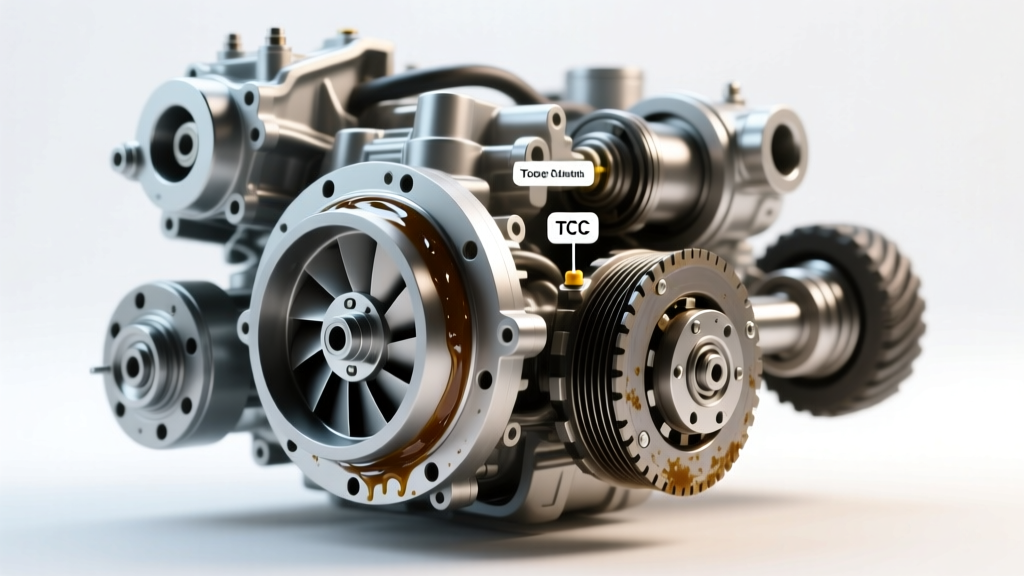
The most common fluid-induced bad torque converter sound—and the one most frequently misdiagnosed as an engine misfire or bad motor mount—is Torque Converter Clutch (TCC) shudder. Modern transmissions rely on controlled TCC slip to improve fuel economy and reduce emissions. This controlled slip requires highly specialized friction modifiers in the ATF.
When these additives shear down and deplete over time, the TCC lining transitions from a state of viscous coupling to boundary friction. The result is a rapid stick-slip cycle that generates a low-frequency rumbling sound and a violent vibration through the chassis. According to Sonnax Technical Resources, ignoring TCC shudder will rapidly glaze or delaminate the clutch friction material, contaminating the entire hydraulic system and necessitating a complete rebuild.
Case Study: GM 6L80 and Ford 10R80 Shudder
Two transmissions notorious for fluid-induced shudder are the GM 6L80 and the Ford 10R80. Both units utilize aggressive TCC lockup strategies that demand exact fluid chemistry.
- GM 6L80 / 6L90: Requires ACDelco Dexron VI. If serviced with older Dexron III or generic multi-vehicle fluids lacking the precise friction coefficients, shudder will manifest within 500 miles. The fix requires a complete fluid exchange and the addition of a specialized shudder-fix additive (like Dr. Tranny Shudder Fixx) to restore the friction modifier balance.
- Ford 10R80: Requires Motorcraft MERCON ULV (Ultra Low Viscosity). Using standard MERCON LV in this unit causes severe hydrodynamic drag and TCC shudder due to the higher viscosity preventing the micro-slip control solenoids from modulating pressure correctly.
Expert Service Protocols: Flushing, Filling, and Torque Specs
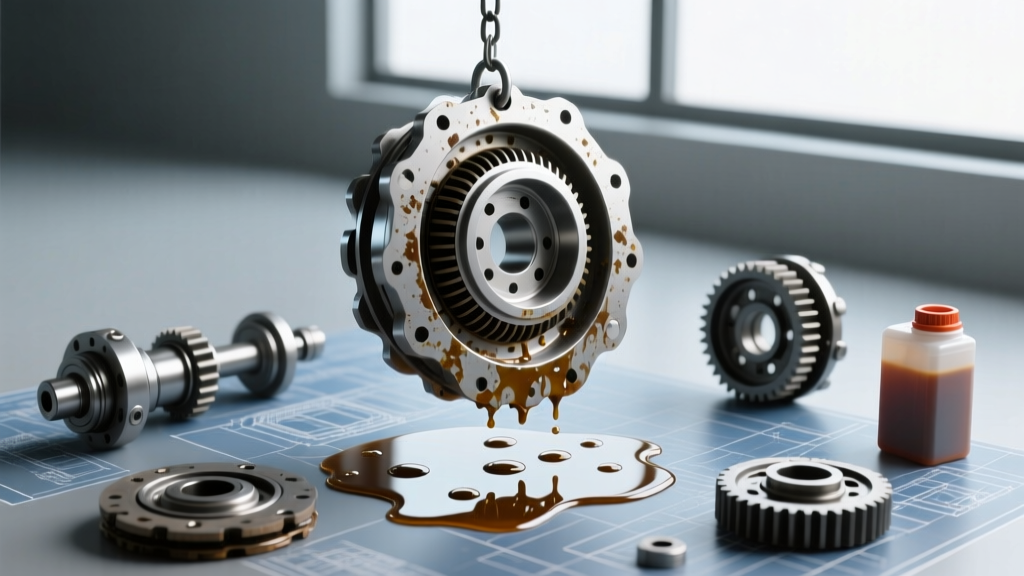
When a bad torque converter sound is traced to fluid degradation, a simple 'drain and fill' is rarely sufficient. The torque converter itself holds between 40% and 60% of the transmission's total fluid capacity. To properly diagnose and cure fluid-related noise, a pressurized flush or a multi-cycle drain-and-fill protocol is mandatory.
Expert Tip: Never perform a high-pressure flush on a transmission with over 150,000 miles that has never been serviced. The sudden introduction of high-detergent fluid can dislodge varnish and clutch material, clogging the narrow TCC apply orifices in the valve body and converting a simple shudder into a complete loss of lockup.
Crucial Service Specifications for Common Transmissions
Precision is paramount. Overfilling causes aeration (whining), while underfilling causes cavitation (grinding). Adhere strictly to these OEM specifications:
- GM 6L80 (Dexron VI):
- Total System Capacity: 11.2 Liters (11.9 Quarts)
- Pan Drop Capacity: ~6.0 Quarts
- Pan Bolt Torque: 10 Nm (89 lb-in) in a crisscross pattern
- Level Check Temperature: 86°F - 122°F (30°C - 50°C)
- ZF 8HP (ZF LifeguardFluid 8):
- Total System Capacity: ~8.5 to 10.5 Liters (varies by application)
- Drain Plug Torque: 25 Nm (18 lb-ft)
- Filling Protocol: Must be filled with the engine RUNNING and transmission in PARK, utilizing a scan tool to monitor fluid temperature precisely between 30°C and 40°C.
- Ford 10R80 (MERCON ULV):
- Total System Capacity: 13.1 Quarts
- Level Plug Torque: 12 Nm (106 lb-in)
- Note: The 10R80 utilizes a complex thermal bypass valve. Fluid level checks must only be performed when the transmission fluid temperature (TFT) PID reads between 185°F and 200°F to ensure the bypass is closed and the cooler circuit is fully primed.
When Fluid Isn't the Culprit: Mechanical Edge Cases
While fluid issues are the primary cause of early-stage torque converter noise, technicians must know when to abandon fluid diagnostics and prepare for mechanical teardown. If a fresh, OEM-spec fluid flush fails to eliminate the bad torque converter sound, the issue has likely crossed the threshold from hydrodynamic to mechanical.
According to ATRA (Automatic Transmission Rebuilders Association) technical bulletins, a persistent 'whirring' that increases proportionally with engine RPM regardless of gear selection or vehicle speed usually indicates a failed torque converter needle bearing or a damaged impeller hub. Similarly, a loud 'clunk' upon engagement accompanied by metallic debris on the drain plug magnet signifies a failed stator one-way clutch sprag. In these scenarios, continued driving will send hardened steel particles through the transmission cooler and into the valve body, turning a $1,200 torque converter replacement into a $4,500 complete transmission rebuild.
Cost Expectations and Preventative Best Practices
Addressing a fluid-related bad torque converter sound early is highly cost-effective. A professional machine flush using OEM-specified fluid typically ranges from $180 to $280, depending on the fluid capacity and regional labor rates. Conversely, replacing a torque converter that has been destroyed by prolonged cavitation or TCC shudder will cost between $1,400 and $2,800 in parts and labor, requiring transmission removal and bellhousing separation.
Best Practice Summary: Treat ATF as a highly engineered, wear-prone component rather than a lifetime fill. For vehicles subjected to towing, stop-and-go traffic, or aggressive driving, implement a 45,000-mile fluid exchange interval. By maintaining the precise friction modifiers and hydrodynamic viscosity required by modern lockup clutches, you will eliminate the vast majority of bad torque converter sounds and extend the drivetrain's operational lifespan well beyond 200,000 miles.