The Limits of a Torque Converter Calculator in Real-World Diagnostics
When tuning, rebuilding, or diagnosing a modern drivetrain, enthusiasts and transmission professionals often rely on a torque converter calculator to predict stall speed, torque multiplication ratios, and expected slip RPM. These software tools and mathematical formulas are invaluable for matching a converter to an engine's torque curve. However, they operate in a theoretical vacuum. A standard calculator assumes perfect fluid shear, optimal kinematic viscosity, and zero contamination. In the real world, torque converter fluid issues drastically alter hydraulic behavior, rendering theoretical math inaccurate and leading to severe drivability symptoms.
As automatic transmissions have evolved from simple 4-speed units to complex 8-speed and 10-speed architectures, the role of Automatic Transmission Fluid (ATF) has shifted from a simple hydraulic medium to a highly engineered, friction-modified structural component. Diagnosing fluid degradation requires looking beyond the calculator and understanding the physical and chemical breakdown of the fluid inside the torque converter.
How Fluid Viscosity and Thermal Degradation Alter Stall Speed Math
The stall speed predicted by a torque converter calculator is heavily dependent on fluid coupling efficiency. ATF transfers kinetic energy from the impeller to the turbine via fluid shear. When fluid undergoes thermal breakdown, its kinematic viscosity (measured in centistokes, or cSt) drops. Thinner, degraded fluid cannot maintain the same hydrodynamic coupling pressure, leading to increased parasitic slip and an artificial inflation of the stall speed.
The 6L80 and 8L90 Thermal Breakdown Thresholds
General Motors' 6L80 and 8L90 transmissions are notorious for running hot, particularly in towing applications or tuned vehicles. The factory torque converter clutch (TCC) relies on precise Pulse Width Modulation (PWM) to manage slip. When the ATF exceeds 240°F (115°C) for sustained periods, the base oil begins to oxidize, and the friction modifiers shear out of suspension.
- Normal Operating Temp: 175°F - 195°F (Optimal viscosity for TCC apply)
- Degradation Threshold: 240°F+ (Accelerated oxidation, varnish formation)
- Critical Failure Point: 280°F+ (Complete friction modifier collapse, severe TCC shudder)
If your calculated stall speed is 2,400 RPM, but your degraded fluid is causing excessive impeller-to-turbine slip, you may observe a flash stall of 2,700 RPM or higher. This is not a mechanical failure of the stator or fins, but a fluid dynamics failure that no online calculator can predict.
Fluid Contamination: The Silent Killer of TCC Lockup
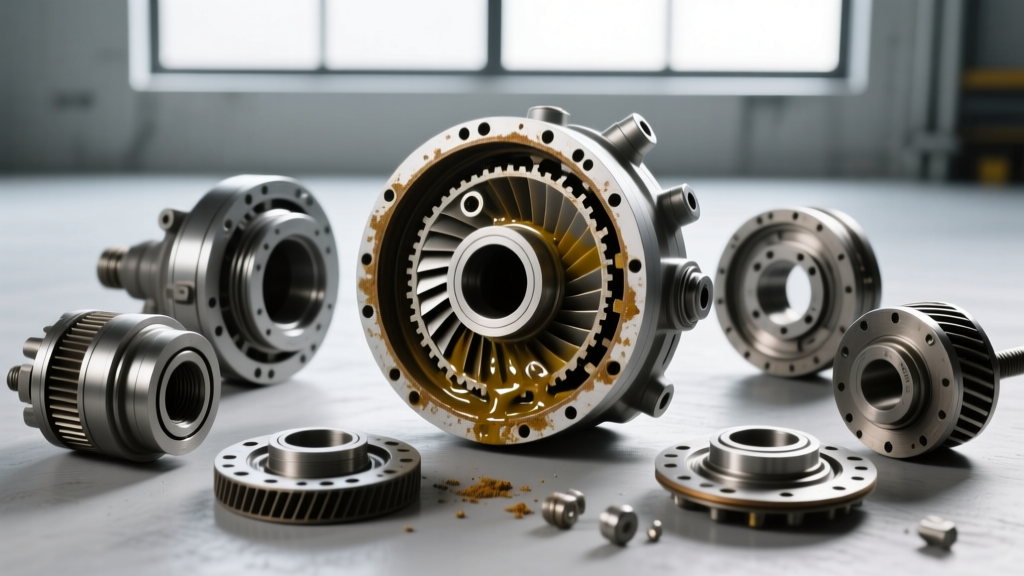
The torque converter acts as the primary sump and debris trap for the entire transmission. Because it holds a significant portion of the system's total fluid capacity (often 40% to 50%), any clutch material, metal shavings, or bushing wear ends up circulating through the converter before being caught by the filter—or worse, lodging in the TCC control valves.
According to Sonnax Transmission Tech Resources, microscopic friction material suspended in the ATF can score the precision-machined bore of the TCC regulator valve in the valve body. This causes cross-leaking, resulting in delayed lockup, erratic slip RPMs, and eventual P0741 (TCC Stuck Off) or P0742 (TCC Stuck On) diagnostic trouble codes.
| Contaminant Type | Primary Source | Impact on TC & Hydraulics |
|---|---|---|
| Friction Material | Worn TCC lining, 3-5-R clutch packs | Clogs PWM solenoid screens, causes valve body bore scoring, triggers TCC slip codes. |
| Steel/Metal Particulate | Failing thrust bearings, bushing wear | Acts as an abrasive lapping compound, destroying the TC stator one-way clutch and turbine hub. |
| Varnish/Sludge | Oxidized ATF from extreme heat | Causes TCC piston to stick in the apply/release bore, leading to harsh engagements or engine stalling. |
| Coolant/Water | Failing radiator transmission cooler | Emulsifies fluid (strawberry milkshake), completely destroys friction coefficient, rapid TC failure. |
Expert Flushing & Refill Protocols for Modern 8-Speed and 10-Speed Transmissions
Addressing torque converter fluid issues in modern units requires strict adherence to OEM service protocols. The days of simply dropping the pan and dumping the filter are over. Units like the ZF 8HP and Ford/GM 10R80 utilize integrated plastic pans with built-in filters and precise fluid level check plugs.
ZF 8HP Service Specifications
The ZF 8HP (found in BMW, Audi, Dodge, and Ram applications) requires ZF LifeguardFluid 8. ZF officially states their fluid is a 'lifetime' fill, but industry experts and ZF LifeguardFluid Specifications acknowledge that severe duty cycles necessitate changes every 60,000 to 80,000 miles.
- Total System Capacity: ~8.5 to 9.5 Liters (varies by specific 8HP variant)
- Pan Drop Yield: ~5.5 Liters (The torque converter does not have a drain plug; it retains ~3-4 liters)
- Pan Bolt Torque Spec: 10 Nm (7.4 lb-ft) - Critical to avoid cracking the integrated plastic filter neck.
- Level Check Temp: Fluid must be between 30°C and 50°C (86°F - 122°F) when checking the fill plug.
Ford 10R80 Service Specifications
The Ford 10R80 utilizes MERCON ULV (Ultra Low Viscosity) fluid. Using standard MERCON LV or Dexron VI in this unit will cause immediate TCC shudder and shift timing errors due to the highly calibrated hydraulic clearances designed for ULV fluid.
- Total System Capacity: 13.1 Quarts
- Pan Drop Yield: 5.0 - 6.0 Quarts
- Pan Bolt Torque Spec: 8 Nm (71 lb-in)
- Fluid Temp for Leveling: 95°F - 113°F via IDS/FORScan PID monitoring.
Best Practices for TCC Shudder Resolution
TCC shudder is the most common symptom of torque converter fluid issues. It manifests as a rhythmic vibration (typically between 20-45 Hz) during light throttle application at highway speeds, right as the TCC attempts to transition from slipping to fully locked. While AA1Car's Automatic Transmission Fluid Diagnostics notes that shudder can be mechanical, 80% of early-stage shudder cases are fluid-related.
Friction Modifier Additives vs. Complete Fluid Exchange
If a customer presents with mild TCC shudder, a complete fluid exchange (using a pressurized flush machine to swap out the fluid trapped inside the torque converter) is the gold standard. However, for DIYers or shops without a flush machine, performing three consecutive 'drain-and-fill' procedures over 3,000 miles will gradually dilute the degraded fluid in the converter.
In cases where the base oil is intact but friction modifiers have depleted, adding a specialized limited-slip friction modifier (such as Lubegard Instant Shudder Fixx or Dr. Tranny Shudder Fixx) can temporarily alter the fluid's coefficient of friction, allowing the PWM solenoid to smoothly apply the TCC without oscillation. This is a band-aid, not a cure, but it is a highly effective diagnostic tool to confirm the issue is fluid-related and not a warped TCC piston or damaged stator hub.
Sourcing the Right Fluid: OEM Part Numbers and Capacities
Using the incorrect fluid is a catastrophic torque converter fluid issue. Modern ATF formulations are mutually exclusive. Mixing Dexron VI with MERCON ULV, or using a generic 'Multi-Vehicle' ATF in a ZF 8HP, will result in immediate TCC apply failures. Below are the exact OEM part numbers for the most common modern platforms:
- GM Dexron VI (6L80, 6L90, 8L90): ACDelco Part # 88865618 (1 Quart). Required for all GM 6-speed and 8-speed RWD applications.
- GM Dexron ULV (10L90): ACDelco Part # 19417577. Do not substitute with Dexron VI.
- Ford MERCON ULV (10R80): Motorcraft Part # XT-12-QULV. Essential for maintaining correct TCC slip RPMs in Ford's 10-speed.
- ZF LifeguardFluid 8 (8HP45, 8HP70, 8HP90): ZF Part # S671 090 255. While Pentosin ATF 1 is sometimes cited as an alternative, ZF recommends only their branded Lifeguard fluid for warranty and performance compliance.
Expert Takeaway: A torque converter calculator is only as accurate as the physical health of the hydraulic system it represents. Before blaming a mismatched stall speed or a failing TCC solenoid, verify the fluid's thermal history, viscosity, and contamination level. Proper fluid maintenance is the single most cost-effective way to preserve torque converter efficiency and transmission longevity.