Introduction to Release Bearing Acoustics
The throw-out bearing (technically known as the clutch release bearing) serves as the critical mechanical bridge between your clutch pedal—or mechatronic hydraulic unit—and the pressure plate diaphragm spring. When this component experiences lubrication breakdown or axial load fatigue, the acoustic signature is unmistakable: a high-pitched whine, a metallic grind, or a low-frequency rumble that shifts with pedal application or gear engagement. However, the diagnostic pathway diverges wildly depending on the transmission architecture. When technicians weigh the diagnostic approach for dual clutch vs single clutch systems, the throw-out bearing presents a unique set of variables. In this 2026 model-specific repair guide, we dissect throw-out bearing noise, contrasting the Ford MT-82 single clutch platform with the Volkswagen/Audi DQ250 wet dual-clutch transmission (DSG).
The Anatomy of Throw-Out Bearing Failure
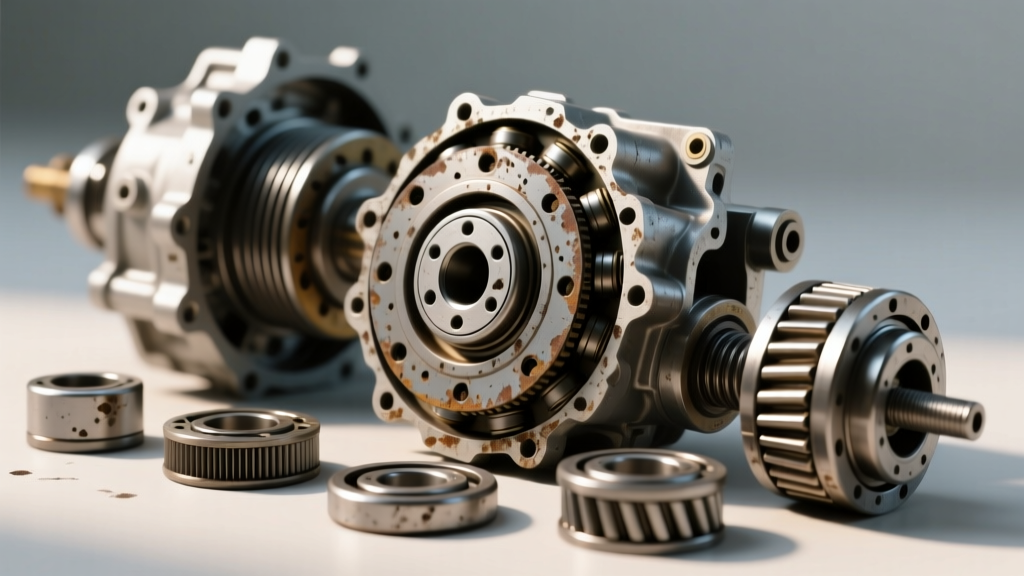
Modern release bearings are typically sealed angular contact ball bearings designed to handle high axial loads while rotating at engine speeds. Failure generally initiates in one of two ways:
- Thermal Degradation: Excessive clutch slipping transfers heat through the pressure plate fingers into the bearing race, breaking down the synthetic grease.
- Brinelling and Spalling: Constant light-contact riding (common in hydraulic concentric slave cylinders) causes microscopic indentations on the bearing races, leading to a harmonic whine that scales with engine RPM.
Expert Diagnostic Tip: Never rely solely on auditory feedback from the driver's seat. Use a PicoScope NVH (Noise, Vibration, and Harshness) kit with a magnetic accelerometer mounted directly to the bellhousing. A failing throw-out bearing typically generates distinct frequency spikes between 1.8 kHz and 4.2 kHz, isolating it from input shaft bearing noise which usually resonates below 1.2 kHz.
Single Clutch Diagnostics: Ford MT-82 Case Study
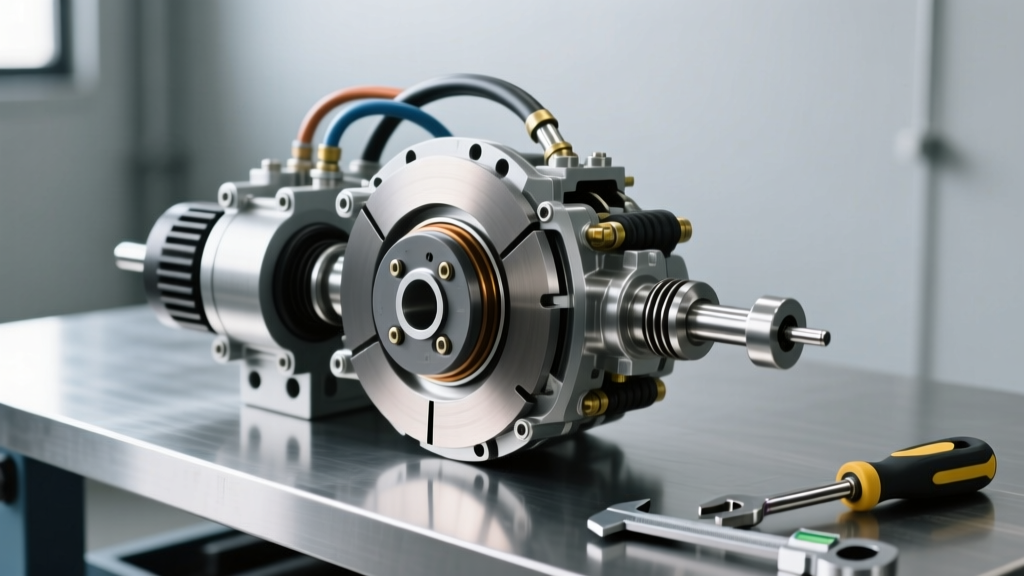
The Ford Mustang S550 and S650 platforms equipped with the Tremec MT-82 manual transmission utilize a hydraulic Concentric Slave Cylinder (CSC). In this design, the throw-out bearing is permanently integrated into the CSC piston assembly. Unlike older cable-driven setups with a release fork, the MT-82 CSC maintains constant light contact with the pressure plate fingers to eliminate free-play.
Identifying MT-82 Bearing Noise
Because the bearing is under constant pre-load, a failing MT-82 throw-out bearing will produce a continuous whirring or grinding noise that intensifies when the clutch pedal is depressed. This is a critical distinction: if the noise disappears when the pedal is pressed, you are likely diagnosing a failing input shaft bearing or a worn clutch disc damper spring, not the release bearing. Furthermore, if the CSC internal seal fails alongside the bearing, you will find DOT 4 brake fluid contaminating the clutch friction material.
MT-82 Repair Specs and Torque Data
Replacing the CSC on the MT-82 requires dropping the transmission. According to Tremec's official service guidelines and Ford workshop manuals, precision is mandatory during reassembly:
- OEM Part Number: Ford Motorcraft CM6A-7A548-B or LuK 510 0195 10.
- Part Cost: $140 - $220 USD.
- Bellhousing to Engine Block (M12x1.75): 55 Nm (41 lb-ft).
- Flywheel to Crankshaft (M11x1.0): 115 Nm (85 lb-ft) plus an additional 90-degree turn.
- Hydraulic Bleed Procedure: Requires a pressure bleeder set to 15 PSI. Gravity bleeding is insufficient for the MT-82's long hydraulic line and will result in a spongy pedal and incomplete clutch disengagement.
Dual Clutch Diagnostics: VAG DQ250 DSG Case Study
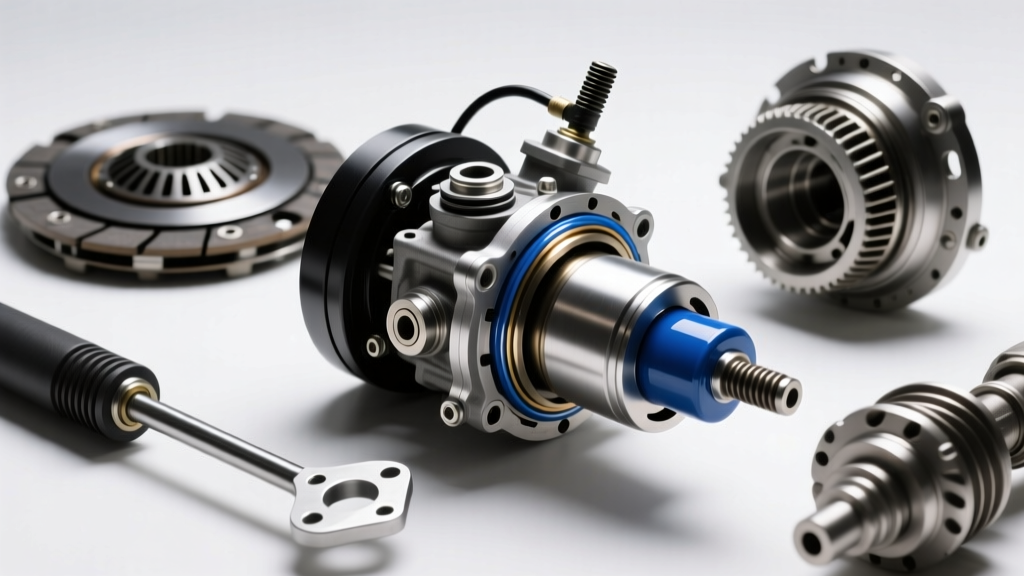
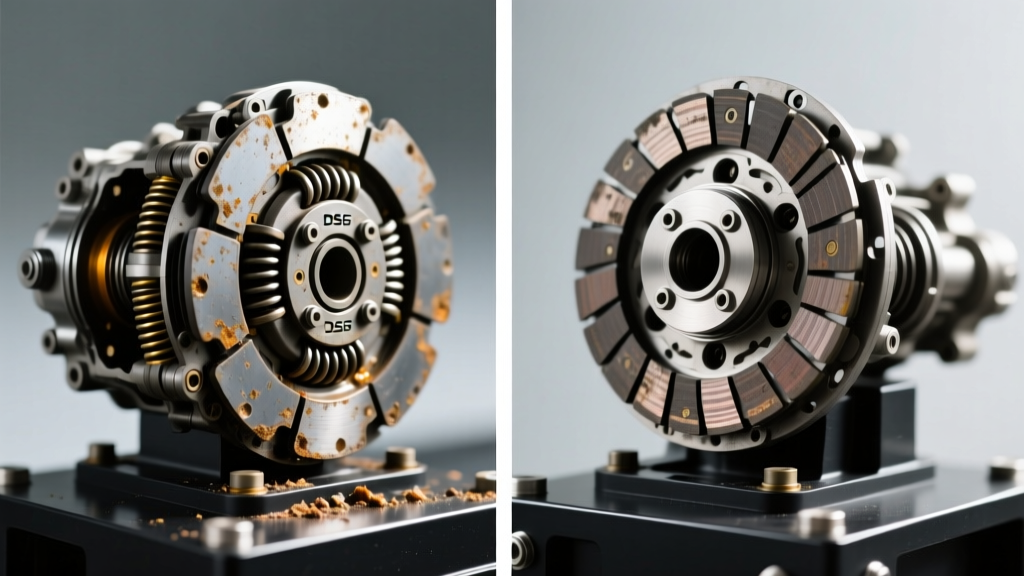
The Volkswagen/Audi DQ250 6-speed wet dual-clutch transmission represents a massive leap in complexity. Instead of a single clutch and bearing, the DQ250 utilizes two multi-plate wet clutches and two separate concentric release bearings, all actuated by the mechatronic unit's hydraulic valves. When evaluating dual clutch vs single clutch failure modes, the DQ250 requires technicians to think in terms of gear-dependent fault isolation.
Isolating DQ250 Release Bearing Noise
Because the two clutches operate independently, a failing throw-out bearing in a DSG will manifest differently depending on which gear is engaged. Clutch 1 handles odd gears (1, 3, 5, R), while Clutch 2 handles even gears (2, 4, 6). If Bearing 1 is spalling, the driver will hear a metallic whine exclusively in odd gears. If the noise is present in all gears and accompanied by a low-frequency clunk during 2-3 or 4-5 upshifts, the issue is likely a failing dual-mass flywheel (DMF) or mechatronic accumulator pressure loss, rather than the release bearings themselves.
DQ250 Repair Specs and Mechatronic Data
Accessing the DQ250 release bearings requires removing the entire clutch pack assembly. Parts sourcing from reputable suppliers like FCP Euro or direct from VAG is highly recommended to ensure proper friction material compatibility with the OEM DSG fluid.
- OEM Clutch Pack & Bearing Kit: VAG 02E 141 741 F or Sachs 3000 950 019.
- Part Cost: $850 - $1,200 USD (Kit includes both clutches and integrated bearings).
- Mechatronic Hydraulic Pressure: Clutch engagement pressure should read 4.5 to 5.5 bar at idle via VCDS/OBDeleven.
- DMF Runout Limit: Maximum 0.5mm lateral runout. Exceeding this will destroy the new release bearings within 5,000 miles.
- Adaptation Requirement: A basic settings adaptation (Group 060 or equivalent via ODIS) must be performed to teach the mechatronic unit the new clutch bite points and bearing clearances.
Comparative Analysis: Dual Clutch vs Single Clutch
To streamline your shop's diagnostic workflow, refer to the matrix below when estimating repair scopes and diagnosing customer complaints regarding release bearing noise.
| Diagnostic Variable | Single Clutch (Ford MT-82) | Dual Clutch (VAG DQ250 DSG) |
|---|---|---|
| Bearing Configuration | Single integrated CSC bearing | Dual concentric release bearings |
| Acoustic Trigger | Worsens upon pedal depression | Gear-dependent (Odd vs. Even) |
| Secondary Failure Risk | DOT 4 fluid contaminating clutch disc | Mechatronic valve body contamination |
| Average Parts Cost | $140 - $220 USD | $850 - $1,200 USD |
| Book Labor Time | 4.5 Hours | 8.2 Hours |
| Post-Repair Calibration | Manual hydraulic bleed only | Hydraulic bleed + ODIS software adaptation |
Advanced Diagnostic Tooling for 2026
As transmission architectures become more tightly packaged, traditional stethoscopes are no longer sufficient for definitive throw-out bearing diagnosis. Modern drivetrain specialists rely on acoustic frequency analysis. By connecting a chassis ear or a PicoScope NVH system to the transmission bellhousing, technicians can map the noise frequency against engine RPM. A true release bearing failure will track linearly with engine speed (Order 1.0 or higher depending on pulley ratios), whereas gear rattle or DMF spring failure will often exhibit non-linear, load-dependent frequency shifts.
Furthermore, when diagnosing automated manuals, monitoring the hydraulic solenoid duty cycle via factory scan tools is paramount. If the mechatronic unit is commanding a 15% higher duty cycle to maintain clutch engagement, it often indicates that the release bearing has seized on its guide sleeve, creating excessive drag that the hydraulic system is attempting to overcome. Catching this data point early can save the mechatronic unit's internal pump from catastrophic burnout.
Final Thoughts on Drivetrain Acoustics
Whether you are turning wrenches on a weekend track-day Mustang or diagnosing a daily-driven Golf R, understanding the mechanical realities of the dual clutch vs single clutch debate is essential for accurate troubleshooting. Throw-out bearing noise is never just a nuisance; it is a critical warning sign of impending hydraulic or mechanical failure. By leveraging frequency analysis, adhering to strict torque specifications, and performing mandatory software adaptations, technicians can ensure long-term drivetrain reliability and eliminate costly comeback repairs.
For further reading on drivetrain tribology and hydraulic clutch actuation standards, refer to the latest technical papers published by the Society of Automotive Engineers (SAE).