The Evolution of NVH: Traditional Driveshafts vs. EV Half-Shafts
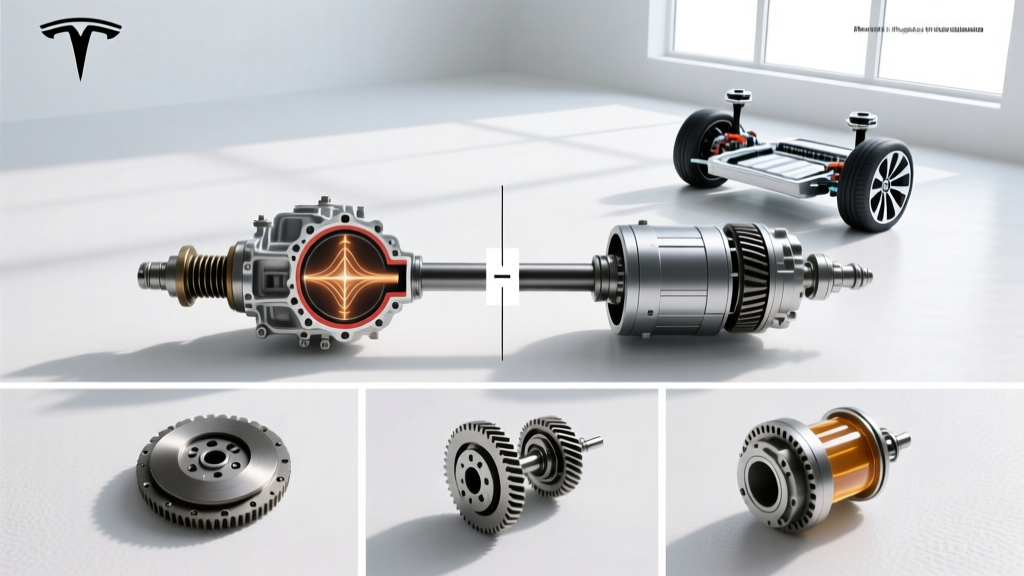
As the automotive landscape shifts toward electrification, drivetrain technicians are facing a paradigm shift in Noise, Vibration, and Harshness (NVH) diagnosis. For decades, diagnosing a driveline shudder meant crawling under a rear-wheel-drive truck, checking Spicer U-joints, and inspecting center support bearings on a multi-piece steel driveshaft. Today, reviewing a Tesla drivetrain diagram reveals a completely different mechanical architecture. There is no longitudinal transmission, no transfer case, and no traditional driveshaft. Instead, power is delivered via integrated Drive Units (DUs) directly to the wheels through CV half-shafts.
This article serves as a comprehensive comparison and buyer's guide for drivetrain vibration diagnosis, contrasting traditional Internal Combustion Engine (ICE) driveshaft troubleshooting with Tesla's EV-specific half-shaft and motor mount diagnostics. Whether you are equipping a modern shop or tackling a complex NVH complaint, understanding the mathematical and mechanical differences between these layouts is critical.
Decoding the Layout: ICE Driveshaft vs. Tesla Drivetrain Diagram
To diagnose a vibration, you must first understand the rotational mass and the power flow. In a traditional ICE vehicle equipped with a ZF 8HP or GM 6L80 transmission, power routes through a slip yoke, into a tubular steel or aluminum driveshaft, across U-joints or CV joints, and finally to the differential pinion flange. Vibrations here are typically categorized by their rotational order relative to the driveshaft speed.
Conversely, when you examine a Tesla drivetrain diagram for a Model 3 or Model Y, the powertrain is decentralized. The Rear Drive Unit (containing the inverter, motor, and reduction gearbox) mounts directly to the rear subframe. Power is transmitted to the wheels via left and right inner and outer CV half-shafts. Because the reduction gear ratio is fixed (typically around 9:1 in Tesla models), the half-shafts spin at exactly the wheel speed, while the motor rotor spins at up to 18,000 RPM. This creates high-frequency electrical and mechanical harmonics that mimic traditional driveshaft vibrations but require entirely different diagnostic approaches.
The Mathematics of Driveline Frequency
Before purchasing diagnostic equipment, technicians must understand frequency mapping. A vibration is measured in Hertz (Hz), or cycles per second.
- ICE Driveshaft Speed: At 70 MPH with a 3.73 axle ratio and 28-inch tires, the wheels turn at roughly 840 RPM (14 Hz). The driveshaft spins at 3,133 RPM (52.2 Hz). A 1st-order driveshaft imbalance vibrates at 52.2 Hz. A 2nd-order U-joint bind vibrates at 104.4 Hz.
- Tesla EV Motor Frequency: At the same 70 MPH, the Tesla half-shaft also spins at 14 Hz. However, the internal motor rotor (with a 9:1 reduction) spins at 7,560 RPM (126 Hz). The electrical pole pass frequency (based on a 4-pole-pair motor) generates electromagnetic vibrations at 504 Hz. What feels like a 'driveshaft shudder' in a Tesla is often a high-frequency inverter harmonic or a degraded motor mount failing to isolate 100+ Hz rotor vibrations.
Buyer's Guide: NVH Diagnostic Tools for Modern Drivetrains
Relying on a 'seat-of-the-pants' feel is no longer viable for modern drivetrain diagnostics, especially when comparing the low-frequency thump of a worn ICE center bearing to the high-frequency buzz of a failing Tesla inverter mount. Investing in an accelerometer-based NVH kit is mandatory for any shop handling both legacy and EV platforms.
| Tool / Software | Best Application | Approx. Cost | Key Feature for EV/ICE |
|---|---|---|---|
| Pico NVH Kit (W/ PicoScope) | Deep-dive frequency analysis | $1,800 - $2,500 | Maps OBD RPM data against accelerometer Hz to pinpoint exact component orders. |
| Snap-on ZEUS+ (with NVH) | General shop workflow | $12,000+ | Integrated scanner and scope; excellent for correlating ICE misfires with driveline shakes. |
| Teslascope / CAN Bus Logger | Tesla-specific EV diagnosis | $300 - $600 | Reads proprietary Tesla CAN data (motor torque ripple, inverter temps) unavailable on standard OBD2. |
| Chassis Ear (Wireless) | Quick component isolation | $250 - $400 | Clamp-on microphones help isolate whether a hum is from a Tesla half-shaft CV joint or a wheel bearing. |
For shops specializing in both domains, the Pico NVH system remains the gold standard. Its ability to overlay accelerometer data with OBD2 RPM and ABS wheel speed sensors allows technicians to definitively separate a 1st-order tire imbalance from a 2nd-order half-shaft issue.
Traditional ICE Driveshaft Vibration Diagnosis
When diagnosing a traditional RWD or 4WD vehicle (e.g., a Ford F-150 or a Chevrolet Silverado with a 6L80E), vibrations generally manifest between 45 and 65 MPH and are highly sensitive to throttle position.
Common Failure Points & Torque Specs
- U-Joint Bind (2nd Order Vibration): Often felt as a cyclic shudder that peaks and valleys twice per driveshaft revolution. Caused by lack of lubrication or improper strap torque. Spec: Spicer 1310/1410 U-joint strap bolts should be torqued to 15-25 lb-ft. Over-torquing distorts the bearing caps, causing immediate bind.
- Center Support Bearing Wear: Manifests as a low-frequency boom or howl that changes with load. The rubber isolator degrades, allowing the driveshaft to whip. When replacing, proper bearing preload and alignment are critical; the bearing must not be bound when the exhaust and crossmember are torqued to spec (typically 35-50 lb-ft).
- Slip Yoke Spline Clunk/Vibration: Lack of spline grease causes a bind-release cycle. Using a high-molybdenum CV grease rather than standard chassis lube is required for modern aluminum slip yokes.
Tesla EV Half-Shaft & Drivetrain Vibration Diagnosis
Because a Tesla drivetrain diagram lacks a longitudinal driveshaft, 'driveshaft vibrations' in the EV world actually refer to half-shaft CV joint wear, motor mount collapse, or reduction gear whine. Tesla's instantaneous torque (up to 500+ lb-ft at zero RPM in Plaid models) puts immense stress on inner tripod CV joints.
Identifying EV-Specific Driveline Shudders
- Inner CV Joint Tripod Wear: Unlike ICE vehicles where CV joints mostly fail due to torn boots and water ingress, Tesla inner tripod joints can develop pitting on the needle bearings due to high-torque launch cycles. This causes a lateral shake under hard acceleration, typically between 20 and 40 MPH.
- Motor Mount Bushing Degradation: The Tesla Rear Drive Unit is mounted via large polyurethane or fluid-filled bushings. If the bushing collapses, the high-frequency magnetic whine and rotor vibrations transfer directly into the chassis, feeling exactly like an out-of-balance ICE driveshaft.
- Half-Shaft Axle Nut Back-off: If the massive hub nut was not properly torqued during a previous service, the half-shaft splines will fret against the wheel hub, causing a severe vibration under load.
Parts Pricing & Replacement Cost Comparison
Understanding the financial implications of these repairs is vital for service advisors and buyers evaluating used vehicles.
| Component | Vehicle Type | Part Cost (OEM/Quality Aftermarket) | Labor Time |
|---|---|---|---|
| Driveshaft Rebalance & U-Joints | ICE RWD (e.g., GM 4L60E/6L80) | $150 - $350 | 1.5 - 2.5 Hours |
| Complete Driveshaft Assembly | ICE AWD/4WD | $600 - $1,400 | 2.0 - 3.0 Hours |
| Half-Shaft Assembly (e.g., P/N 1092755-00-A) | Tesla Model 3 / Y Rear | $450 - $650 per side | 1.5 - 2.0 Hours |
| Rear Drive Unit Mount Bushings | Tesla Model 3 / Y | $120 - $250 (Kit) | 4.0 - 6.0 Hours (Subframe drop required) |
Critical Torque Specifications for Driveline Assembly
Improper torque is the leading cause of repeat driveline vibrations. Always adhere to manufacturer specifications, utilizing a calibrated torque wrench and new stretch bolts where applicable.
Expert Warning: Never use an impact wrench to final-torque driveline flange bolts or CV axle nuts. The harmonic shock can brinell the bearing races, creating a vibration that mimics a bent shaft within 500 miles.
- ZF 8HP Transmission Output Flange to Driveshaft: 80 Nm (59 lb-ft) + 90 degrees (TTY bolts).
- Spicer 1410 Series U-Joint Strap Bolts: 22 Nm (16 lb-ft).
- Tesla Model 3/Y Rear Half-Shaft to Hub Axle Nut: 300 Nm (221 lb-ft). Note: This is a prevailing torque nut and must be replaced every time it is removed.
- Tesla Drive Unit to Subframe Mount Bolts: 115 Nm (85 lb-ft).
Final Verdict: Adapting Your Diagnostic Strategy
The transition from analyzing a traditional ICE layout to interpreting a Tesla drivetrain diagram requires technicians to expand their understanding of NVH physics. While the fundamental rule remains the same—isolate the frequency and match it to the rotational speed of the component—the tools and mechanical touchpoints have evolved. By investing in accelerometer-based diagnostic software and adhering strictly to EV and ICE torque specifications, shops can accurately diagnose and cure driveline vibrations across the entire spectrum of modern vehicles. For further reading on driveline geometry and U-joint operating angles, consult the Spicer Technical Resources library to ensure your builds are mathematically sound before they ever hit the road.