The Great Automotive Debate: Powertrain vs. Drivetrain
If you have ever browsed automotive forums, read a vehicle review, or argued with a dealership service advisor, you have likely encountered the terms "powertrain" and "drivetrain" used interchangeably. For beginners entering the automotive world—especially as we navigate the massive shift toward electrification in 2026—this confusion is completely understandable. However, from an engineering and warranty perspective, the distinction between an EV drivetrain and a complete powertrain is vast, legally significant, and mechanically critical.
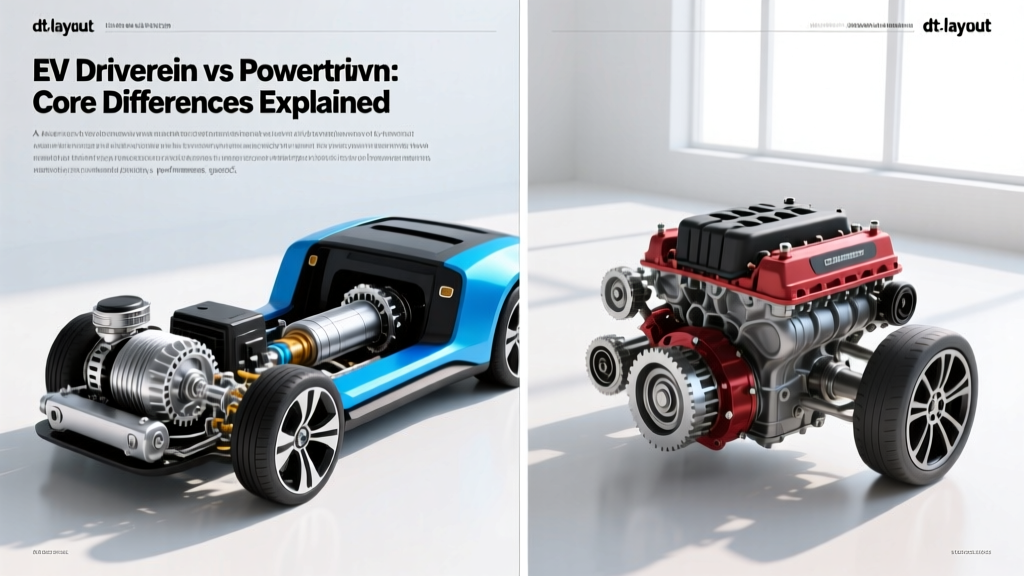
To put it in the simplest beginner-friendly terms: think of the powertrain as the heart, lungs, and brain of the vehicle (everything that generates and manages power). Think of the drivetrain as the muscles, tendons, and bones (everything that physically transfers that power to the road). Let us break down exactly what separates these two systems, how they differ between internal combustion engine (ICE) vehicles and electric vehicles (EVs), and what this means for your wallet when something breaks.
What Exactly is a Powertrain?
The powertrain encompasses every single component involved in generating power and delivering it to the road surface. If a part is responsible for creating kinetic energy or managing the primary energy source, it belongs to the powertrain.
In a Traditional Gas Vehicle (ICE)
The ICE powertrain is a complex symphony of controlled explosions and mechanical conversions. It includes:
- The Engine: Block, cylinder heads, pistons, crankshaft, and valvetrain.
- The Fuel System: Fuel tank, high-pressure fuel pumps, injectors, and fuel lines.
- The Exhaust & Emissions: Catalytic converters, particulate filters, and oxygen sensors.
- The Transmission: Whether it is a manual, a traditional torque-converter automatic, or a continuously variable transmission (CVT).
In an Electric Vehicle (EV)
According to the U.S. Department of Energy, an EV powertrain replaces the combustion elements with high-voltage electrical components. The EV powertrain includes:
- The Traction Battery Pack: The massive lithium-ion or LFP energy storage system.
- The Inverter: Converts DC battery power to AC power for the motor.
- The Electric Traction Motor: The actual electromagnetic motor that generates rotational force.
- The Onboard Charger & Thermal Management: Systems that regulate battery temperature and accept grid power.
What is an EV Drivetrain?
This is where the keyword EV drivetrain comes into focus. The drivetrain is strictly the subset of the powertrain responsible for transmitting torque from the power source (engine or electric motor) to the drive wheels. It does not generate power; it only routes it.
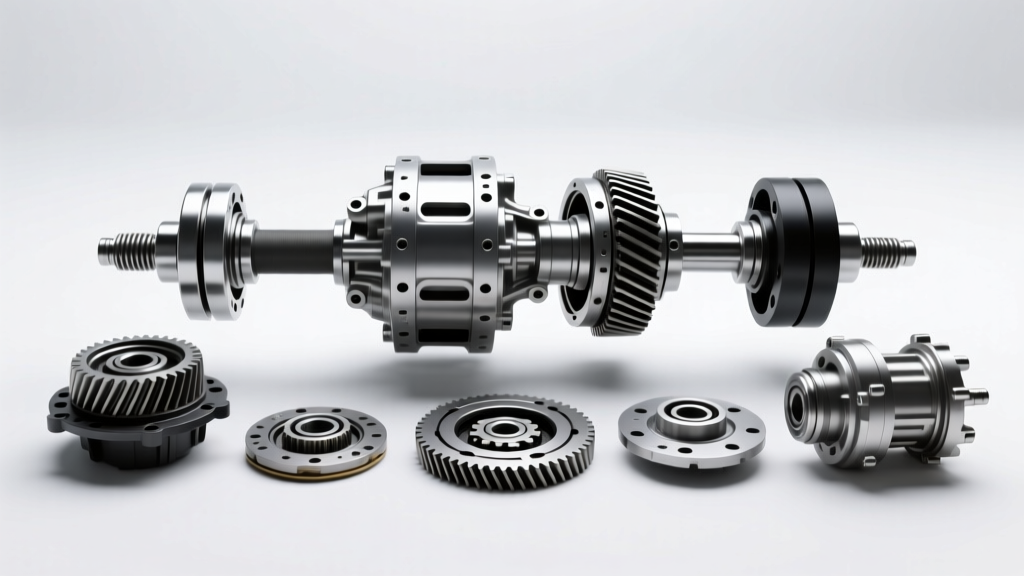
In an EV, the drivetrain is remarkably elegant compared to a gas car, but it operates under immense, instantaneous torque loads. The core components of an EV drivetrain include:
- Reduction Gearbox: EVs rarely need multi-speed transmissions. Instead, they use a single-speed reduction gear (often with a ratio between 9:1 and 10.5:1) to multiply the motor's high-RPM, low-torque output into usable wheel torque.
- Differential: Allows the left and right wheels to spin at different speeds during cornering. In many EVs, this is integrated directly into the motor housing.
- Half-Shafts (CV Axles):strong> The physical shafts connecting the differential to the wheel hubs, equipped with Constant Velocity (CV) joints to handle suspension articulation.
- e-Axle Assemblies: In modern 2026 EV architectures, the motor, inverter, and reduction gear are often cast into a single, integrated unit known as an e-Axle or Electric Drive Module (EDM).
Side-by-Side: Drivetrain vs Powertrain Components
To visualize the boundary line between these two systems, review the comparison chart below.
| Component | Powertrain or Drivetrain? | Function |
|---|---|---|
| Traction Battery / Fuel Tank | Powertrain | Stores primary energy |
| Electric Motor / Engine Block | Powertrain | Generates rotational force |
| Inverter / Engine Control Unit | Powertrain | Manages power delivery |
| Reduction Gear / Transmission | Drivetrain (Borderline) | Multiplies and routes torque |
| Driveshaft / CV Axles | Drivetrain | Transfers torque to wheels |
| Differential | Drivetrain | Splits torque between wheels |
Note: The transmission or reduction gearbox is often claimed by both categories depending on the manufacturer's warranty literature, but mechanically, it is the first step of the drivetrain.
Why the Distinction Matters: The Warranty Trap
Understanding the difference between an EV drivetrain and a powertrain is not just academic; it can save you thousands of dollars. The U.S. Department of Energy's Fuel Economy Guide notes that federal mandates require EV batteries and core powertrain components to carry extensive warranties (typically 8 years / 100,000 miles).
However, drivetrain components are frequently excluded from extended powertrain warranties. If the electric motor bearings fail, you are covered under the 100,000-mile powertrain warranty. But if your CV axle boot tears at 45,000 miles, or a wheel hub bearing seizes, dealerships will often classify these as "wear-and-tear" or "suspension/drivetrain" items, leaving you to foot a bill that can range from $400 to $1,200 out-of-pocket. Always read the fine print of your warranty booklet to see exactly where the manufacturer draws the line between the motor and the axle.
Mechanic's Corner: Real-World Specs and Torque Data
For the DIY enthusiasts and aspiring technicians reading this, let us move past the beginner analogies and look at the hard mechanical data that defines these systems in the real world. Comparing a legacy ICE drivetrain to a modern EV drivetrain highlights the engineering shift.
Legacy ICE: ZF 8HP70 Transmission (Drivetrain)
The ZF 8HP 8-speed automatic is legendary in the automotive world, found in everything from BMWs to Dodge Chargers.
- Fluid Specification: ZF LifeguardFluid 8.
- Capacity: Approximately 9.5 Liters (dry fill).
- Torque Converter Hub Bolts: 25 Nm (18.4 lb-ft).
- Transmission Oil Pan Bolts: 10 Nm (7.4 lb-ft) - Note: The pan is plastic and integrates the filter and mechatronic sleeve, requiring full assembly replacement during service.
- Common Failure: Mechatronic sleeve adapter leaks and bridge seal degradation leading to harsh 4-5 shifts.
Modern EV: Tesla Model 3 Rear Drive Unit (EV Drivetrain)
The Tesla Model 3 Rear Drive Unit (RDU) is a masterclass in integrated EV drivetrain packaging, combining the motor, inverter, and reduction gear.
- Assembly Part Number: 1120950-00-J (Varies by revision and year).
- Fluid Specification: Tesla Proprietary Gearbox Fluid (Part No. 1135385-00-A) or Pentosin ATF 9 equivalent.
- Capacity: 2.4 Liters.
- Rear Axle Nut Torque: 245 Nm (181 lb-ft) plus a 90-degree yield turn. Warning: This is a one-time-use stretch bolt. Reusing it risks catastrophic axle detachment under high-torque EV launches.
- Common Failure: Early production Model 3 RDUs suffered from premature internal bearing wear, resulting in a distinct high-frequency whine during deceleration (regen braking). This requires a complete RDU swap or specialized bearing rebuild.
2026 Trends: The Rise of the Integrated e-Axle
As we look at the automotive landscape in 2026, the line between powertrain and drivetrain is blurring physically, even if it remains distinct legally. Suppliers like GKN Automotive and Magna are pioneering highly integrated "e-Axles." In these systems, the electric motor, the silicon-carbide inverter, and the two-speed reduction gearbox are cast into a single, sealed aluminum housing that bolts directly to the vehicle's subframe.
This integration reduces weight by up to 15% and eliminates the need for high-voltage cabling between the inverter and motor, drastically reducing electromagnetic interference (EMI). However, it also means that a simple drivetrain issue, like a failing differential bearing, might require the removal and disassembly of the entire powertrain unit, driving up labor costs significantly.
Summary: Know Your Vehicle's Anatomy
Whether you are driving a traditional truck with a ZF 8-speed or a cutting-edge EV with a dual-motor e-Axle setup, knowing the difference between the powertrain and the drivetrain is essential. The powertrain makes the power; the drivetrain puts it to the pavement. By understanding this distinction, you can better navigate warranty claims, anticipate maintenance costs, and appreciate the incredible mechanical engineering that happens beneath the floorboards of your vehicle.