The Economics of Internal TC Bearing and Seal Failures
When an automatic transmission develops a high-pitched whine, suffers from delayed engagements, or leaks fluid from the bellhousing inspection cover, the root cause often traces back to the torque converter. Specifically, internal torque converter bearing and seal failures are among the most deceptive faults in modern drivetrains. Because the torque converter acts as the hydraulic bridge between the engine and the transmission gearsets, a failing stator bearing or a degraded impeller hub seal will mimic catastrophic internal transmission damage. Understanding the true torque converter replacement cost requires looking beyond the price of the part and examining the labor intensiveness, collateral fluid contamination, and machine shop economics that define this repair in 2026.
Why Shops Replace Rather Than Rebuild
From a purely mechanical standpoint, the bearings and seals inside a torque converter are inexpensive. A replacement stator needle bearing or a set of turbine shaft O-ring seals typically costs between $15 and $45. However, the torque converter is a welded, hermetically sealed unit. To access these internal components, a technician must mount the converter on a specialized TC lathe, cut the outer cover away, replace the internal bearings and seals, and then weld the unit back together. Finally, the unit must be dynamically balanced on a high-RPM spin tester to prevent severe harmonic vibrations at highway speeds.
According to the Automatic Transmission Rebuilders Association (ATRA), the capital equipment required to safely cut, weld, and balance a torque converter exceeds $25,000. Consequently, the vast majority of general repair shops and even dedicated transmission centers do not rebuild torque converters in-house. Instead, they rely on remanufactured exchange units. Therefore, the torque converter replacement cost is driven not by the raw material cost of a $20 seal, but by the core exchange price of a remanufactured unit and the substantial labor required to remove the transmission from the vehicle.
2026 Torque Converter Replacement Cost Breakdown
The financial impact of a torque converter bearing or seal failure varies heavily depending on the vehicle platform, the accessibility of the bellhousing, and the required fluid flush procedures. Below is a detailed cost matrix for three of the most common transmissions plagued by torque converter bearing and seal issues in the current aftermarket landscape.
| Transmission Model | Common TC Failure Point | Reman TC Cost (2026) | Removal & Install Labor | Fluid & Flush | Total Estimated Cost |
|---|---|---|---|---|---|
| GM 6L80 / 6L90 | Stator Support Bearing & Hub Scoring | $450 - $650 | 7.5 - 9.0 hrs ($1,125 - $1,530) | $180 (Dexron ULV) | $1,755 - $2,360 |
| Ford 6R80 | TCC Apply Seal Rings & Impeller Bearing | $380 - $550 | 6.5 - 8.0 hrs ($975 - $1,360) | $140 (Mercon LV) | $1,495 - $2,050 |
| ZF 8HP45 / 8HP55 | Turbine Shaft Seals & Lockup Clutch | $650 - $950 | 8.0 - 10.5 hrs ($1,200 - $1,830) | $220 (ZF 8-Speed) | $2,070 - $3,000 |
Note: Labor rates are calculated using a 2026 national independent shop average of $150 to $175 per hour. Dealership rates will push these totals 25-40% higher.
Collateral Damage: The Hidden Costs of Metallic Debris
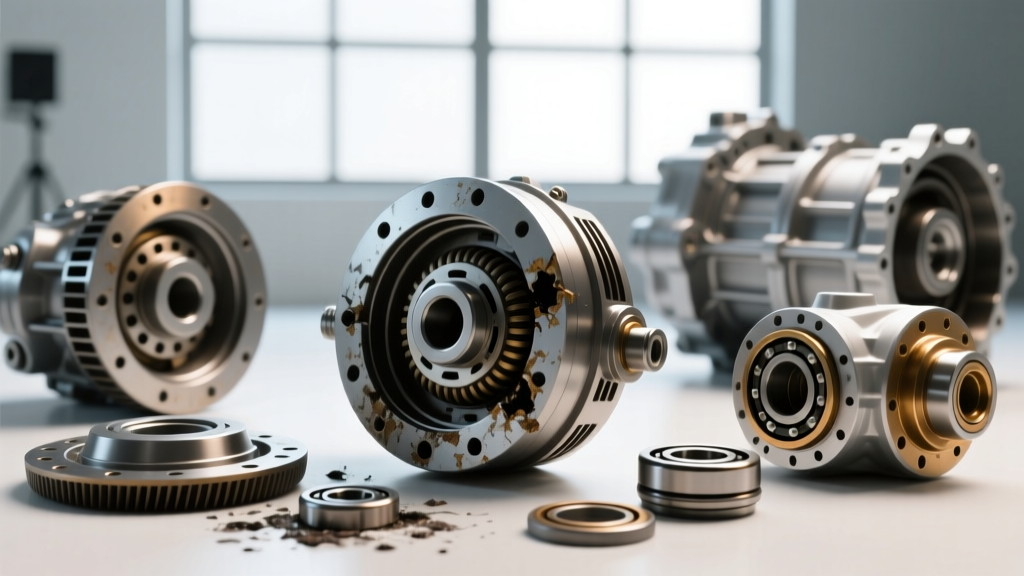
When an internal torque converter bearing disintegrates, it does not simply fail in isolation. The bearing cage and needle rollers are immediately swept into the high-velocity hydraulic fluid stream. This metallic glitter is pumped directly into the transmission cooler lines, the radiator-mounted transmission cooler, and the transmission valve body. If a technician replaces the torque converter without addressing this contamination, the new unit will fail within a few thousand miles due to restricted cooler flow and scored valve body spool valves.
To mitigate this, a proper repair protocol mandates a complete cooling system flush or replacement. The hidden costs associated with bearing failures include:
- Inline Cooler Replacement: Many modern vehicles use integrated transmission fluid warmers/coolers that cannot be effectively flushed. Replacing a GM 6L80 auxiliary cooler adds $250 to $400 in parts.
- Valve Body Solenoid Cleaning: Metallic debris frequently jams the Torque Converter Clutch (TCC) apply solenoids. Ultrasonic cleaning or solenoid replacement adds $150 to $300 to the repair bill.
- Stator Support Shaft Repair: If the TC impeller hub bearing fails and spins on the stator support shaft, it will gouge the aluminum or steel shaft. Using a repair sleeve, such as the Sonnax 95034-01K hub sleeve kit, is mandatory to restore proper clearance and prevent immediate failure of the new remanufactured converter.
Diagnostic Framework: Isolating TC Noise from Pump Cavitation
Misdiagnosis is the primary reason customers overpay for transmission repairs. A failing torque converter stator bearing produces a distinct whining or growling noise that is frequently misdiagnosed as a failing transmission front pump. Replacing the transmission pump requires a full teardown, whereas identifying the torque converter as the culprit limits the repair to a transmission R&R and TC swap.
Acoustic and Fluid Analysis
To accurately isolate a torque converter bearing failure from a geartrain or pump issue, master technicians utilize a combination of acoustic testing and fluid analysis. A torque converter bearing noise is directly tied to engine RPM, not vehicle speed or gear ratio. The noise will be present in Park and Neutral, and will typically pitch up seamlessly as the engine revs. Conversely, a geartrain bearing noise will change pitch during a coast-down shift or when the torque converter clutch (TCC) locks and unlocks.
Furthermore, inspecting the transmission pan is critical. If the pan contains a heavy concentration of fine, iridescent metallic paste (often described as 'glitter' or 'pearl paint'), the torque converter bearing or the transmission pump gear faces are disintegrating. If the debris is accompanied by small, circular shavings of brass or bronze, the torque converter impeller hub bushing/bearing has failed and is machining away the stator support shaft. Catching this symptom early is the only way to keep the torque converter replacement cost from ballooning into a full transmission rebuild.
Precision Reassembly: Critical Torque Specs and Clearances
Once the failed torque converter is removed and the transmission is reinstalled, the reassembly process demands strict adherence to factory torque specifications. A torque converter that is not fully seated into the transmission front pump before the bellhousing is bolted to the engine block will instantly destroy the new converter's front seal and the pump gear upon engine startup.
Before mating the transmission to the engine, the technician must measure the 'setback' or 'pull-back' distance. Using a straight edge across the bellhousing mating surface, the distance to the torque converter mounting pads should typically be between 1/8-inch and 3/16-inch (approx. 3mm to 5mm) depending on the specific application. If the converter is flush with the bellhousing, it is not fully seated into the pump stator splines.
During final assembly, the flexplate-to-torque converter bolts are a critical failure point. These bolts endure immense shear stress. For the ubiquitous GM 6L80 and 6L90 platforms, the M10x1.5 flexplate bolts must be tightened to exactly 45 Nm (33 lb-ft) and secured with a medium-strength threadlocker (such as Loctite 243). Over-torquing these bolts can stretch the torque converter cover, leading to internal pressure leaks and TCC shudder. The bellhousing-to-engine block bolts (typically M12x1.75) must be torqued to 50 Nm (37 lb-ft) in a star pattern to ensure the transmission centerline remains perfectly parallel with the engine crankshaft, preventing premature wear on the newly installed torque converter pilot bearing and impeller hub seal.
By understanding the mechanical realities of internal bearing and seal failures, vehicle owners and technicians can accurately forecast the torque converter replacement cost, avoid unnecessary transmission teardowns, and ensure the longevity of the replacement unit through meticulous diagnostic and reassembly protocols.