The Hidden Culprits of Transmission Failure: Bearings and Seals
When mechanics and DIYers search for how to check torque converter health, the immediate focus usually lands on torque converter clutch (TCC) slip, shudder, or stall speed anomalies. However, internal bearing degradation and impeller hub seal leaks are equally catastrophic and often fly under the radar until catastrophic transmission failure occurs. The torque converter relies on a delicate balance of rotating assemblies supported by stator, turbine, and impeller bearings, while the front pump seal maintains the critical hydraulic pressure boundary.
Ignoring the early acoustic and visual symptoms of bearing wear or seal compromise will inevitably lead to front pump destruction, total fluid loss, and complete driveline failure. In this comprehensive cost and diagnostic guide, we break down exactly how to identify these specific failures, the engineering reasons behind them, and the real-world financial impact of repairing versus replacing the assembly.
Identifying Bearing and Seal Failure Symptoms
Before tearing into the bellhousing, you must accurately map the symptoms to the internal components. Bearing and seal issues present differently than TCC solenoid codes or valve body wear.
- High-Pitched Whining or Grinding: A whine that changes pitch with engine RPM (not vehicle speed) often points to a failing stator support bearing or turbine needle bearing. As the bearing cage degrades, metal-on-metal contact generates a distinct harmonic frequency.
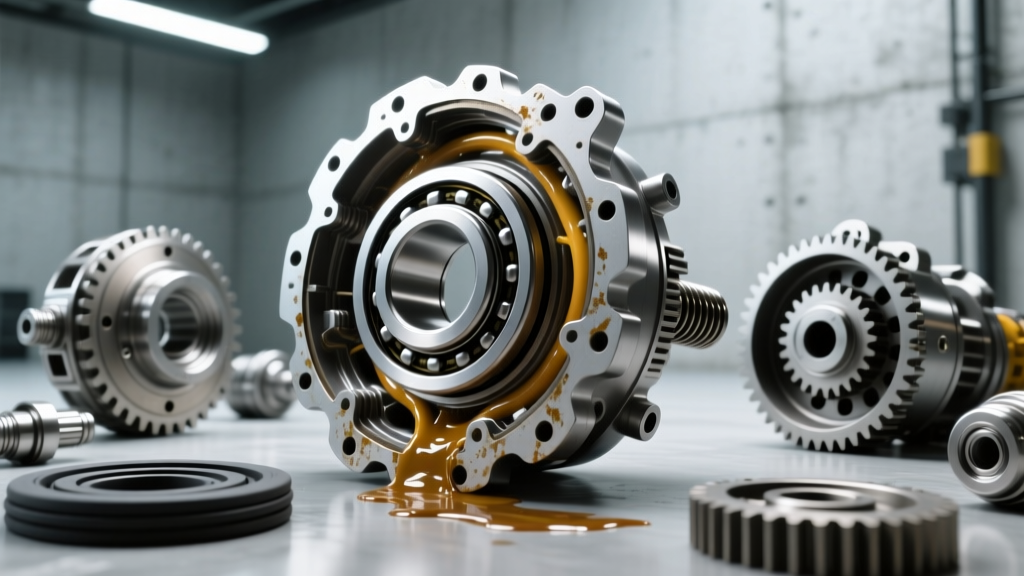
- Bellhousing Fluid Leaks: If you find automatic transmission fluid (ATF) pooling between the engine block and transmission case, the front pump seal or the torque converter impeller hub is compromised.
- Vibration at Idle: A worn pilot bearing or excessive torque converter endplay can cause a noticeable harmonic vibration at idle, which disappears when the transmission is shifted into neutral.
- Overheating and Debris: Failing bearings shed microscopic metallic particulates. If your transmission pan contains a heavy, glitter-like sludge but no large clutch chunks, bearing disintegration is the primary suspect.
Step-by-Step: How to Check Torque Converter Bearings and Seals
Proper diagnosis requires a two-tiered approach: in-vehicle acoustic testing and bench-top physical measurement.
Phase 1: In-Vehicle Diagnostics
Using an automotive stethoscope, place the probe near the bellhousing inspection cover while the engine is idling in park. A failing stator bearing will emit a harsh, metallic growl that isolates to the center axis of the converter. Next, perform a leak-down test. If the vehicle sits for 48 hours and the bellhousing is wet with ATF, but the transmission dipstick reads low, the fluid is migrating past the front pump seal due to a grooved torque converter hub or a hardened seal lip.
Phase 2: Bench Inspection and Measurement
Once the torque converter is removed from the vehicle, a rigorous bench inspection is mandatory. According to Sonnax Technical Resources, you must measure the impeller hub where the front pump seal rides. Using a micrometer, check the hub diameter and surface finish. If the hub exhibits a wear groove deeper than 0.002 inches, or if the diameter is out of OEM roundness specifications, a new seal will not stop the leak. The hub must be machined with a wear sleeve or the converter must be replaced.
Next, check converter endplay. Mount the converter on a bench fixture and use a dial indicator to measure axial play between the turbine and impeller. Acceptable endplay typically ranges from 0.010 to 0.030 inches. Excessive play indicates severe turbine bearing wear, which will eventually cause the TCC friction material to drag against the front cover, leading to immediate lockup failure.
Cost Analysis: Repair vs. Replacement Breakdown
Because the torque converter and front pump seal require transmission removal to access, the labor cost is the most significant variable. The table below outlines the 2026 market averages for diagnosing and rectifying bearing and seal issues across common rear-wheel-drive platforms.
| Component / Failure Mode | Part Cost (OEM / Reman) | Labor Hours (R&R) | Total Estimated Cost |
|---|---|---|---|
| Front Pump Seal Leak (Hub OK) | $15 - $35 (Seal Kit) | 6.5 - 8.5 Hours | $950 - $1,350 |
| Front Pump Seal Leak (Grooved Hub) | $250 - $450 (Reman TC) | 6.5 - 8.5 Hours | $1,250 - $1,750 |
| Stator Support Bearing Failure | $300 - $550 (Reman TC) | 7.0 - 9.0 Hours | $1,400 - $1,950 |
| Turbine Bearing / Endplay Issue | $350 - $600 (Reman TC) | 7.0 - 9.0 Hours | $1,500 - $2,100 |
| Full Transmission Rebuild (Bearing Debris) | $1,200 - $2,500 (Master Kit + TC) | 12.0 - 16.0 Hours | $3,000 - $4,800 |
Note: Labor rates calculated at an average independent shop rate of $145-$175 per hour. Dealership rates will increase total costs by 30-45%.
Deep Dive: Common Failure Points by Transmission Model
Different transmission architectures experience bearing and seal failures in unique ways. Understanding these model-specific quirks is vital for accurate cost estimation and diagnosis.
GM 6L80 and 6L90 Transmissions
The GM 6L80 is notorious for stator support bushing and bearing wear. When the stator support bearing degrades, the torque converter hub begins to wobble. This eccentric movement destroys the front pump seal lip, resulting in massive fluid leaks. Furthermore, the TCC hub inside the 6L80 converter is prone to wear, which compromises the internal sealing rings. If you are replacing a 6L80 torque converter due to a seal leak, always inspect the stator support shaft for scoring. Replacing the stator support sleeve (often requiring specialized pullers and drivers) adds roughly $120 in parts and 1.5 hours of bench time to the rebuild cost.
ZF 8HP (8HP70 / 8HP90) Applications
Found in modern BMW, Audi, and Dodge/Chrysler vehicles, the ZF 8HP utilizes a highly compact front pump design. Front pump seal leaks here are rarely just a bad rubber lip; they are frequently caused by the aluminum pump bore wearing out due to converter hub friction. As highlighted by Transmission Digest technical bulletins, simply installing a new OEM seal will result in a comeback within 5,000 miles. The correct repair involves machining the pump bore and installing a hardened steel sleeve (such as the Sonnax 106740-03K). Expect to add $250 for machine shop services and specialized tooling to your ZF 8HP repair estimate.
Ford 6R80 Platforms
The Ford 6R80 (based on the ZF 6HP26 architecture) suffers from internal turbine bearing failures when subjected to heavy towing or modified engine torque outputs. When the turbine bearing collapses, the converter loses its ability to maintain proper fluid coupling, leading to severe overheating. Because the 6R80 requires specialized cutting and welding equipment to open the torque converter casing, internal bearing replacement is not a DIY or standard shop procedure. The unit must be sent to a dedicated torque converter rebuilder or replaced outright with a remanufactured unit, costing between $350 and $500 for the part alone.
Expert Reassembly Tips and Torque Specifications
If you have diagnosed a seal leak and are installing a new torque converter or front pump seal, precision during reassembly is non-negotiable. A misaligned converter will instantly destroy the new seal and potentially crack the front pump housing.
- Seal Lubrication: Always coat the inner lip of the front pump seal and the torque converter hub with the exact ATF specified for the transmission (e.g., Dexron VI for GM, ZF LifeguardFluid 8 for 8HP units). Never install dry.
- Seal Depth: Use a seal driver to ensure the front pump seal is seated perfectly flush. A seal driven 1mm too deep will miss the converter hub sealing surface; a seal sitting proud will be crushed upon bellhousing mating.
- Flexplate Runout: Check flexplate runout with a dial indicator before mating. Runout exceeding 0.015 inches will induce harmonic vibrations that will prematurely wear the new pilot bearing and front pump seal.
- Torque Specs: When reinstalling the torque converter to the flexplate, use new OEM bolts. For standard GM V8 applications (like the 6.0L LQ4 paired with the 6L80), flexplate-to-crankshaft bolts are typically torque-to-yield, requiring an initial torque of 35 Nm followed by a 50-degree turn. Converter-to-flexplate bolts should generally be torqued to 45-50 Nm (33-37 lb-ft) using a medium-strength threadlocker.
Conclusion: The True Cost of Ignoring the Signs
Learning how to check torque converter bearings and seals is an exercise in preventative maintenance. While a $25 front pump seal seems inexpensive, the labor required to access it pushes the baseline repair cost near $1,000. If a failing bearing is ignored, the resulting metallic debris will circulate through the transmission cooler, contaminating the valve body and clutch packs, escalating a $1,500 torque converter replacement into a $4,500 complete transmission overhaul. Accurate diagnosis, precise micrometer measurements, and model-specific repair protocols are the only ways to ensure a lasting, cost-effective repair.