The Evolution of TCC Lockup in GM's 8L90 and 6L80 Transmissions
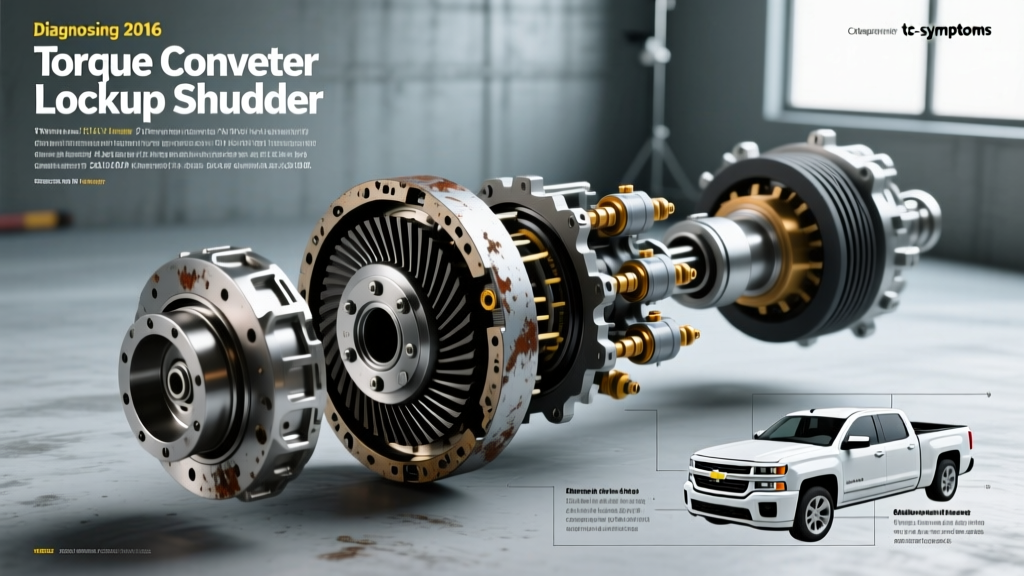
As we navigate the automotive landscape in 2026, the 2016 Chevy Silverado remains a dominant force on the road and in fleet operations. However, as these trucks cross the 10-year and 120,000-mile thresholds, transmission drivability complaints have surged. The most prevalent of these is torque converter clutch (TCC) shudder. When evaluating a 2016 Chevy Silverado torque converter for lockup shudder, it is critical to understand that GM's lockup strategy is no longer a simple 'on/off' hydraulic switch. It is a highly calibrated, Pulse Width Modulated (PWM) micro-slip system designed to eliminate NVH (Noise, Vibration, and Harshness) and improve fuel economy.
Depending on your engine configuration, your 2016 Silverado is equipped with either the 6L80 (typically behind the 4.3L V6) or the 8L90 (paired with the 5.3L and 6.2L V8s). Both transmissions utilize a controlled-slip TCC apply strategy. The Transmission Control Module (TCM) commands the TCC solenoid to maintain a precise slip rate—usually between 20 and 40 RPM—during light throttle cruising. When the friction material degrades, the hydraulic fluid loses its shear stability, or the solenoid bore wears, this micro-slip turns into a violent 100+ RPM oscillation that the driver feels as a severe shudder, often mistaken for a misfire or bad spark plugs.
Scan Tool Diagnostics: Reading the TCC Slip PIDs
Before dropping the transmission pan or ordering replacement parts, you must verify the TCC operation using a bi-directional OBD2 scan tool. Guesswork leads to misdiagnosis. Connect your scanner and navigate to the Transmission Data PIDs. You need to monitor three specific parameters simultaneously while driving at a steady 45-55 MPH in top gear with the TCC commanded 'ON'.
| PID Parameter | Normal Operation (Healthy) | Failing TCC / Shudder Condition | Diagnostic Meaning |
|---|---|---|---|
| TCC Slip Speed (RPM) | 10 to 40 RPM | Oscillates between -50 and +120 RPM | Friction material failure or fluid shear loss causing hydraulic instability. |
| TCC Solenoid Duty Cycle | 60% to 85% (Steady) | Rapidly fluctuating or pegged at 100% | TCM is desperately trying to maintain apply pressure; indicates solenoid wear or internal leak. |
| Transmission Fluid Temp (TFT) | 160°F - 195°F | Over 210°F | Excessive slip is generating severe heat, accelerating Dexron fluid degradation. |
| TCC Apply Pressure (PSI) | 90 - 110 PSI | Drops below 70 PSI under load | Internal cross-leak in the TCC control valve or worn stator support shaft seals. |
Common DTCs Associated with Lockup Failures
- P0741: Torque Converter Clutch System Stuck Off or Slipping. (Most common shudder code).
- P0742: Torque Converter Clutch System Stuck On. (Usually indicates a mechanically seized TCC control valve in the valve body).
- P2757: Torque Converter Clutch Pressure Control Solenoid Control Circuit Performance. (Points directly to the PWM solenoid or TEHCM wiring).
The Fluid Factor: Dexron VI vs. Dexron ULV
One of the most frequent causes of TCC shudder on the 2016 Silverado is improper fluid service. The 6L80 transmission requires Dexron VI ATF. However, the 8L90 8-speed transmission was engineered for Dexron ULV (Ultra Low Viscosity) fluid. According to ACDelco's official lubricant specifications, mixing these fluids or using generic 'multi-vehicle' ATF will destroy the micro-slip friction coefficient of the 8L90's torque converter lining.
If a shop flushed an 8L90 with standard Dexron VI, the higher viscosity fluid will cause the TCC apply piston to react sluggishly to the high-frequency PWM commands from the TCM, resulting in immediate shudder. If the fluid history is unknown and shudder is present at low mileage, a double-flush using the correct OEM fluid spec and a TCM adaptation reset is the mandatory first step before condemning the hardware.
Electrical and Solenoid Troubleshooting
If the fluid is correct and the scan tool shows the TCM commanding a steady duty cycle while the slip RPM wildly fluctuates, the issue is likely mechanical or electrical within the pan. On the 6L80, the TCC PWM solenoid is a standalone, easily replaceable component located in the valve body. On the 8L90, the solenoids are integrated into the TEHCM (Transmission Electro-Hydraulic Control Module) or the internal wiring harness, making diagnosis slightly more complex.
Multimeter Testing Protocol (6L80 TCC Solenoid)
- Drop the transmission pan and locate the TCC PWM solenoid (usually identified by a specific colored connector, often yellow or black depending on the build date).
- Disconnect the solenoid and set your multimeter to Ohms.
- Measure the resistance across the solenoid pins. A healthy 6L80 TCC solenoid should read between 10.5 and 12.5 Ohms at 68°F (20°C).
- If the reading is below 8 Ohms (shorted) or above 20 Ohms (open/high resistance), the solenoid coil is failing and cannot modulate hydraulic pressure accurately.
- Inspect the internal wiring harness for chafing against the valve body casting, a known issue that causes intermittent P2757 codes.
Mechanical Wear: The Stator Shaft and Control Valve
As detailed in Sonnax Technical Resources, hydraulic cross-leaks are a silent killer of torque converter lockup. The TCC apply oil must travel through the stator support shaft and into the turbine hub to apply the clutch piston. Over 100,000 miles, the TCC control valve in the aluminum valve body bore wears out, creating an oval shape. This allows apply pressure to bleed off into the exhaust circuit. No matter how perfectly the solenoid operates, the physical pressure required to lock the converter against engine torque is lost, resulting in a 100+ RPM slip and severe shudder.
For high-mileage 2016 Silverados exhibiting P0741 codes despite new solenoids and fresh fluid, installing a Sonnax TCC control valve kit with an anodized aluminum replacement valve and reamer is the only permanent fix for the valve body circuit.
Real-World Repair Costs and Part Numbers (2026 Estimates)
Repairing a TCC issue requires a precise decision framework based on the root cause. Below is a breakdown of expected costs and OEM part references for the 2016 Silverado platform.
| Repair Scenario | Required Components | Approx. Parts Cost | Labor Time & Cost |
|---|---|---|---|
| Fluid Degradation / Incorrect Spec | ACDelco Dexron ULV (19355658) or Dexron VI | $60 - $90 | 1.5 Hours ($150-$225) |
| 6L80 TCC Solenoid Failure | ACDelco TCC PWM Solenoid (24230298) | $45 - $75 | 3.0 Hours ($300-$450) |
| Valve Body Bore Wear (8L90/6L80) | Sonnax TCC Valve Kit & Reamer Tool | $85 - $130 | 4.5 Hours ($450-$650) |
| Catastrophic TC Friction Failure | ACDelco Reman Torque Converter | $400 - $750 | 8.0 Hours ($800-$1,200) |
Note: Always verify part numbers against your specific VIN via the RockAuto catalog or GM dealer portal, as mid-year production splits in 2016 can alter TEHCM and solenoid configurations.
Torque Specifications for Reassembly
If your diagnosis requires dropping the pan or removing the transmission to replace the torque converter, strict adherence to GM torque specifications is non-negotiable to prevent future leaks or flexplate damage.
- Transmission Pan Bolts (8L90/6L80): 10 Nm (89 lb-in). Do not overtighten; the aluminum threads strip easily.
- Valve Body to Case Bolts: 11 Nm (97 lb-in).
- Torque Converter to Flexplate Bolts: 46 Nm (34 lb-ft). Must use new OEM bolts with pre-applied threadlocker.
- Transmission Crossmember to Frame: 95 Nm (70 lb-ft).
Expert Verdict: When to Replace the Converter
Not every shudder requires a new torque converter. If the shudder is caught early (slip oscillations under 60 RPM) and no severe overheating has occurred, a fluid exchange with the correct OEM spec, followed by a TCM 'Fast Adapt' reset via the scan tool, resolves the issue in roughly 40% of cases. However, if your scan tool data shows the TCC duty cycle is pegged at 100% and the slip RPM is consistently reading over 150 RPM under light load, the internal friction lining has physically disintegrated. At this stage, the converter must be replaced, and the transmission cooler must be flushed using a pressure machine to prevent metallic debris and friction material from destroying the new TEHCM and valve body.