The Hidden Cost of Rotational Friction: Automotive vs. Small-Engine CVTs
Whether you are diagnosing a heavy-duty automotive automatic transmission or rebuilding a custom off-road buggy, the torque converter remains the critical bridge between engine output and drivetrain input. In 2026, as transmission systems become increasingly complex, bearing and seal failures within the torque converter assembly represent some of the most misdiagnosed and financially punishing mechanical faults in the powertrain.
Interestingly, the term 'torque converter' spans two very different mechanical worlds. In automotive applications (like the GM 6L80 or ZF 8HP), it refers to a sealed fluid coupling. In powersports and small-engine applications, it refers to the Comet/TAV 30-series asymmetric Continuously Variable Transmissions (CVTs). While their operating principles differ, both rely heavily on precision bearings and high-temperature seals to manage extreme rotational loads. This comprehensive cost analysis breaks down the failure modes, diagnostic procedures, and real-world repair costs for torque converter bearing and seal issues across both platforms.
Automotive Torque Converter Bearing & Seal Failures
In modern automotive automatic transmissions, the torque converter is subjected to immense thermal and mechanical stress. When internal bearings or external hub seals fail, the resulting damage often cascades into the transmission itself.
Front Pump Seal & Impeller Hub Runout
The most common external seal failure occurs at the front pump seal, where the torque converter impeller hub rides inside the transmission's front pump gear. The hub is supported by a bushing or bearing. Over time, heat cycling and torque loading cause the impeller hub surface to wear or score.
If the hub runout exceeds the manufacturer specification (typically a maximum of 0.010 to 0.012 inches Total Indicator Runout, or TIR), the front pump seal cannot maintain a fluid barrier against the spinning, wobbling hub. The result is a massive leak of Automatic Transmission Fluid (ATF) dumping directly into the bellhousing and out the inspection cover weep hole.
- Part Cost: Front pump seal ($15 - $35). Impeller hub repair sleeve kit, such as those from Sonnax, costs roughly $45 - $80.
- Labor Cost: The transmission must be completely removed to access the seal. At 2026 average shop rates of $150-$195/hour, a 6.5-hour R&R (Remove and Replace) job costs $975 - $1,267.
- Total Estimated Cost: $1,050 - $1,400.
Stator Support Bearing & One-Way Clutch Failure
Inside the sealed torque converter housing, the stator assembly is supported by a stator shaft and a needle or roller bearing. In high-mileage ZF 8HP and Ford 6R80 units, this bearing is a known wear item. When the stator bearing fails, the stator wobbles on its axis.
This wobble causes the Torque Converter Clutch (TCC) piston to apply unevenly against the front cover, resulting in severe TCC shudder, delamination of the friction material, and the generation of fine metallic debris. This debris is then pulled into the transmission pan, eventually clogging the valve body solenoids. If caught early, a torque converter replacement saves the transmission. If ignored, a full transmission rebuild is required.
- Part Cost: Remanufactured torque converter with upgraded stator bearings (e.g., Precision of New America) ranges from $350 - $650.
- Labor Cost: Transmission R&R and fluid exchange: $1,100 - $1,500.
- Total Estimated Cost: $1,450 - $2,150.
Small-Engine CVT: 30 Series Torque Converter Belt Size & Pulley Bearings
Transitioning to small-engine applications, the Comet 30-series (and its ubiquitous TAV2 clones) operates as a mechanical CVT utilizing a driver pulley, a driven pulley, and a specialized drive belt. While it lacks hydraulic fluid, it is highly susceptible to bearing and seal failures—often directly caused by improper maintenance or incorrect component sizing.
The Lateral Load Problem: Belt Sizing and Bearing Destruction
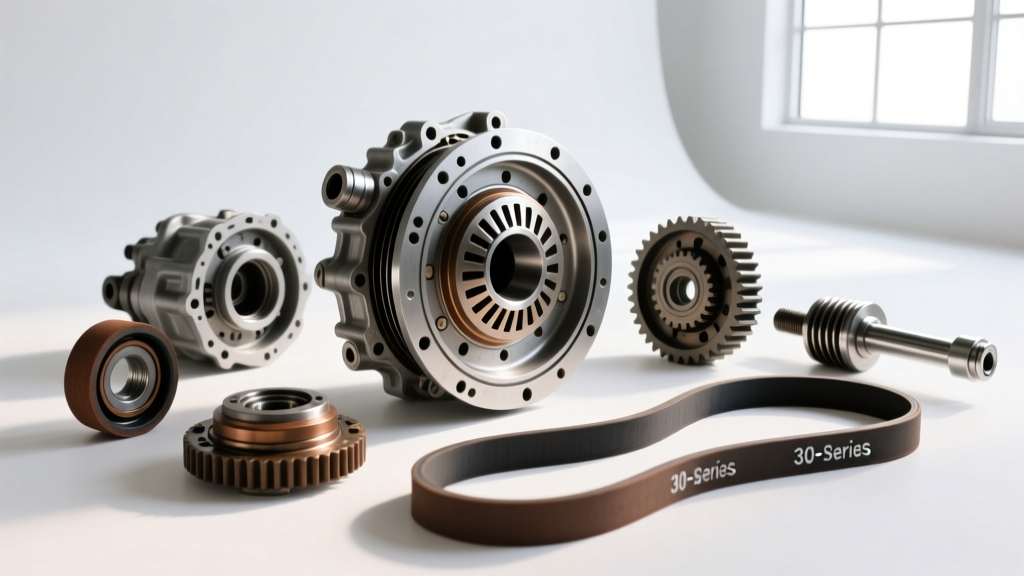
Many DIY mechanics misdiagnose a failing driver pulley bearing as simple belt slip. Before tearing down the pulley, verifying the exact 30 series torque converter belt size is critical. The standard 30-series asymmetric belt requires a 3/4-inch (19mm) top width, a 27-inch (686mm) outer circumference, and a specific 30-degree angle.
According to Comet Industries specifications, using an undersized belt, a standard 1/2-inch V-belt, or an incorrect length forces the belt to ride too deep in the driver sheave. When the belt bottoms out, it acts as a wedge, pushing the movable and fixed sheave halves apart laterally. This extreme lateral force bypasses the cam slots and pushes directly against the internal driver pulley bearing (typically a 17x40x12mm sealed bearing) and the outer grease seal. The bearing seizes, the seal tears, and the pulley destroys itself.
Cost Breakdown: 30-Series Rebuild vs. Replacement
Unlike automotive applications, small-engine CVT repair is highly accessible and cost-effective, provided the crankshaft has not been damaged by a seized pulley.
- Driver Pulley Bearing & Seal Kit: $12 - $25 (Includes 17mm ID bearing and lip seal).
- Complete 30-Series Torque Converter Kit (Driver, Driven, Belt): $110 - $160 for high-quality aftermarket replacements.
- Labor Cost: 1 to 2 hours. Small engine shops typically charge $85 - $120/hour, bringing labor to $85 - $240.
- Total Estimated Cost: $150 (DIY Rebuild) to $320 (Professional Full Replacement).
2026 Cost & Failure Comparison Matrix
The following table illustrates the stark contrast in financial risk between automotive fluid-coupling torque converters and mechanical 30-series CVTs when bearing and seal integrity is compromised.
| System / Component | Primary Failure Trigger | Part Cost (2026) | Labor Cost | Cascading Risk |
|---|---|---|---|---|
| GM 6L80 Front Pump Seal | Impeller Hub Runout (>0.012'') | $15 - $80 | $975 - $1,267 | Fluid starvation, transmission burnout |
| ZF 8HP Stator Bearing | Thermal degradation, high mileage | $350 - $650 (Full TC) | $1,100 - $1,500 | TCC shudder, valve body contamination |
| Comet 30-Series Driver Bearing | Incorrect belt size / lateral wedge | $12 - $25 | $85 - $240 | Pulley seizure, crankshaft scoring |
Diagnostic Framework: Isolating the Fault
Accurate diagnosis prevents unnecessary parts replacement. Use this framework to isolate bearing and seal faults based on your specific drivetrain type.
Automatic Transmission Diagnostics
- Bellhousing Leak Isolation: Clean the engine rear main seal and oil pan gasket. Add UV dye to the ATF. Run the vehicle to operating temperature and inspect the bellhousing weep hole with a blacklight. If ATF is present, the front pump seal or converter hub is the culprit.
- Auditory Stator Bearing Test: Use a mechanic's stethoscope on the transmission bellhousing while the vehicle is idling in gear (with brakes firmly applied). A stator bearing failure will emit a distinct, high-frequency metallic whine that changes pitch as the TCC attempts to apply.
- Pan Inspection: Drop the transmission pan. If you find fine, glitter-like metallic powder but no large chunky debris, the torque converter internal bearings are likely deteriorating. As noted by the Automatic Transmission Rebuilders Association (ATRA), flushing the cooler lines is mandatory if internal TC bearing failure is confirmed to prevent valve body scoring.
30-Series CVT Diagnostics
- Belt Deflection & Sizing Check: Measure the belt. If it does not match the 3/4" x 27" 30 series torque converter belt size specifications, replace it immediately. Check static deflection; it should be approximately 5/16" to 3/8" when pressed midway between the pulleys.
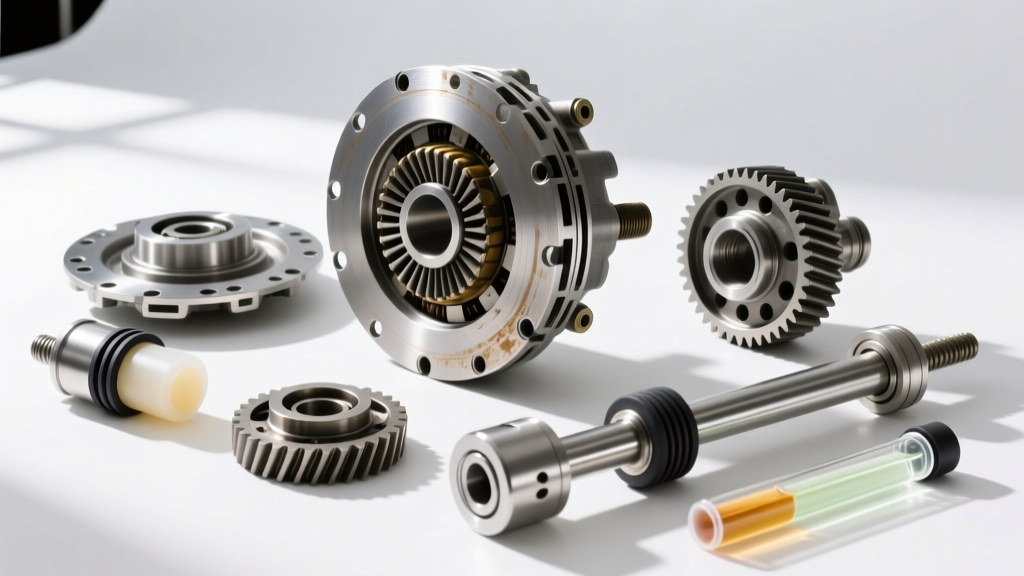
- Pulley Disassembly: If the belt is correct but slipping or squealing, remove the driver pulley. Inspect the plastic cam shoes for flat spots and check the 17mm bearing for rough rotation. A torn outer seal will manifest as dry, rusted cam slots lacking molybdenum grease.
Preventative Maintenance and Fluid Specifications
Extending the life of torque converter bearings and seals requires strict adherence to fluid and maintenance protocols. For modern automotive automatics, using the exact OEM fluid specification (such as Dexron ULV for GM 10-speeds or ZF Lifeguard 8 for ZF 8HP units) is non-negotiable. These fluids contain specific friction modifiers and anti-wear additives designed to protect stator bearings and maintain seal elasticity at high operating temperatures.
For 30-series small-engine CVTs, preventative maintenance is mechanical rather than chemical. Regularly inspecting the drive belt for fraying, ensuring the correct belt size is installed, and periodically rebuilding the driver pulley with fresh high-temperature moly grease every 500 hours of operation will virtually eliminate bearing and seal failures. By understanding the unique mechanical demands of your specific torque converter system, you can avoid catastrophic drivetrain failures and manage repair costs effectively in 2026 and beyond.