The Hidden Thermal Bottleneck in Subaru's Symmetrical AWD
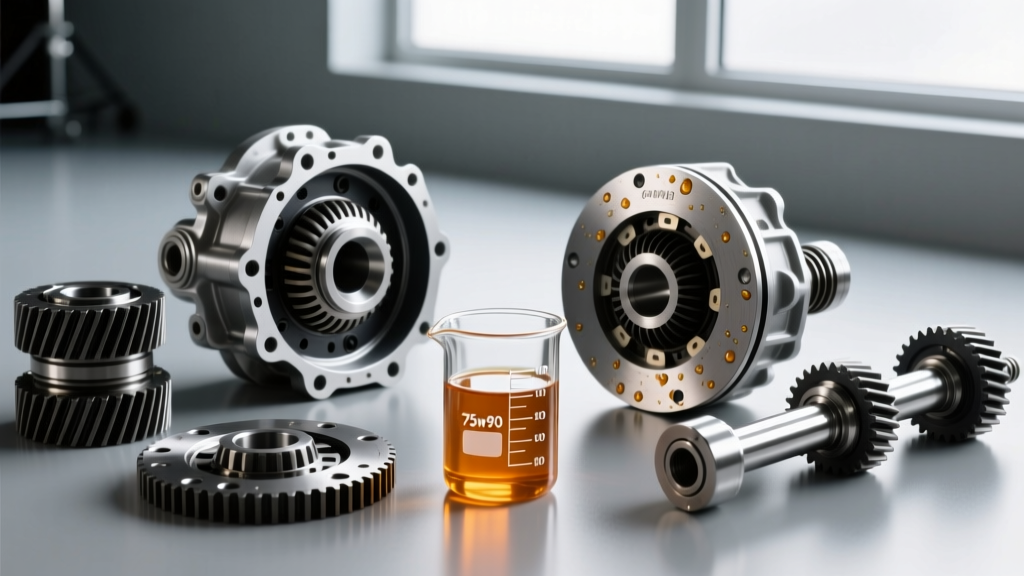
When enthusiasts and daily drivers alike approach the Subaru Outback rear differential fluid change, the focus is almost exclusively on the fluid itself. However, treating the rear differential merely as a sealed vessel for gear oil ignores a critical engineering reality: thermal management. The Subaru Symmetrical All-Wheel Drive system relies on a continuous rear driveshaft connection, meaning the rear ring and pinion are constantly under load, generating significant friction and heat.
In this technical deep-dive, we will explore the often-overlooked relationship between your differential cover design, ambient cooling efficiency, and the chemical stability of your gear oil. Whether you are towing a lightweight camper up a 6% grade or navigating stop-and-go traffic in high ambient temperatures, understanding the thermal limits of your Outback's rear axle is paramount to preventing catastrophic bearing and gear failure.
R160 vs. R190: Identifying Your Outback's Rear Differential
Before discussing cooling dynamics, you must identify which differential housing your Outback utilizes, as this dictates both fluid capacity and thermal mass:
- R160 Differential: Standard on 2.5L (FB25) naturally aspirated models. Features a 160mm ring gear. The smaller housing holds less fluid, meaning it has a lower thermal buffer and reaches critical temperatures faster under heavy load.
- R190 Differential: Found on 3.6R (EZ36 H6) and 2.4T (FA24F XT/Onyx) models. Features a 190mm ring gear and a physically larger housing, offering slightly better passive heat dissipation and a larger fluid volume to absorb thermal energy.
Thermal Degradation: Why the Stock Differential Cover Falls Short
The stock rear differential cover on most non-Wilderness Outback trims is a smooth, stamped steel or basic cast aluminum pan. While cost-effective for manufacturing, smooth steel is a poor thermal conductor and lacks the surface area required for convective cooling. Furthermore, the rear differential sits in a relatively stagnant aerodynamic pocket behind the rear subframe, directly adjacent to the exhaust muffler and resonator.
According to Machinery Lubrication's technical analysis on gear oil oxidation, the base stocks in standard GL-5 gear oils begin to rapidly oxidize once temperatures exceed 250°F (121°C). For every 18°F (10°C) increase in temperature above this threshold, the oxidation rate doubles, effectively halving the oil's usable lifespan.
The Chemistry of GL-5 Heat Failure
Subaru recommends their Hyper-Fluid 75W-85 GL-5 (Part # SOA635040). This fluid relies on sulfur-phosphorus Extreme Pressure (EP) additives to protect the hypoid gear cut of the ring and pinion. When the differential cover fails to shed heat and internal temperatures spike past 270°F, these EP additives can thermally decompose. This not only strips the gears of their boundary lubrication protection but can also form corrosive sulfuric acids that attack the steel carrier bearings and rubber axle seals.
Cover Upgrades: Stamped Steel vs. Finned Aluminum
Upgrading to an aftermarket finned aluminum differential cover is one of the most effective mechanical interventions you can perform during a Subaru Outback rear differential fluid change. By replacing the stock pan with a 6061-T6 billet or cast aluminum cover featuring integrated cooling fins, you drastically alter the thermal dissipation profile of the axle.
| Parameter | Stock Stamped Steel Cover (R160) | Aftermarket Finned Aluminum Cover (R160) |
|---|---|---|
| Material Composition | Low-Carbon Stamped Steel | 6061-T6 Aerospace Aluminum |
| Thermal Conductivity | ~50 W/(m·K) | ~167 W/(m·K) |
| External Surface Area | ~450 sq cm | ~950 sq cm (with deep fins) |
| Avg. Temp Drop (Highway Load) | Baseline | -15°F to -22°F |
| Weight | 4.2 lbs | 2.6 lbs |
As noted in SAE Standard J308 regarding driveline lubricant viscosity and thermal shear, maintaining lower baseline temperatures ensures the 75W-85 fluid retains its kinematic viscosity, preventing the oil film from thinning out between the hypoid gear teeth during high-torque cornering or hill climbs.
Step-by-Step: Subaru Outback Rear Differential Fluid Change & Cooling Inspection
Performing the fluid change requires precision and an understanding of the thermal stress markers on your hardware. Here is the expert procedure for servicing the rear differential while evaluating its cooling health.
1. Preparation and Thermal Equilibrium
Drive the vehicle for 15-20 minutes to bring the gear oil up to operating temperature (approx. 140°F). Warm oil flows faster and suspends metallic particulates, ensuring a more complete drain. Safely lift and support the rear of the Outback on jack stands, ensuring the vehicle is perfectly level to achieve an accurate fill volume.
2. Drain and Magnetic Plug Analysis
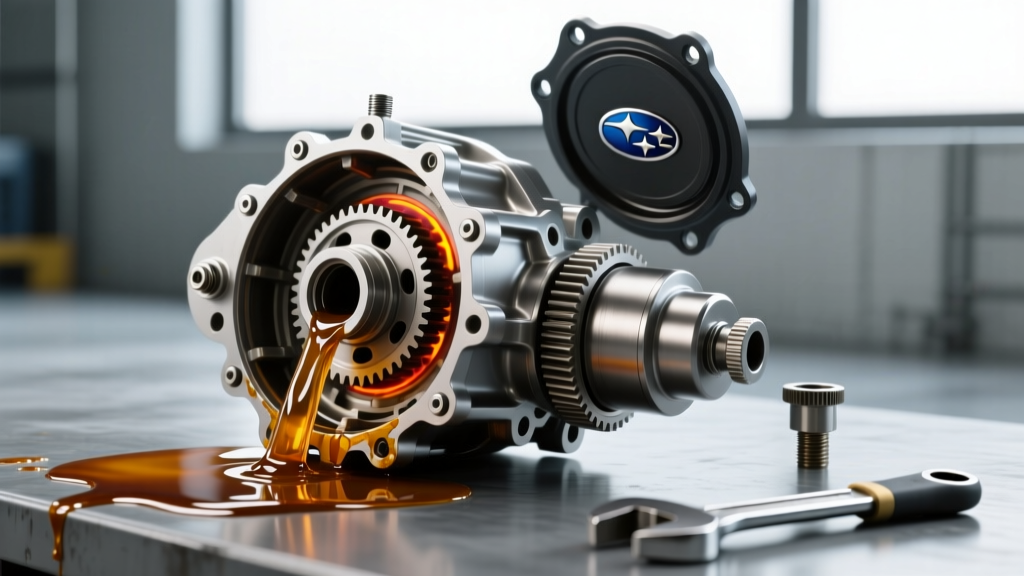
Using a 10mm hex key, remove the fill plug first. (Never remove the drain plug before confirming the fill plug is free; a stripped fill plug on an empty differential requires removing the entire cover to refill). Next, remove the drain plug. Inspect the magnetic tip of the drain plug:
- Normal: A fine, grey metallic paste. This is standard wear from the ring and pinion mating surfaces.
- Thermal Failure Indicator: The oil smells distinctly burnt (like sulfur or rotten eggs), and the magnetic plug holds large, jagged ferrous shards or bronze-colored flakes. This indicates boundary lubrication failure due to severe overheating, requiring immediate carrier bearing and seal inspection.
3. Differential Cover Inspection (If Upgrading)
If you are upgrading to a finned cooling cover, unbolt the 10mm or 12mm flange bolts securing the stock cover. Clean the mating surface on the differential housing with brake cleaner. Apply a 2mm bead of high-temperature RTV silicone (such as Permatex Ultra Black or Subaru Gear Oil RTV, Part # 04331141) to the new cover. Allow it to tack up for 10 minutes before mating.
4. Refilling to Exact Specifications
Using a fluid transfer pump, inject the specified 75W-85 GL-5 gear oil until it begins to weep from the fill hole. Reinstall both plugs and apply the exact torque specifications.
Torque Specs and Fluid Capacities Reference
- R160 Fluid Capacity: 0.84 US Quarts (0.8 Liters)
- R190 Fluid Capacity: 1.05 US Quarts (1.0 Liters)
- Drain Plug Torque: 33 ft-lbs (44 Nm)
- Fill Plug Torque: 33 ft-lbs (44 Nm)
- Cover Flange Bolt Torque (M8): 17 ft-lbs (23 Nm) in a crisscross star pattern
Diagnosing Heat-Related Gear Oil Failure in the Outback
Many Outback owners mistakenly attribute rear axle whine to gear wear, when in fact it is a symptom of thermal cavitation and oil starvation. When the stock differential cover allows internal temperatures to exceed the flash point of the gear oil's base stock, micro-bubbles form in the fluid. As these bubbles are crushed between the ring and pinion gears under load, they create microscopic pitting on the gear faces, leading to the characteristic 'howl' during deceleration.
By combining a rigorous Subaru Outback rear differential fluid change interval (every 30,000 miles for towing/severe use, or 60,000 miles for standard duty) with an upgraded finned aluminum cooling cover, you effectively eliminate this failure mode. For further insights into Subaru's AWD thermal engineering, refer to the official Subaru Symmetrical AWD engineering overview.
Expert Verdict: Is a Cooling Cover Worth the Investment?
If your Outback is strictly a grocery-getter in mild climates, the stock stamped cover and standard fluid change intervals are sufficient. However, if you frequently tow, carry heavy roof loads, drive in mountainous terrain, or own a 2.4T XT model that generates significant exhaust heat soak, upgrading the differential cover is a highly cost-effective insurance policy. A billet aluminum cooling cover costs between $80 and $150—a fraction of the $1,200 to $2,500 required to rebuild an R160 or R190 differential that has suffered heat-induced bearing and gear spalling.