The Symmetrical AWD Mystery: Where is the Transfer Case?
If you are a new Subaru owner preparing for your first major drivetrain maintenance, you have likely searched for a Subaru differential service guide and found yourself utterly confused. Traditional body-on-frame trucks like the Toyota Tacoma or Ford F-150 feature a distinct, heavy metal box bolted directly behind the transmission known as the transfer case. This box has its own dedicated drain and fill plugs, requiring separate gear oil. When you look under your Outback, Forester, or WRX, you will not find this standalone box.
This absence leads to a common point of confusion at quick-lube shops and dealership service desks. To properly service your Subaru's all-wheel-drive system, you must first understand how Subaru's legendary Symmetrical AWD system integrates the transfer case and the front differential into a single, unified housing. As we navigate the 2026 service landscape for everything from the standard Crosstrek to the rugged Outback Wilderness, understanding this mechanical relationship is the key to avoiding unnecessary upsells and ensuring your drivetrain survives the long haul.
The Anatomy of Symmetrical AWD: Longitudinal vs. Transverse
Most modern AWD crossovers (like the Honda CR-V or Toyota RAV4) utilize a transverse engine layout. The engine sits sideways, and power is sent to the rear wheels via a Power Take-Off (PTO) unit and a separate rear drive module. Subaru does things differently. Almost all Subaru vehicles utilize a longitudinal engine layout, meaning the engine is mounted front-to-back, in line with the transmission.
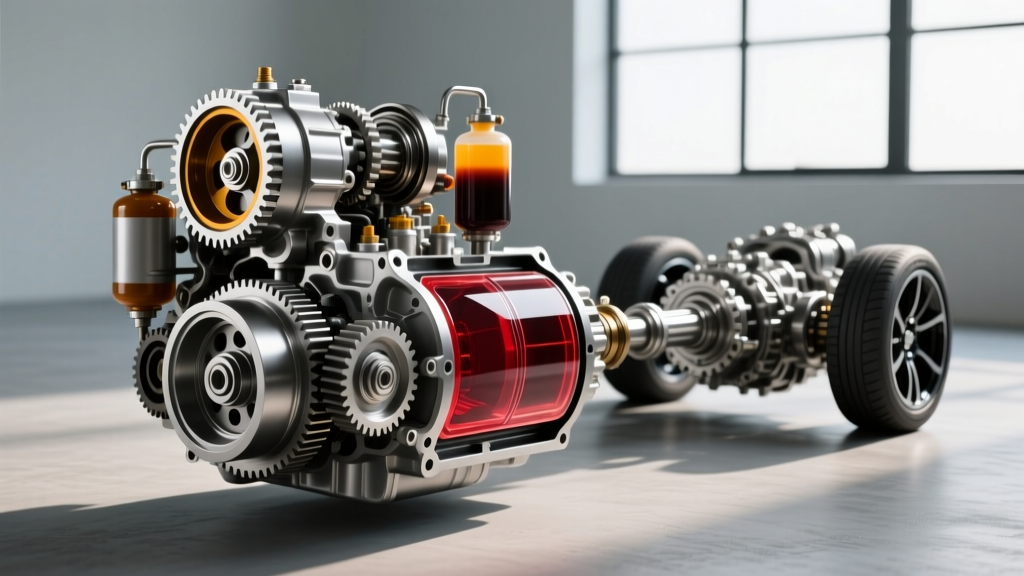
Because the engine and transmission are already aligned with the centerline of the vehicle, Subaru does not need a PTO or a chain-driven transfer case to redirect power 90 degrees. Instead, the 'transfer case' components—specifically the center differential or the AWD transfer clutch pack—are housed directly inside the rear extension housing of the transmission itself. Power flows straight back through the center differential, down the driveshaft, and into the rear differential. This straight-line power delivery minimizes parasitic loss and reduces vibration, but it completely changes how you approach fluid maintenance.
Manual vs. CVT/Automatic: How Fluid Routing Works
The most critical factor in your Subaru differential service is determining which transmission your vehicle has. The relationship between the transfer case, the front differential, and the fluid they share changes drastically between manual and automatic/CVT models.
The Manual Transmission Setup (5MT and 6MT)
If you drive a manual-equipped WRX, STI, or an older Forester, your front differential and your center differential (the transfer case) are both housed inside the main transmission casing. They share the exact same fluid. There is no separate 'transfer case fluid' or 'front differential fluid' to buy. A single drain and fill of the manual transmission case services the gearbox synchros, the front differential ring and pinion, and the center limited-slip or viscous coupling differential simultaneously.
- Fluid Type: 75W-90 GL-5 Gear Oil (e.g., Motul Gear 300 75W-90 or Red Line 75W90).
- Capacity: Approximately 3.5 to 4.0 liters, depending on whether you have the 5MT or the STI-spec 6MT.
The CVT and Automatic Setup (Lineartronic and 5EAT)
For the vast majority of modern Subarus on the road today, the vehicle is equipped with the Lineartronic CVT or a traditional automatic transmission. In these vehicles, the transfer clutch pack and the front differential are bathed in the exact same Automatic Transmission Fluid (ATF) or Continuously Variable Transmission Fluid (CVTF) as the rest of the transmission.
Therefore, there is no separate front differential or transfer case drain plug on a CVT Subaru. When you perform a CVT fluid drain and fill, you are inherently servicing the front differential and the AWD transfer clutches. The only separate differential fluid on a modern automatic Subaru is located in the rear differential.
2026 Subaru Drivetrain Fluid Capacity Chart
Use the following reference table to determine your exact service requirements. Always verify with your specific owner's manual, as slight variations exist between standard and 'Wilderness' trim levels.
| Vehicle / Transmission | Front Diff & Transfer Case | Rear Differential | Rear Diff Fluid Spec |
|---|---|---|---|
| WRX / STI (6MT) | Shared w/ Trans (~3.7L) | Separate (~0.8L) | 75W-90 GL-5 |
| BRZ / GR86 (RWD) | N/A (No Front Diff) | Separate (~1.2L) | 75W-90 GL-5 |
| Outback / Forester (CVT) | Shared w/ CVTF (~4-5L D&F) | Separate (~0.8L) | 75W-90 GL-5 |
| Ascent / Legacy (CVT) | Shared w/ High-Torque CVTF | Separate (~0.8L) | 75W-90 GL-5 |
Executing the Rear Differential Service: Step-by-Step
Since the rear differential is the only standalone gear-oil bath on modern automatic Subarus, mastering this service is essential. The rear differential contains the hypoid ring and pinion gears that make the final 90-degree turn to send power to your rear axles. Neglecting this fluid leads to catastrophic pinion bearing failure.
Tools and Parts Required
- Fluid: 1 Quart of 75W-90 GL-5 Synthetic Gear Oil (Subaru Extra-HP or equivalent).
- Hardware: Two new OEM aluminum crush washers. Part number 803918060 is standard for most 18mm/M18 drain and fill plugs, though some newer models use a 13mm hex bit without a washer. Always inspect your plug.
- Tools: 1/2-inch drive ratchet (or 13mm hex socket), fluid pump, torque wrench, and a wire brush.
The Service Procedure
- Level the Vehicle: The car must be perfectly level to ensure an accurate fill. Use a floor jack and jack stands on all four corners.
- Open the FILL Plug First: This is the golden rule of differential service. If you drain the fluid and then discover the fill plug is seized or stripped, your vehicle is stranded. The fill plug is located on the passenger side or front-facing side of the rear diff housing.
- Drain the Fluid: Remove the bottom drain plug. Allow the thick, dark gear oil to drain completely. Inspect the drain plug for large metal shards; a fine, glittery metallic paste on the magnet is normal wear, but chunks indicate gear or bearing failure.
- Clean and Reinstall Drain Plug: Clean the threads with a wire brush, install a new crush washer, and torque the drain plug to 44 lb-ft (60 Nm).
- Fill the Differential: Using a hand pump, fill the rear differential with fresh 75W-90 until the fluid begins to weep out of the fill hole. This typically takes about 0.8 Liters (approx. 27 oz).
- Seal the Fill Plug: Wipe the mating surface, install a new crush washer, and torque the fill plug to 44 lb-ft (60 Nm).
For a comprehensive database of Subaru fluid specifications and visual plug locations, enthusiast resources like Cars101's Subaru Fluid Guide remain an invaluable cross-reference for DIY mechanics.
Diagnosing Drivetrain Noise: Transfer Case vs. Rear Diff
Beginners often misdiagnose drivetrain whines, assuming a noisy rear differential when the issue actually lies in the integrated transfer case or front differential. Because the front diff and transfer clutches share the main transmission housing on CVTs, diagnosing them requires a keen ear.
The Coast-Down Test
To isolate a rear differential whine, perform a coast-down test on a quiet, safe road. Accelerate to 45 MPH, then take your foot off the gas and let the car coast in gear.
- Whine on Load (Accelerating): Typically indicates wear on the drive side of the ring and pinion gear teeth in the rear differential.
- Whine on Coast (Decelerating): Usually points to a failing rear differential pinion bearing or wear on the coast side of the hypoid gears.
- Whine that Changes with Steering: If the noise gets louder when turning left or right, the issue is almost certainly a worn rear axle wheel bearing, not the differential itself.
Torque Bind and Transfer Case Issues
If you experience a jerking sensation or 'torque bind' when turning tightly at low speeds (such as pulling into a parking space), the issue is rarely the rear differential. In manual Subarus, this indicates a failing center viscous limited-slip differential. In CVT models, it points to a degraded AWD transfer clutch solenoid or degraded CVTF that is causing the transfer clutches to drag. In these scenarios, a standard rear Subaru differential service will not fix the problem; a CVT fluid exchange and potentially a transmission pan drop to inspect the transfer clutch control valve body is required.
Final Thoughts on Maintenance Intervals
While Subaru's official severe maintenance schedule often recommends inspecting the rear differential fluid every 30,000 miles and replacing it at 60,000 miles, most independent Subaru specialists recommend a more conservative approach. If you frequently drive on unpaved roads, tow small trailers, or live in areas with extreme temperature fluctuations, performing a complete rear differential service every 30,000 miles is a cheap insurance policy against a $2,500 rear differential replacement. By understanding that your 'transfer case' is safely tucked inside your transmission, you can focus your DIY efforts exactly where they are needed: on the rear hypoid gears and the transmission fluid that keeps your Symmetrical AWD system perfectly balanced.