The Core Question: How Does a Stall Torque Converter Work?
If you have ever driven an automatic vehicle, you have relied on a torque converter, even if you never knew it was there. Unlike a manual transmission that uses a friction clutch to mechanically connect and disconnect the engine from the gearbox, an automatic transmission relies on a fluid coupling device. But for performance enthusiasts and tuners, the term 'stall torque converter' comes up frequently. So, how does a stall torque converter work, and why is it so critical to your vehicle's drivetrain dynamics?
At its most basic level, a torque converter transfers rotating power from the engine's crankshaft to the transmission's input shaft using automatic transmission fluid (ATF). It acts as a fluid pump, a torque multiplier, and, in modern applications, a mechanical lockup clutch. Understanding the fluid dynamics inside this sealed metal donut is the key to diagnosing drivetrain issues, selecting the right aftermarket upgrade, and maximizing your vehicle's performance.
Inside the Shell: The Four Main Components
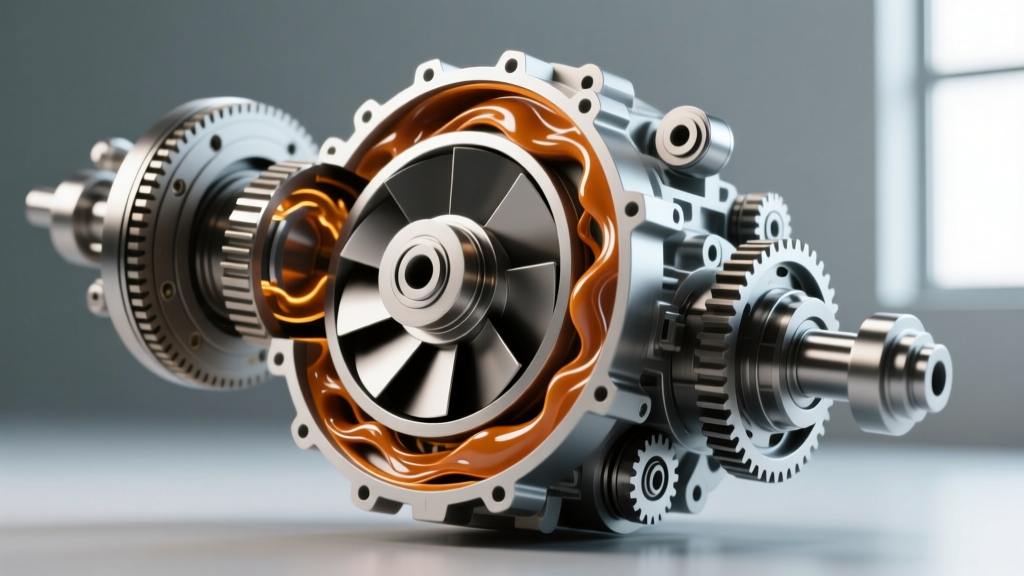
To understand stall speed and torque multiplication, you first need to know what is happening inside the converter's welded steel housing. According to Sonnax Tech Resources, there are four primary internal components working in perfect harmony:
- The Impeller (Pump): This is bolted directly to the converter cover, which is bolted to the engine's flexplate. As the engine spins, the impeller spins. Its internal vanes grab the ATF and fling it outward using centrifugal force, creating a high-pressure fluid stream.
- The Turbine: Sitting directly opposite the impeller, the turbine is splined to the transmission's input shaft. The high-pressure fluid thrown by the impeller crashes into the turbine's vanes, forcing it to spin and ultimately driving the wheels.
- The Stator: This is the secret weapon of the torque converter. Located in the center between the impeller and turbine, the stator sits on a one-way clutch. Its job is to redirect the returning fluid back into the impeller, multiplying torque and preventing the fluid from fighting the impeller's rotation.
- The Torque Converter Clutch (TCC): In modern vehicles, a friction clutch pack is housed inside the converter. When engaged by the transmission control module (TCM), it mechanically locks the turbine to the impeller, eliminating fluid slip and vastly improving fuel economy at highway speeds.
What Exactly is 'Stall Speed'?
When enthusiasts ask how a stall torque converter works, they are usually referring to the 'stall speed' rating. Stall speed is defined as the maximum RPM the engine can achieve when the transmission is in gear, the output shaft is held completely stationary (brakes locked), and the throttle is wide open (WOT).
It is a common misconception that a '3000 RPM stall converter' will make your car feel like it is slipping or revving to 3000 RPM during normal daily driving. In reality, a higher stall converter simply allows the engine to rev higher into its powerband before the fluid coupling becomes tight enough to launch the vehicle. As detailed by HowStuffWorks Auto, this fluid slip generates immense heat but allows a highly modified engine (with a narrow powerband or a large camshaft) to launch at an RPM where it is already making peak torque.
Real-World Stall Speed Comparison Chart
| Application | Transmission | Stock Stall (RPM) | Performance Stall (RPM) | Torque Multiplication |
|---|---|---|---|---|
| Daily Driver / Commuter | GM 4L60E | 1,500 - 1,800 | 2,200 - 2,400 | 1.8:1 to 2.0:1 |
| Heavy Towing / Hauling | Ford 6R80 | 1,600 - 1,900 | 2,000 - 2,200 | 2.0:1 |
| Drag Racing / Bracket | TH400 (Aftermarket) | N/A | 3,500 - 5,500 | 2.4:1 to 2.8:1 |
| Pro-Touring / Street | ZF 8HP70 | 1,800 - 2,100 | 2,800 - 3,200 | 2.1:1 |
Torque Multiplication: The Magic of the Stator
A manual clutch transfers torque at a 1:1 ratio. If your engine makes 400 lb-ft of torque, the transmission input shaft receives exactly 400 lb-ft. A torque converter, however, can multiply torque. When you launch from a dead stop, the speed difference between the impeller and the turbine is massive. The stator's one-way clutch locks up, and its angled vanes redirect the returning ATF so that it strikes the back of the impeller vanes, essentially giving the impeller a 'push' in the direction it is already spinning.
This hydraulic leverage results in a torque multiplication ratio typically between 2.0:1 and 2.5:1. If your engine produces 300 lb-ft of torque at launch, a 2.2:1 torque converter will feed roughly 660 lb-ft of torque into the transmission's input shaft. This is why automatic vehicles often feel punchier off the line than their manual counterparts.
The Torque Converter Clutch (TCC) and Modern Efficiency
Fluid slip is great for launching and multiplying torque, but it is terrible for fuel economy and highway cruising temperatures. To solve this, engineers introduced the Torque Converter Clutch (TCC). When the vehicle reaches a steady cruising speed (usually above 35-45 mph), the TCM commands a solenoid to apply a friction clutch inside the converter, mechanically locking the engine to the transmission.
In modern 8-speed and 10-speed transmissions like the ZF 8HP and the Ford/GM 10R80/10L90, the TCC is rarely just 'on' or 'off'. These units utilize highly advanced Pulse Width Modulation (PWM) solenoids to apply the TCC progressively. This allows the converter to remain in a state of 'controlled micro-slip' across multiple gears, absorbing engine vibrations (especially in V8s with cylinder deactivation) while maintaining near-perfect mechanical efficiency.
Recognizing Torque Converter Symptoms and Failures
Because the torque converter is a wear item subjected to extreme hydraulic pressure and friction, recognizing the symptoms of failure early can save your transmission. Common torque converter symptoms include:
- TCC Shudder: Often described as driving over a rumble strip at 40-55 mph. This happens when the TCC friction material is worn or the ATF has lost its friction-modifying additives, causing the clutch to rapidly grab and release.
- Overheating and Burnt Fluid: If the internal stator clutch fails and the stator freewheels in both directions (or locks in both directions), the converter will generate massive amounts of heat, boiling the ATF and turning it a dark, burnt-smelling brown.
- Metal Debris in the Pan: A failing needle bearing between the stator and the turbine will shed shiny metal flakes into the transmission pan. If caught early, a converter replacement and flush can save the gearbox. If ignored, that metal circulates through the valve body and destroys the clutch packs.
Installation Specs and Upgrade Costs
If you are upgrading to a performance stall converter from manufacturers like Circle D Specialties or Yank Performance, precision during installation is non-negotiable. According to Circle D Specialties Tech Info, improper installation is the leading cause of premature converter and transmission pump failure.
Critical Installation Specifications:
- Flexplate-to-Converter Clearance: When the transmission is fully seated against the engine block, the gap between the flexplate and the converter mounting pads must be exactly 1/8-inch to 3/16-inch (3.1mm to 4.7mm). If the gap is too tight, you will crush the transmission front pump. If it is too wide, the flexplate will bend and crack when you tighten the bolts.
- Bolt Torque: Use only Grade 8 or OEM-equivalent flanged bolts. For most GM applications using M10 bolts, the torque spec is 35 to 45 lb-ft. Always apply a medium-strength threadlocker (like Loctite 242) to prevent the bolts from backing out under high-RPM centrifugal force.
- Fluid Capacity and Type: A standard GM 4L60E holds roughly 11.5 quarts of Dexron VI, with the torque converter itself accounting for 4 to 5 quarts of that capacity. Always pre-fill a new, dry aftermarket converter with at least 2 quarts of ATF before starting the engine to prevent instant pump cavitation and dry-start damage.
Pricing Expectations: A stock replacement torque converter for a daily driver typically ranges from $250 to $450. High-performance, billet-front, furnace-brazed aftermarket stall converters designed to handle 800+ horsepower generally cost between $900 and $1,600, depending on the complexity of the internal stator and TCC clutch materials.
Final Thoughts
Understanding how a stall torque converter works bridges the gap between basic automotive maintenance and advanced drivetrain tuning. Whether you are diagnosing a frustrating TCC shudder on your morning commute or selecting a 3200-RPM flash stall converter for your weekend track car, respecting the fluid dynamics, clearances, and thermal limits of this incredible component is the key to reliable, effortless power delivery.