The Physics of Clutch Horsepower Ratings
When building a high-performance drivetrain, relying solely on marketing terms like "Stage 3" or "Stage 4" is a recipe for catastrophic mechanical failure. As we navigate the 2026 aftermarket landscape, the clutch horsepower rating guide has shifted from peak horsepower metrics to sustainable torque capacity (lb-ft) and thermal management. Horsepower is merely a mathematical function of torque and RPM. A clutch assembly rated for "1,200 HP" might slip violently at 650 lb-ft of torque if that horsepower figure was calculated at 7,500 RPM. For serious builders, understanding the friction coefficient, clamp load, and the structural integrity of the outer drum—often referred to in extreme drag and standing-mile applications as the stage6 clutch bell—is non-negotiable.
Friction materials dictate the bite and thermal threshold, but the physical housing that contains those discs determines whether the assembly survives a 4,000 RPM transbrake dump. This guide breaks down the exact specifications, torque capacities, and installation protocols required to match your engine output to the correct multi-disc clutch and bellhousing configuration.
Model-Specific Focus: SN95 Mustang T56 Magnum Swap
The 1996–2004 Ford Mustang (SN95/New Edge) platform remains one of the most popular candidates for high-horsepower Coyote or built 4.6L Modular V8 swaps. When pushing these chassis past the 800 WHP threshold, the factory TR-3650 or T-45 transmission must be swapped for a Tremec T56 Magnum. This swap introduces critical bellhousing alignment challenges and demands a multi-disc clutch setup capable of handling 900+ lb-ft of torque without destroying the transmission's input shaft.
The factory Mustang bellhousing is cast aluminum and prone to deflection under extreme clamp loads. When upgrading to a competition-grade clutch, you must replace the factory housing with an SFI-approved aftermarket unit. Furthermore, the clearance inside the T56 Magnum's input shaft area requires precise flywheel step measurements. A standard 26-spline input shaft will twist and shear if paired with a high-clamp-load ceramic disc without the proper rotational mass buffering provided by a heavy-duty billet steel flywheel.
Matching the Stage6 Clutch Bell and Friction Materials
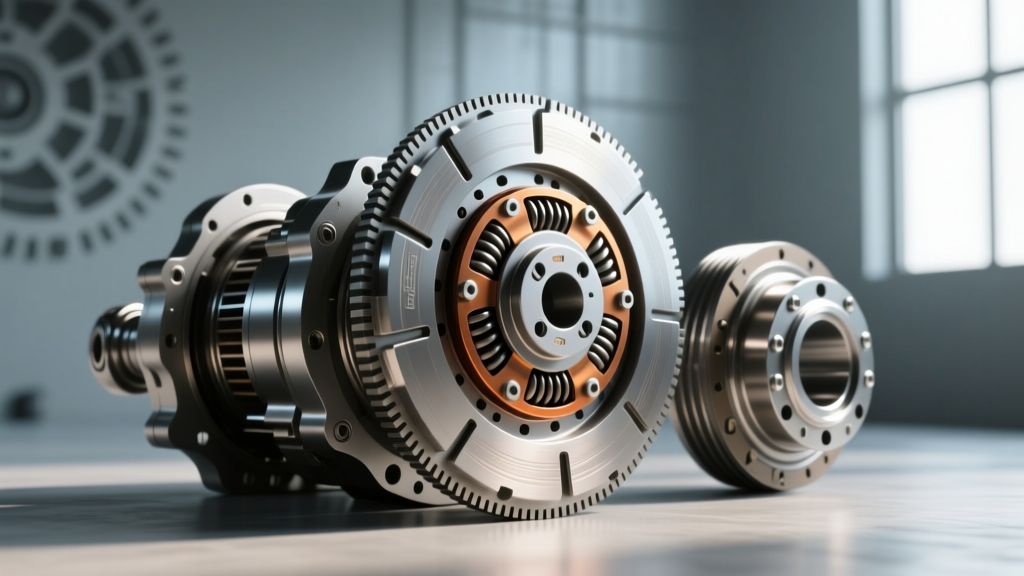
In extreme 1,000+ HP applications, racers often upgrade to a multi-plate sintered iron setup housed within a reinforced outer drum. In racing circles, this heavy-duty, centrifugal-load-bearing outer basket is frequently designated as a stage6 clutch bell. Unlike standard organic or Kevlar discs that use a stamped steel cover, a true competition multi-disc setup utilizes a billet steel or forged aluminum clutch bell to contain the sintered friction plates. This prevents the outer drum from fracturing under the immense rotational inertia generated during hard launches.
Sintered iron provides a coefficient of friction (COF) between 0.35 and 0.45, significantly higher than organic materials (0.25 COF). However, sintered iron requires immense heat to operate efficiently and will shatter a lightweight aluminum flywheel if the driver does not slip the clutch adequately during street-speed takeoffs. The stage6 clutch bell assembly is designed specifically to handle the abrasive nature of sintered metallic dust, featuring hardened inner splines that resist the "galling" that typically destroys standard stamped steel pressure plates.
The 2026 Clutch Horsepower Rating Matrix
Below is a definitive clutch horsepower rating guide tailored for modern V8 and forced-induction platforms. Note that pedal effort increases exponentially as you move toward sintered and multi-disc configurations. Always base your purchase on the torque rating at the crank, not the peak horsepower number.
| Clutch Tier | Friction Material | Disc Count | Torque Capacity (lb-ft) | HP Rating (Crank) | Pedal Effort |
|---|---|---|---|---|---|
| Stage 2 | Kevlar / Organic Blend | Single | 450 - 550 | ~600 HP | OEM + 15% |
| Stage 4 | Full Ceramic (Puck) | Single | 650 - 800 | ~850 HP | OEM + 40% |
| Stage 5 | Twin-Disc Organic/Ceramic | Twin | 850 - 1,000 | ~1,100 HP | OEM + 25% |
| Stage 6 (Race) | Triple-Disc Sintered Iron | Triple | 1,200 - 1,600+ | 1,500+ HP | OEM + 80% |
Note: HP ratings assume a 6,500 RPM peak. If your engine makes peak torque at 3,500 RPM (common in supercharged and turbo-diesel applications), you must over-spec your clutch tier by at least one level to account for the low-RPM torque spike.
Precision Installation: Torque Specs & Bellhousing Alignment
Installing a high-horsepower multi-disc clutch requires surgical precision. The McLeod Racing and SFI Foundation guidelines dictate that any vehicle running slicks and producing over 600 HP must utilize an SFI 1.1 or 1.2 certified bellhousing. This isn't just for safety in the event of a clutch explosion; it ensures the housing does not flex under the 3,000+ lbs of clamp load generated by a stage6 clutch bell assembly.
Critical Torque Specifications (T56 Magnum / LS/Modular V8)
- Flywheel to Crankshaft (ARP 3/8" Bolts): 85 ft-lbs using Red Loctite 262. Do not use standard hardware store washers; use the specific ARP hardened washers to prevent bolt head pull-through.
- Clutch Disc Alignment: Use a billet aluminum alignment tool that matches the exact 26-spline input shaft diameter (1.125"). Plastic tools will warp and cause binding.
- Pressure Plate / Clutch Bell to Flywheel: 35 ft-lbs in a strict star pattern. Torque in three progressive steps (15 ft-lbs, 25 ft-lbs, 35 ft-lbs) to ensure the diaphragm springs seat evenly without warping the cover.
- Bellhousing to Engine Block: 35-40 ft-lbs. Ensure all locating dowels are present. Missing dowels will cause the transmission to hang on the input shaft, leading to premature bearing failure.
- Driveshaft to Pinion Flange (12mm 12-point bolts): 110 ft-lbs with a drop of blue Loctite.
Dial Indicating the Bellhousing
Before tightening the bellhousing to the block, you must measure the Total Indicator Runout (TIR) of the bellhousing bore relative to the crankshaft centerline. Mount a magnetic base dial indicator to the rear of the crankshaft or flywheel. Rotate the assembly 360 degrees. The maximum allowable TIR for a Tremec T56 Magnum is 0.005 inches. If your runout exceeds this, the input shaft will wobble, destroying the front main bearing and causing severe clutch chatter. Use offset dowel pins (available in 0.007", 0.014", and 0.021" increments) to correct the alignment.
Hydraulic Throwout Bearing (HTOB) Setup
High-clamp-load multi-disc clutches require immense hydraulic pressure to disengage. The factory Mustang cable clutch system is entirely inadequate for a stage6 setup. You must convert to a hydraulic throwout bearing system. When setting up the HTOB, the air gap between the bearing face and the pressure plate diaphragm fingers must be exactly 1/8" to 3/16" when the clutch is fully engaged. If the bearing rides constantly on the fingers, it will overheat and fail within 500 miles. Use a -4 AN braided stainless feed line and a 3/4" bore master cylinder to ensure adequate fluid volume and rapid pedal return.
Troubleshooting Slippage and Deflection
If your newly installed high-horsepower clutch slips under boost, the issue is rarely the friction material itself. In 90% of cases, slippage in a multi-disc setup is caused by bellhousing deflection or improper flywheel step. When a non-SFI stamped steel bellhousing is subjected to 2,500 lbs of clamp load, the housing literally bows backward. This bowing pulls the pressure plate away from the flywheel, reducing the effective clamp load on the friction discs and resulting in violent slippage.
Additionally, verify the "step" of your flywheel. The step is the difference in height between the friction surface and the pressure plate mounting surface. If a machine shop resurfaces your flywheel but fails to maintain the exact factory step (usually between 0.400" and 0.550" depending on the manufacturer), the diaphragm springs will be pre-loaded incorrectly. A step that is too shallow will result in a clutch that will not fully disengage, while a step that is too deep will cause the clutch to slip even when the pedal is fully released. Always measure the step with a digital micrometer before assembling the stage6 clutch bell and discs.