Navigating the 2026 Automotive Clutch Slave Cylinder Market
The landscape of manual and automated-manual transmissions has shifted dramatically over the last decade. As we analyze the 2026 automotive clutch slave cylinder market, it is clear that the industry has heavily pivoted toward Concentric Slave Cylinders (CSC) and integrated release bearings to handle the immense torque outputs of modern internal combustion engines. Whether you are diagnosing a failing hydraulic circuit on a Dodge Challenger Hellcat or sourcing replacement components for a Honda Civic Si, understanding the precise symptoms of slave cylinder degradation is critical for accurate drivetrain repair.
This comprehensive buyer's guide and diagnostic manual cuts through the noise, providing transmission specialists and advanced DIYers with exact part numbers, torque specifications, and market pricing to make informed purchasing decisions.
Definitive Diagnostic Matrix: Clutch Slave Cylinder Symptoms
Hydraulic clutch systems operate under immense pressure, often exceeding 1,200 PSI during aggressive pedal actuation. When the slave cylinder begins to fail, the symptoms can mimic master cylinder issues or mechanical linkage binding. Use the diagnostic matrix below to isolate the exact failure point.
| Symptom | Probable Failure Point | Design Type | Diagnostic Verification |
|---|---|---|---|
| Pedal sinking to floor under constant pressure | Internal seal bypass / Bore scoring | CSC & External | Clamp hard-line; if pedal holds, master is suspect. If it sinks, slave is bypassing. |
| Incomplete gear engagement (grinding into 1st/Reverse) | Fluid volume loss / Air ingress | Primarily CSC | Measure pushrod travel. Less than 18mm indicates hydraulic volume loss. |
| External weeping / Wet bellhousing inspection cover | PTFE seal blowout / Boot saturation | CSC & External | UV dye in DOT 4 fluid; inspect bellhousing drain plug for hydraulic fluid. |
| Clutch chatter upon release / Throwout bearing noise | Preload loss / Eccentric wear on CSC | CSC | Stethoscope on bellhousing; noise changes with RPM but not vehicle speed. |
The CSC vs. External Slave Dilemma
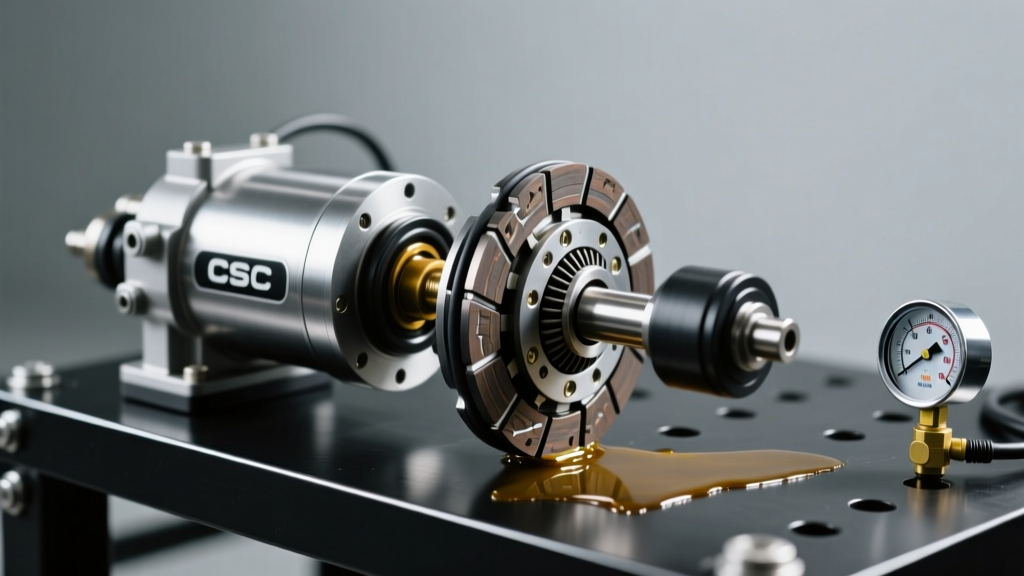
Modern performance vehicles—such as those equipped with the Tremec T56 Magnum or the ZF S6-650—rely almost exclusively on Concentric Slave Cylinders. A CSC wraps around the transmission input shaft, combining the slave cylinder and throwout bearing into a single unit. While this reduces rotational mass and improves pedal feel, a single internal seal failure requires complete transmission removal.
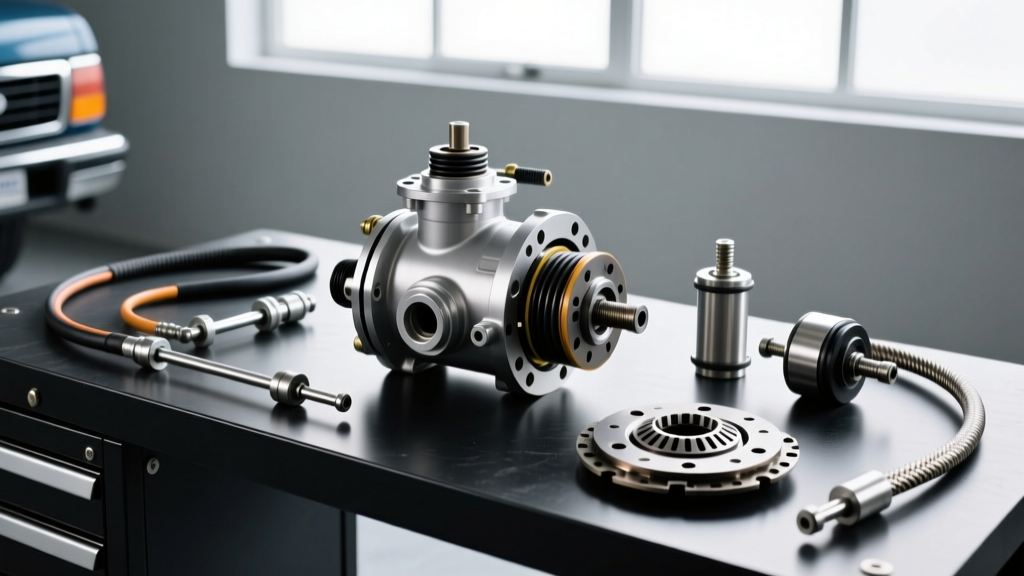
Conversely, external slave cylinders, still prevalent in FWD platforms like the Honda K-Series or older Nissan CD009 applications, mount to the exterior of the bellhousing. They are significantly cheaper to replace but are more prone to pushrod pivot wear and external corrosion.
Buyer’s Guide: OEM vs. Aftermarket Replacements
When sourcing components from the automotive clutch slave cylinder market, avoiding cheap, unbranded overseas castings is paramount. Premature bore scoring in substandard aluminum bodies will destroy your clutch hydraulic system within 5,000 miles. We recommend sticking to Tier-1 OEM suppliers such as ZF SACHS, FTE Automotive, LuK, and Aisin.
Top-Tier Part Numbers & Market Pricing (2026)
- GM 6.2L / Tremec TR-6060 (CSC): SACHS Part #3182 600 103. This unit features an integrated wear-compensation mechanism. Market Price: $135 - $165.
- Nissan 370Z / G37 CD009 (CSC): FTE Automotive Part #KN19035.4.3. Known for high-temperature PTFE seals that resist boiling DOT 4 fluid. Market Price: $170 - $210.
- Honda Civic Si / K20C1 (External): Aisin Part #CRT-011. Features a hardened steel pushrod to prevent pivot ball galling. Market Price: $40 - $60.
- Ford Mustang GT / MT-82 (CSC): LuK Part #LSC115B. Includes the vital quick-connect hydraulic line fittings. Market Price: $110 - $140.
Expert Warning: Never reuse the old hydraulic hard-line or quick-connect fittings when replacing a CSC. The internal O-rings in the quick-connectors degrade and will cause micro-leaks under high-frequency pedal pumping. Always purchase the updated line assembly.
Installation & Torque Specifications
Proper installation of a slave cylinder requires strict adherence to torque specifications to prevent bellhousing misalignment or hydraulic fitting blowouts. Below are standard specifications for common performance applications:
Tremec T56 Magnum / TR-6060 Applications
- CSC to Bellhousing Mounting Bolts (M8x1.25): 15 - 18 lb-ft (20 - 24 Nm). Use medium-strength threadlocker.
- Hydraulic Line Banjo / Quick-Connect Fitting: 11 - 13 lb-ft (15 - 18 Nm). Over-torquing will crack the plastic quick-connect collar.
- Transmission to Engine Bellhousing Bolts: 35 - 45 lb-ft (47 - 61 Nm). Ensure the alignment dowels are fully seated before tightening to prevent input shaft binding.
Fluid Selection: DOT 4 LV vs. DOT 5.1
The modern automotive clutch slave cylinder market demands specific fluid viscosities. For vehicles equipped with ABS-integrated hydraulic circuits or rapid-shift solenoids, DOT 4 LV (Low Viscosity) or Bosch ESI6 is mandatory. Standard DOT 3 or thick DOT 5.1 can cause sluggish pedal return in sub-freezing temperatures. Never use DOT 5 (Silicone-based), as it is highly compressible and will result in a permanently spongy clutch pedal.
Advanced Bleeding Protocols for Concentric Slaves
Bleeding a Concentric Slave Cylinder is notoriously difficult due to its inverted position inside the bellhousing, which traps air at the highest point of the hydraulic circuit. Traditional gravity bleeding is rarely sufficient for modern CSCs.
The Reverse-Bleed Method
For stubborn air pockets in ZF and SACHS CSC units, reverse bleeding is the industry standard. Using a large 60cc syringe and a length of clear polyurethane tubing, inject fresh DOT 4 LV fluid upward through the slave cylinder bleeder valve (or quick-connect port) and push the air back up into the master cylinder reservoir.
- Extract all old fluid from the master cylinder reservoir.
- Attach the syringe to the slave bleeder valve.
- Slowly inject 30-50cc of fluid while monitoring the reservoir for air bubbles.
- Once clear fluid reaches the reservoir, close the valve and pump the clutch pedal 20 times to seat the internal seals.
Conclusion
Understanding clutch slave cylinder symptoms and knowing how to navigate the 2026 automotive clutch slave cylinder market separates professional-grade drivetrain work from amateur guesswork. By investing in Tier-1 OEM components from manufacturers like ZF Group and FTE Automotive, adhering to precise torque specs, and utilizing reverse-bleeding techniques, you ensure a crisp, reliable pedal feel capable of handling modern high-torque powertrains. For further technical documentation on manual transmission integration, consult the engineering resources at Tremec.