The Architecture of Hydraulic Clutch Diagnosis
When a driver experiences a spongy pedal, gear crunching, or an inability to disengage the transmission, the immediate assumption often points to the master cylinder. However, accurately identifying clutch master cylinder symptoms versus slave cylinder failures requires a deep understanding of the specific hydraulic architecture at play. In 2026, with shop labor rates frequently exceeding $150 per hour, misdiagnosing a failing Concentric Slave Cylinder (CSC) as a faulty master cylinder can result in unnecessary parts swapping and hundreds of dollars in wasted diagnostic time.
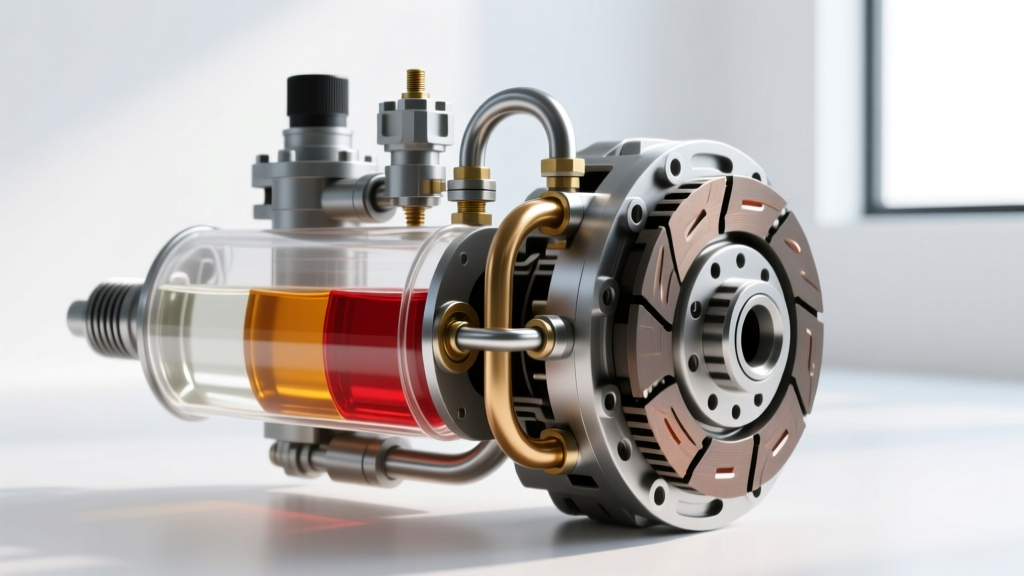
The hydraulic clutch system is a closed-loop fluid displacement network. The master cylinder converts mechanical pedal force into hydraulic pressure, while the slave cylinder converts that pressure back into mechanical movement to actuate the clutch fork or diaphragm spring. Because both components rely on dynamic internal cup seals, their failure modes often overlap. To troubleshoot effectively, we must segment our diagnostic approach based on the two primary slave cylinder types: External Push-Type and Concentric Slave Cylinders (CSC).
Baseline Clutch Master Cylinder Symptoms
Before isolating the slave configuration, establish the baseline symptoms that almost exclusively point to the master cylinder (typically located on the firewall). According to technical bulletins from Schaeffler (LuK), the master cylinder is the primary suspect when you observe the following:
- External Fluid Weeping: Fluid dripping onto the driver's side footwell or running down the firewall exterior indicates a failed rear pushrod seal.
- Compensator Port Blockage: If the clutch slips under heavy load or high ambient temperatures, the master's compensator (replenishment) port may be clogged. As fluid heats up and expands, a blocked port prevents fluid from returning to the reservoir, effectively 'pre-loading' the clutch and causing premature wear.
- Pedal Sink Under Static Load: If you press the clutch pedal to the floor while in gear at a stoplight, and it slowly creeps upward or the car begins to pull forward, the master cylinder's internal primary cup seal is bypassing fluid internally.
Diagnostic Matrix: Master vs. Slave by Configuration
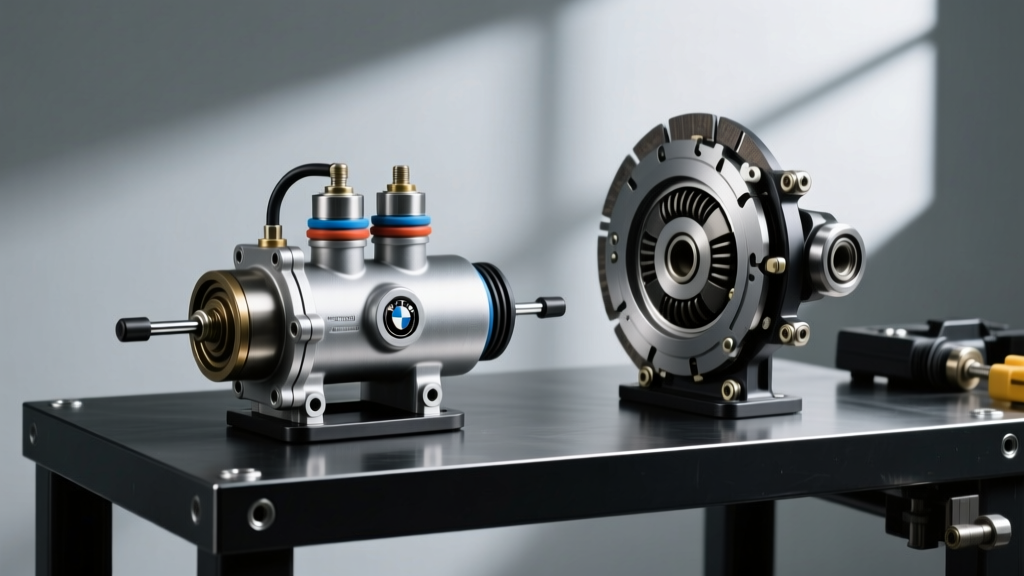
The following matrix helps isolate the failing component based on the specific slave cylinder type installed in the vehicle.
| Observed Symptom | Master Cylinder Fault | External Slave Fault | Concentric Slave (CSC) Fault |
|---|---|---|---|
| Spongy Pedal (No Leaks) | Internal seal bypass | Rare (usually external leak) | Internal bypass / Air trapped in CSC |
| Clutch Drag (Won't Disengage) | Blocked compensator port / Low stroke | Worn pivot ball / Bent fork | Collapsed internal return spring |
| Fluid Loss (Visible) | Firewall weeping / Reservoir crack | Boot tear / Piston seal failure at bellhousing | Internal bellhousing leak (Trans drip) |
| Pedal Vibration / Chatter | Collapsed firewall bracket | Loose mounting nuts | Worn CSC guide tube bearing |
Deep Dive: Troubleshooting External Slave Configurations
External slave cylinders are common on older platforms and specific modern performance applications, such as the C5/C6 Corvette or early Tremec T56 manual transmissions. They mount externally to the bellhousing and push a rod against the clutch fork.
The 'Line-Clamp' Isolation Test
If you suspect internal bypassing but see no external leaks, perform the line-clamp test. Using a specialized soft-jaw hose clamp, gently pinch the flexible hydraulic hose connecting the hard line to the external slave cylinder. Have an assistant press the clutch pedal.
- Result A: The pedal becomes rock-hard immediately. Diagnosis: The master cylinder is sealing perfectly; the issue lies downstream (likely air in the slave or a worn slave piston seal).
- Result B: The pedal still feels spongy or sinks. Diagnosis: The master cylinder's internal seals are bypassing fluid back into the reservoir.
Pushrod Travel and Air Gap Specifications
A frequent misdiagnosis occurs when a new clutch is installed, and the external slave pushrod does not have the correct air gap. For a standard Tremec T56 external slave setup, the pushrod should exhibit roughly 0.050 to 0.100 inches of free play before contacting the fork. If the pushrod is too long (no air gap), it acts like a foot resting on the brake pedal, causing the clutch to slip and mimicking a blocked compensator port symptom on the master cylinder. Always measure pushrod stroke; a healthy external slave should yield between 0.450'' and 0.550'' of total travel during a full pedal depression.
Deep Dive: Troubleshooting Concentric Slave Cylinders (CSC)
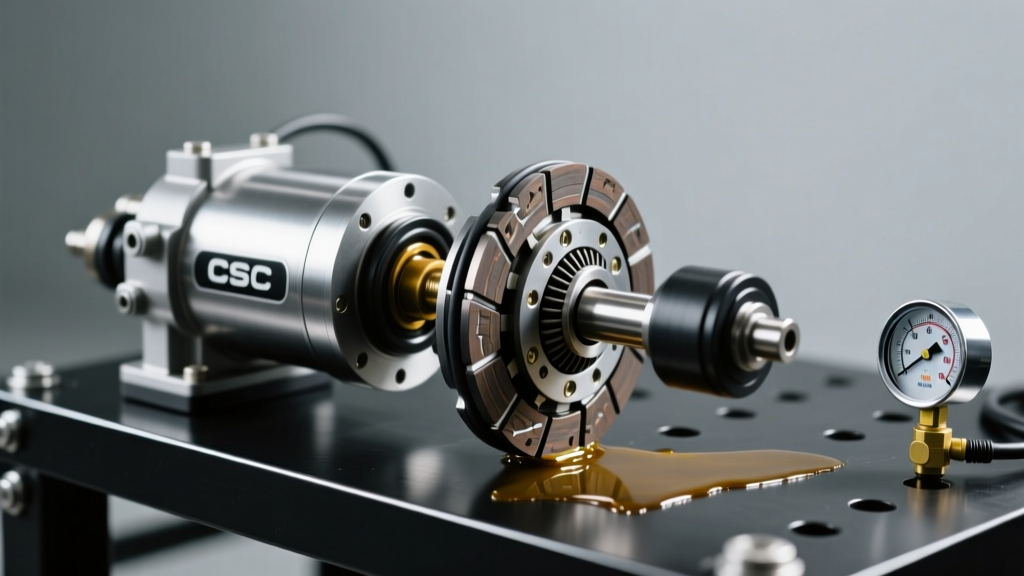
Concentric Slave Cylinders (CSC) wrap around the transmission input shaft and act directly on the diaphragm spring fingers. They are ubiquitous in modern manual vehicles, including the GM LS-platform Camaro (Tremec T56 Magnum), Ford Mustang GT (Getrag MT-82), and Porsche Cayman (ZF G50/G52 transaxles). Because the CSC lives inside the bellhousing, diagnosing it requires a different methodology.
The 'Drop-the-Trans' Tax and Internal Leaks
When a CSC fails, fluid leaks directly into the bellhousing. You will notice fluid dripping from the bottom bellhousing inspection cover, but the master cylinder reservoir will be empty. Do not replace the master cylinder first. According to Tremec Service Documentation, if the master cylinder shows no external firewall leaks and the reservoir is empty, a CSC failure is the primary suspect. In 2026, replacing a CSC (e.g., LuK LSC108 or Sachs SH5009) requires transmission removal. Expect parts to cost between $120 and $250, but labor will range from $900 to $1,600 depending on the chassis.
CSC Bearing and Guide Tube Wear
CSCs integrate a release bearing. A failing CSC often presents as a high-pitched squeal or grinding noise that changes pitch when the pedal is depressed. If the clutch master cylinder is pushing adequate volume (verified via the line-clamp test), but the clutch fails to disengage smoothly, the CSC's internal plastic guide sleeve may be galling against the aluminum or steel transmission input shaft sleeve. When installing a new CSC, always polish the guide tube with 600-grit sandpaper and apply a thin layer of high-temperature synthetic grease (e.g., Mobil 1 Synthetic Grease). Never over-grease, as excess grease can migrate to the clutch friction disc.
Torque Specifications for CSC Mounting
Improper torque on CSC mounting bolts leads to misalignment, causing premature seal wear and internal bypassing. For most M8x1.25 CSC mounting bolts (common on GM and Ford applications), the specification is strictly 18 to 22 lb-ft (25 to 30 Nm). Over-torquing can distort the CSC's plastic or cast-aluminum body, creating a microscopic path for fluid to bypass the piston seal under high hydraulic pressure.
Advanced Hydraulic Testing Procedures
When visual inspections and the line-clamp test yield inconclusive results, pressure testing the hydraulic circuit is mandatory.
- Reservoir Pressure Test: Attach a regulated shop air line set to exactly 20 PSI to the master cylinder reservoir using a modified clutch cap. If the master cylinder's internal seals are compromised, you will hear air hissing into the cabin near the pedal pushrod. If the CSC is leaking, you will hear hissing from the bellhousing.
- Volume Displacement Measurement: Disconnect the hydraulic line at the slave cylinder and route it into a graduated beaker. Have an assistant depress the pedal fully. A standard 5/8'' bore master cylinder should displace approximately 12 to 15 cc of fluid per stroke. If displacement is below 10 cc, the master cylinder bore is worn, or the pedal pushrod adjustment is too shallow, resulting in incomplete clutch disengagement (gear crunching on downshifts).
Fluid Selection and Bleeding Nuances
The type of fluid and bleeding method drastically affect how symptoms present post-repair. Always adhere to the OEM cap specification (usually DOT 3 or DOT 4). Never use DOT 5 (silicone-based) in a standard hydraulic clutch system, as its high compressibility will result in a permanently spongy pedal that mimics a failing master cylinder.
Expert Tip for 2026: Concentric Slave Cylinders are notorious for trapping air in the upper quadrant of the piston bore. Standard gravity bleeding or pedal-pumping rarely clears this air. Always use a reverse pressure bleeder to push fluid from the slave cylinder bleeder valve UP to the master cylinder reservoir. This forces trapped air out against its natural buoyancy, eliminating phantom 'spongy pedal' symptoms that lead technicians to falsely condemn a brand-new master cylinder.
By understanding the distinct mechanical and hydraulic differences between external slaves and CSCs, technicians and DIYers can accurately isolate true clutch master cylinder symptoms from downstream slave failures, saving immense time and avoiding unnecessary transmission removals. For further hydraulic architecture schematics, refer to the ZF Friedrichshafen Drivetrain Guides and OEM service portals.