The Thermodynamics of PTO Clutch Burnout
When operating a commercial zero-turn mower like a Scag Patriot, Tiger Cub, or Cheetah, the Power Take-Off (PTO) clutch is the critical electromechanical link between the engine crankshaft and the mower deck. If you detect a distinct, acrid burning smell emanating from beneath the engine block, you are witnessing the thermal degradation of phenolic resin binders and friction materials. Ignoring this symptom will inevitably lead to a complete loss of blade engagement, leaving you stranded on a commercial job site.
Unlike manual automotive clutches that rely on pedal modulation, or automatic transmission clutch packs that operate in a bath of lubricating fluid, the Scag PTO clutch is a binary, dry-friction electromagnetic device. It is either fully locked or fully slipping. There is no middle ground. When the clutch slips under load, kinetic energy is converted directly into intense surface heat, rapidly destroying the armature and rotor faces.
Automotive Wet Clutches vs. Electromagnetic Dry PTOs
To understand the severity of a PTO clutch burnout, it helps to compare it to automotive drivetrain dynamics. In a GM 4L60E transmission, the 3-4 clutch pack utilizes cellulose and Kevlar friction plates submerged in Dexron VI fluid. The fluid acts as both a lubricant and a thermal sink, carrying heat away to the transmission cooler. Similarly, the ZF 8HP mechatronic unit uses precisely modulated pressure control solenoids to manage micro-slip during shifts without overheating the clutch linings. Even the heavy-duty torque converter clutch (TCC) lining in a 6L80 relies on continuous fluid exchange to survive lockup.
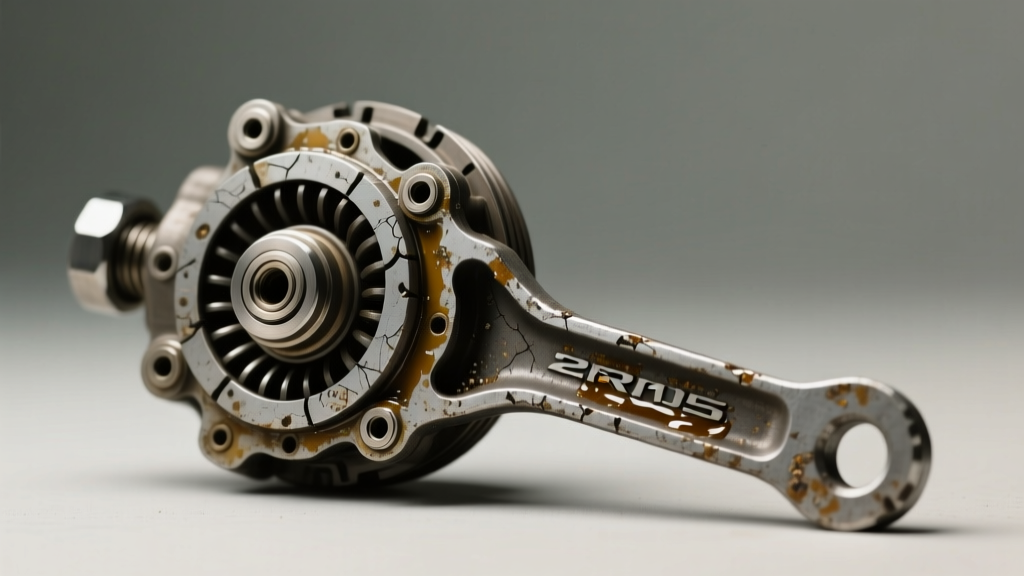
A Scag PTO clutch—typically manufactured by Ogura or Warner—has no such thermal relief. It relies entirely on ambient airflow and the mass of its steel rotor to dissipate heat. When the air gap is incorrect, or the mower deck is bound up, the magnetic field cannot fully clamp the armature. The resulting micro-slipping generates temperatures exceeding 400°F (204°C) in seconds, baking the friction material and producing that unmistakable burning odor. According to Ogura Industrial Clutch specifications, sustained slipping will permanently alter the metallurgical grain structure of the armature, leading to warping and irreversible failure.
4 Root Causes of a Burning Scag PTO Clutch
- Incorrect Air Gap (The Primary Culprit): As the friction material naturally wears down over hundreds of hours, the gap between the rotor and the armature widens. If this gap exceeds 0.020 inches, the electromagnet lacks the field strength to pull the armature into a hard lock. The clutch engages, but it slips continuously under the heavy inertial load of the mower blades, generating massive heat.
- Charging System Voltage Drop: An electromagnetic PTO clutch requires a minimum of 12.2 volts under load to generate maximum clamping force. If the Scag's stator, voltage regulator, or wiring harness is degraded, voltage at the PTO pigtail may drop to 10.5V or lower. This weakens the magnetic field, causing the clutch to slip even if the air gap is perfectly set.
- Deck Spindle Binding & Belt Over-tensioning: If a mower deck spindle bearing is seized, or if the deck belt is routed incorrectly and overtightened, the rotational resistance exceeds the clutch's designed torque capacity (typically 100 to 150 ft-lbs for commercial units). The engine forces the rotor to spin while the armature and blades lag behind, creating a severe friction burn.
- Operator Error (Riding the PTO): Engaging the PTO at full wide-open throttle (WOT) forces the clutch to absorb the entire inertial shock of spinning up heavy laminated steel blades from a dead stop. This violent engagement causes momentary but intense slipping, glazing the friction surfaces and producing a burning smell.
Diagnostic Workflow: Isolating the Thermal Fault
Before ordering a replacement clutch, you must isolate whether the burning smell is caused by a mechanical adjustment issue, an electrical fault, or a physical deck failure. Referencing the Scag Power Equipment Parts Manuals for your specific chassis model will help you identify whether you have a Warner or Ogura unit.
Phase 1: Electrical Load & Coil Testing
Do not rely on a simple battery voltage check. You must test the circuit under load.
- Set your digital multimeter to DC Volts and back-probe the PTO clutch connector while the engine is running at half-throttle and the PTO is engaged.
- You must read a minimum of 12.2V to 12.8V. If the reading is below 11.5V, the clutch is starving for amperage, and the burning smell is due to magnetic slip. Trace the wiring back to the PTO relay and ignition switch for corrosion or voltage drop.
- Next, test the clutch coil resistance. Disconnect the PTO plug and set the multimeter to Ohms (Ω). Place the probes on the clutch terminals. A healthy Warner or Ogura 12V coil should read between 2.5 and 4.0 ohms. A reading near zero indicates a shorted coil (which will blow fuses), while an infinite reading (OL) indicates a broken internal winding.
Phase 2: Mechanical Drag & Air Gap Verification
If the electrical system is healthy, the issue is mechanical.
- The Spindle Drag Test: With the engine OFF and the spark plugs disconnected for safety, reach under the deck and spin each blade by hand. They should spin freely with a smooth, slight hydraulic resistance from the spindle grease. If any blade requires excessive force to turn, or makes a grinding noise, a bad spindle bearing is overloading the PTO clutch. Replace the spindle assembly immediately.
- Air Gap Measurement: Use a feeler gauge to measure the gap between the rotor and the armature at all three adjustment points (typically spaced 120 degrees apart). The specification for almost all Scag commercial PTOs is 0.010 to 0.015 inches.
- Adjustment Procedure: If the gap is wider than 0.018 inches, loosen the three adjustment lock nuts (usually 5/16-inch or 3/8-inch). Turn the adjustment nuts clockwise to draw the armature closer to the rotor. Re-check with the feeler gauge until you achieve a uniform 0.012-inch gap across all three points. Tighten the lock nuts and re-verify the gap, as tightening can pull the armature slightly out of spec.
Scag PTO Clutch Specifications & Replacement Data
If the friction material is heavily glazed, cracked, or the armature is blued from extreme heat, adjustment will not save the unit. The clutch must be replaced. Below is a reference table for common Scag commercial mower PTO setups.
| Scag Model / Engine | Common OEM / Aftermarket PTO | Air Gap Spec | Crank Bolt Torque | Est. Replacement Cost |
|---|---|---|---|---|
| Scag Patriot (Kawasaki FX) | Ogura GT2.5 / Scag #483194 | 0.010' - 0.015' | 55 - 65 ft-lbs | $280 - $340 |
| Scag Tiger Cub (Kohler) | Warner 5219-63 / Scag #483194 | 0.010' - 0.015' | 45 - 55 ft-lbs | $220 - $275 |
| Scag Cheetah (Vanguard) | Xtreme XTS250 / Ogura SA2.5 | 0.012' - 0.018' | 60 - 70 ft-lbs | $310 - $380 |
| Scag V-Ride (Kawasaki) | Warner 5219-45 | 0.010' - 0.015' | 45 - 55 ft-lbs | $190 - $240 |
Note: Always apply medium-strength threadlocker (blue Loctite) to the crankshaft PTO bolt threads and torque to the engine manufacturer's specification. A loose PTO clutch will wallow out the crankshaft keyway, destroying the engine block.
Rebuilding vs. Replacing: The Glazing Threshold
Unlike automotive transmission clutch packs which can sometimes be flushed and reconditioned if caught early, a dry PTO clutch cannot be rebuilt in the field. The friction material is riveted or bonded directly to the armature plate. Once you smell the distinct odor of burning phenolic resin, and you observe a glassy, mirror-like glaze on the friction surface, the coefficient of friction has been permanently altered. No amount of sanding or cleaning will restore the clamping force required to spin a 72-inch commercial mower deck through thick, wet grass.
Pro-Tip: The Bedding-In Procedure
When installing a brand new Ogura or Warner PTO clutch on your Scag, do not engage it at full throttle for the first 10 cycles. The new friction surfaces must be thermally mated. Start the mower, set the throttle to 50% (roughly 1800 RPM), and engage the PTO. Let it run for 10 seconds, then disengage. Repeat this 5 to 10 times. This controlled slip generates mild heat, seating the friction material to the rotor face without causing the thermal shock and burning smell associated with premature burnout.
Summary
A burning smell from your Scag PTO clutch is an urgent mechanical distress signal. By understanding the thermal limitations of dry electromagnetic clutches compared to their automotive wet-clutch counterparts, you can accurately diagnose the root cause. Always verify your charging system voltage under load, check for deck spindle binding, and rigorously maintain the 0.010 to 0.015-inch air gap. When the friction material is glazed and the burning odor persists, replace the unit with an OEM-spec Ogura or Warner clutch, torque the crank bolt properly, and perform a meticulous bedding-in procedure to ensure thousands of hours of reliable, slip-free operation.