The Reality of the Honda Ridgeline Torque Converter Recall
When discussing the honda ridgeline torque converter recall, most owners are actually referring to a series of critical Technical Service Bulletins (TSBs) and extended warranty campaigns issued for the second-generation Ridgeline (2017-2020 models). While the National Highway Traffic Safety Administration (NHTSA) tracks official safety recalls, the widespread drivetrain shudder plaguing the Ridgeline’s ZF 9-speed (9HP48) and early Honda 6-speed automatic transmissions is a well-documented mechanical symptom of torque converter clutch (TCC) degradation. For enthusiasts, off-roaders, and heavy towers, simply replacing the failing unit with another stock OEM torque converter is a temporary band-aid. In 2026, the definitive solution lies in the performance aftermarket.
This guide bridges the gap between diagnosing the notorious Ridgeline TCC shudder and executing a heavy-duty performance torque converter upgrade. By addressing the root causes of the factory failure, we can transform the J35 V6-powered unibody truck into a reliable, high-capacity towing and off-road machine.
Diagnosing the Shudder: TCC Slip vs. Mechanical Failure
Before upgrading, you must confirm that your symptoms align with the classic torque converter failure profile associated with the Ridgeline campaigns. The shudder typically manifests between 30 and 50 mph under light throttle application. This is the exact RPM range where the Transmission Control Module (TCM) commands the torque converter clutch to apply partial lockup for fuel economy.
The ZF 9HP48 Multi-Plate Weakness
The ZF 9HP transmission utilizes a compact, multi-plate wet clutch inside the torque converter. Under the stress of the Ridgeline’s 5,000-pound towing capacity, the factory friction materials overheat and glaze. As the ZF Aftermarket documentation notes, degraded automatic transmission fluid (ATF) loses its shear stability, leading to micro-slip across the clutch plates. This micro-slip creates a harmonic resonance felt in the cabin as a violent shaking or 'shudder.' Over time, the metallic debris from the wearing friction material contaminates the transmission's mechatronic valve body, leading to harsh shifts and eventual solenoid failure.
The Performance Upgrade Path: Billet Converters
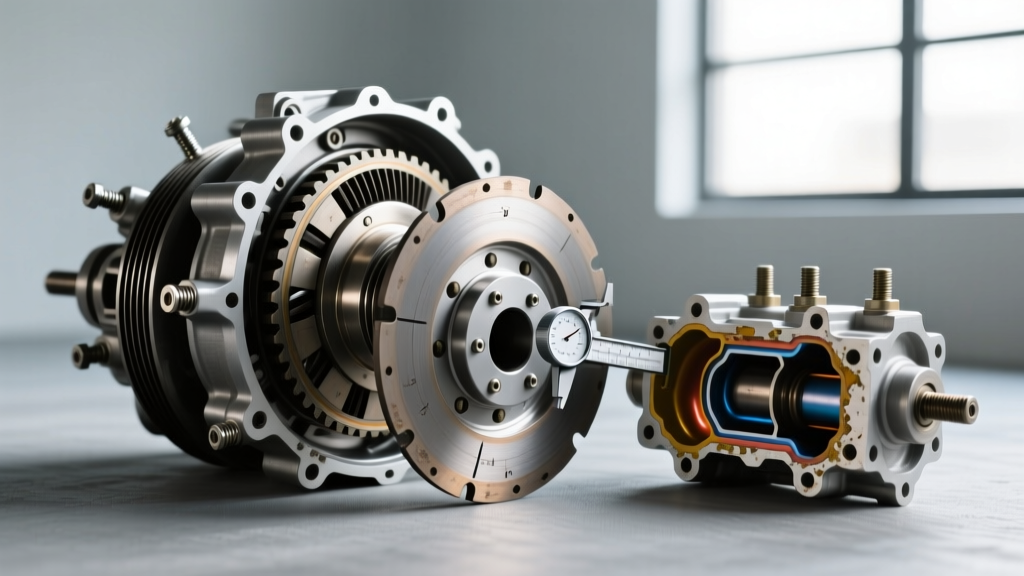
To permanently cure the symptoms associated with the honda ridgeline torque converter recall, performance builders recommend abandoning the stamped-steel OEM cover in favor of a CNC-machined billet torque converter. Upgrading to a heavy-duty billet unit from manufacturers like Circle D Specialties or Precision Industries fundamentally changes the drivetrain's durability profile.
- Billet Steel Covers: Factory covers flex under high torque loads, altering the clutch apply pressure and causing premature wear. A billet cover maintains zero deflection, ensuring uniform TCC clamping force.
- Forged Stators: Performance stators are engineered with optimized fin angles to redirect fluid flow more efficiently, multiplying torque at lower RPMs and reducing internal fluid cavitation.
- Upgraded Friction Materials: High-performance converters utilize advanced carbon-composite or Kevlar-lined TCC discs that can withstand significantly higher thermal loads before glazing occurs.
Stock vs. Performance Torque Converter Specs (Ridgeline J35Y6)
| Specification | OEM ZF 9HP / Honda 6-Speed TC | Heavy-Duty Billet Performance TC |
|---|---|---|
| Cover Material | Stamped Steel | CNC Billet Steel |
| TCC Clutch Type | Multi-Plate Wet (OEM Friction) | Multi-Plate (Carbon-Composite) |
| Stall Speed | 1,800 - 2,000 RPM | 2,200 - 2,400 RPM (Towing Spec) |
| Max Torque Capacity | ~350 lb-ft | 550+ lb-ft |
| Balancing | Standard OEM | Dynamic Multi-Plane Precision |
| Estimated Cost (Part) | $900 - $1,300 | $1,500 - $2,200 |
Tuning Stall Speed for the J35Y6 V6
The Honda Ridgeline is powered by the J35Y6 3.5L V6, producing 280 horsepower and 262 lb-ft of torque. A common misconception is that raising the stall speed will ruin the truck's daily drivability. However, for a Ridgeline used for towing boats, campers, or hauling dirt bikes up steep inclines, a mild stall increase to 2,200 RPM is highly beneficial.
The J35 engine’s torque curve is relatively flat, but it doesn't reach its peak pulling power until higher in the rev range. A 2,200 RPM stall converter allows the engine to bypass the sluggish low-end response and immediately engage the meat of the powerband when launching from a standstill with a heavy trailer. This reduces the time the TCC spends in the 'slip' phase during heavy acceleration, directly combating the heat generation that causes the factory shudder.
Expert Insight: Never exceed a 2,600 RPM stall on a street-driven Ridgeline without an upgraded transmission cooler. The J35 V6 relies heavily on the radiator's integrated ATF cooler, and excessive slip at highway speeds will overwhelm the stock cooling capacity.
Fluid Selection and TCM Relearn Procedures
Installing a performance torque converter is only half the battle. The Ridgeline's transmission is highly adaptive, and the TCM learns the friction characteristics of the original, failing converter. If you install a new billet unit without resetting the adaptives, the TCM will apply the wrong clamping pressures, resulting in brutal lockup engagements and potential driveline shock.
The Mandatory Relearn Protocol
- Fluid Flush: Drop the transmission pan, replace the filter (if accessible on your specific ZF/Honda variant), and refill with exact-capacity fluid. While Honda ATF DW-1 is the factory spec, many performance builders in 2026 opt for high-shear synthetic alternatives like Amsoil Signature Series Multi-Vehicle ATF for superior thermal resistance.
- TCM Reset: Using a bidirectional OBD2 scanner (such as an Autel MaxiSys or Foxwell NT530), access the Transmission Control Module and select 'Reset Adaptive Values' or 'Clear TCC Adaptives.'
- The Drive Cycle: Perform the manufacturer-specified relearn drive cycle. This typically involves driving the vehicle on a flat, level road and performing 10-15 light-throttle accelerations from 0 to 50 mph, allowing the TCM to recalibrate the clutch volume and apply pressure maps for the new friction material.
Cost Breakdown: OEM Replacement vs. Billet Performance Upgrade
When weighing the costs, it is vital to factor in labor. Dropping the subframe and removing the transmission on a Gen 2 Ridgeline is a labor-intensive process, often requiring 8 to 11 hours of shop time at $150-$200 per hour. Because the labor cost is a sunk cost, the delta between an OEM replacement and a performance upgrade is much smaller than it appears on paper.
- OEM Route: $1,100 (TC) + $1,200 (Labor) + $150 (Fluid/Seals) = $2,450
- Performance Route: $1,800 (Billet TC) + $1,200 (Labor) + $180 (Synthetic Fluid/Seals) = $3,180
For an additional $730, the performance route eliminates the risk of recurring TCC shudder, adds hundreds of pound-feet of torque capacity, and optimizes the J35 V6 for heavy towing. For Ridgeline owners who refuse to compromise on reliability and capability, the billet upgrade is the only logical path forward.
Final Thoughts on Drivetrain Longevity
The honda ridgeline torque converter recall and associated TSBs exposed a fundamental mismatch between the factory torque converter's thermal limits and the real-world demands placed on a midsize pickup truck. By understanding the hydraulic and mechanical symptoms of TCC failure, owners can pivot from a cycle of warranty claims to a definitive, performance-oriented solution. Upgrading to a precision-balanced, billet torque converter not only cures the shudder but unlocks the true potential of the Ridgeline’s drivetrain for years to come.