The Hidden Cost of Ignoring Rear Differential Service
Rear differential service and maintenance often take a backseat to engine oil changes or transmission fluid flushes. However, the rear axle assembly operates under extreme mechanical stress, transferring hundreds of pound-feet of torque to the pavement while managing immense heat and friction. When the internal bearings begin to degrade, the drivetrain sends out specific auditory and physical warnings. Recognizing these symptoms early is the difference between a standard overhaul and a catastrophic failure that destroys the ring and pinion gears, the carrier, and the axle housing. In 2026, with the rising cost of heavy-duty drivetrain components and average shop labor rates hovering between $150 and $225 per hour, accurately diagnosing the need for replacing rear differential bearings before secondary damage occurs is a critical money-saving skill for both DIY enthusiasts and professional technicians.
Anatomy of the Rear End: Which Bearing is Failing?
To troubleshoot effectively, you must understand the three distinct bearing sets inside a standard solid rear axle (such as the ubiquitous GM 8.5-inch 10-bolt or the Ford 8.8-inch). Each set has a unique failure mode and produces a specific symptom profile.
1. Pinion Bearings (Inner and Outer)
The pinion gear is supported by two tapered roller bearings. The inner bearing handles the bulk of the thrust load generated during vehicle acceleration, while the outer bearing manages deceleration and coasting loads. Because the pinion spins at driveshaft speed (often 2,000 to 3,000 RPM at highway speeds), these bearings are highly susceptible to lubrication starvation and heat-induced spalling. When replacing rear differential bearings, the pinion set is the most labor-intensive to access, requiring the removal of the driveshaft, pinion flange, and crush sleeve or solid spacer.
2. Carrier (Side) Bearings
The differential carrier houses the ring gear and the internal spider/planet gears. It is supported by two large side bearings pressed onto the carrier housing and seated into the axle tubes. These bearings manage the lateral thrust generated by the hypoid gear cut of the ring and pinion. Failure here usually manifests as cornering noises or a low-speed rumble, as the carrier shifts under load, altering the critical ring-and-pinion backlash and contact pattern.
3. Axle Shaft Bearings
Located at the outer ends of the axle tubes, these bearings support the vehicle's actual weight and the rotational mass of the axle shafts. While technically part of the axle assembly rather than the differential 'gear' set, they are serviced during comprehensive rear differential maintenance. Failure here often triggers ABS tone ring misalignment, resulting in erratic speedometer readings or false ABS/TCM fault codes alongside a distinct rotational hum.
Auditory Diagnostics: Whine, Rumble, and Howl
Differentiating between gear wear and bearing wear is the hallmark of an expert drivetrain diagnostician. Gear whine is typically load-dependent (changing pitch or volume when you step on the throttle versus letting off). Bearing noise, conversely, is primarily speed-dependent and load-independent.
| Symptom Profile | Probable Failing Component | Diagnostic Test (Road & Shop) |
|---|---|---|
| Continuous high-pitched whine that rises with vehicle speed, regardless of throttle load. | Pinion Bearings (Inner or Outer) | Stethoscope test on the pinion yoke while spinning the driveshaft on a lift. Check for rotational notchiness. |
| Low-frequency rumble or growl that worsens during tight turns or lateral loading. | Carrier (Side) Bearings | Perform figure-eight maneuvers in a parking lot. Check carrier bearing preload and ring gear runout with a dial indicator. |
| Growling noise isolated to one side of the vehicle, accompanied by ABS/Speedometer faults. | Outer Axle Shaft Bearing | Jack up the rear corner, grasp the tire at 12 and 6 o'clock, and check for vertical play. Inspect the ABS exciter ring for damage. |
| Whine only on deceleration (coasting). | Ring & Pinion Gear Set (Coast Side) | Not a bearing issue. Requires pinion depth adjustment or gear replacement. Check fluid for metallic paste. |
Fluid Forensics: Reading the Differential Oil
Rear differential service and maintenance begins with pulling the fill plug and the cover. The condition of the gear oil (typically 75W-90 or 75W-140 full synthetic) provides a direct window into the health of the bearings.
- Normal Wear (Glitter): A slight metallic sheen in the oil is normal for limited-slip differentials (LSD) due to clutch pack friction and initial bearing seating. This does not mandate replacing rear differential bearings.
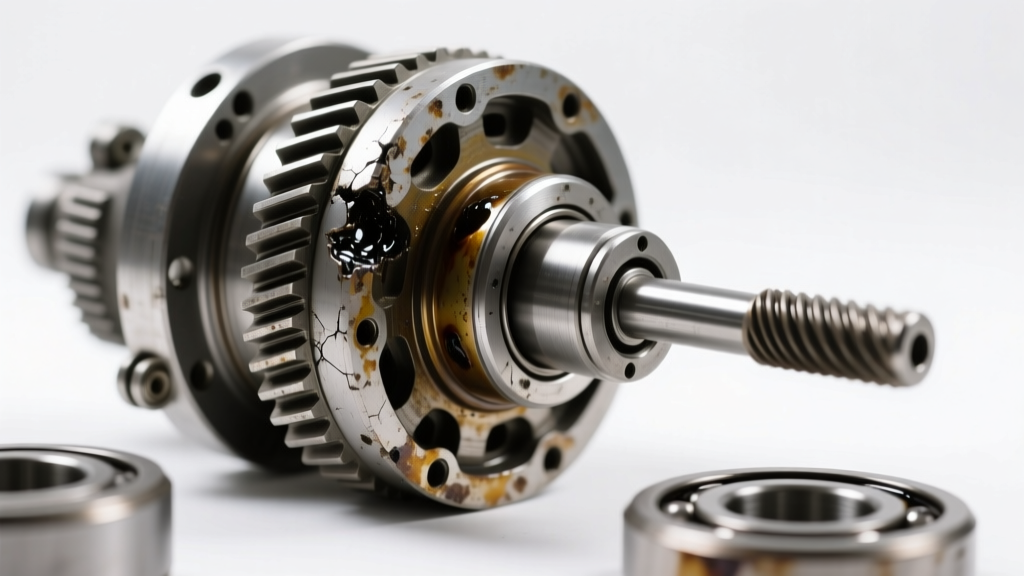
- Abnormal Wear (Shards and Chips): If you find distinct metallic flakes, chunks, or needle-roller fragments on the drain plug magnet or the bottom of the housing, a bearing cage has disintegrated. Immediate teardown is required to prevent the debris from scoring the ring and pinion gear teeth.
- Fluid Discoloration and Burnt Smell: Dark, burnt-smelling fluid indicates severe overheating, usually caused by inadequate pinion bearing preload or incorrect gear oil viscosity. Over-tightened pinion bearings generate massive friction, boiling the oil and destroying the bearing races.
Measurement and Teardown: The Troubleshooting Protocol
Before tearing down the differential, baseline measurements are mandatory. According to the Ring & Pinion Technical Help guidelines, you must measure ring gear backlash and carrier bearing cap runout before unbolting anything.
Mount a magnetic dial indicator on the axle housing with the probe resting on the ring gear teeth. Standard backlash for most street-driven hypoid gears is between 0.006 and 0.010 inches. If your backlash is erratic (varying wildly as you rotate the carrier), the carrier bearings are worn, or the ring gear is improperly bolted. Furthermore, check the pinion yoke for radial play. Any detectable up-and-down movement in the yoke confirms that the pinion bearings have lost their preload and are actively damaging the pinion seal and mating races.
The Crush Sleeve vs. Solid Spacer Conversion
When replacing rear differential bearings on the pinion shaft, technicians face a choice: reuse the factory one-time-use crush sleeve or upgrade to a solid pinion spacer. Factory crush sleeves are designed to collapse to a specific thickness to achieve the correct pinion bearing preload (typically 15 to 25 inch-pounds of rotational torque for new bearings). However, if a U-joint fails or the pinion nut is ever removed, the sleeve must be replaced, and achieving the exact crush depth requires immense torque and guesswork.
Expert rebuilders universally recommend installing a solid spacer kit (such as those from Ratech Manufacturing) with precision shims. This eliminates the risk of over-crushing the sleeve (which destroys the new bearings) and makes future differential service and maintenance significantly easier. You simply measure the rotational drag with an inch-pound torque wrench and swap shims until the 15-25 in-lb spec is met.
Real-World Costs and Part Sourcing for 2026
Sourcing high-quality tapered roller bearings is non-negotiable. While budget kits exist, drivetrain experts rely on Timken or SKF Automotive bearings to ensure precise metallurgical tolerances. For a standard GM 8.5-inch 10-bolt, a master overhaul kit (including Timken SET 10 inner pinion, SET 9 outer pinion/carrier bearings, new races, and a solid spacer kit) costs between $120 and $180. Add $40 for a high-quality synthetic 75W-90 gear oil with LSD friction modifier, and $15 for a new pinion seal and RTV gasket maker.
If you are performing the labor yourself, the total parts cost for replacing rear differential bearings is under $250. However, if you require a professional shop to perform the teardown, bearing press work, and gear pattern setup, expect labor charges to push the total invoice to $800 - $1,200, assuming the ring and pinion gears are still salvageable. If bearing failure was ignored and the gears are scored, add $400 to $600 for a new matched gear set and professional setup.
Expert Takeaway: Rear differential service and maintenance is not just about swapping fluid every 50,000 miles. It is about active listening and mechanical forensics. By recognizing the speed-dependent whine of a failing pinion bearing and catching the metallic shards in the differential oil early, you can execute a targeted bearing replacement and save thousands of dollars in catastrophic drivetrain repairs.