The CR-V AWD Architecture: Why the Rear Diff Acts as the Center Differential
When enthusiasts and daily drivers alike experience binding, groaning, or juddering during low-speed maneuvers, the immediate suspect is often the transmission. However, in Honda’s Real Time AWD ecosystem, the root cause frequently lies aft of the cabin. Specifically, the condition of your Honda CRV rear differential fluid dictates the health of the entire all-wheel-drive coupling mechanism. To properly diagnose these symptoms, we must first dismantle a common automotive misconception regarding center differentials and Honda’s unique drivetrain layout.
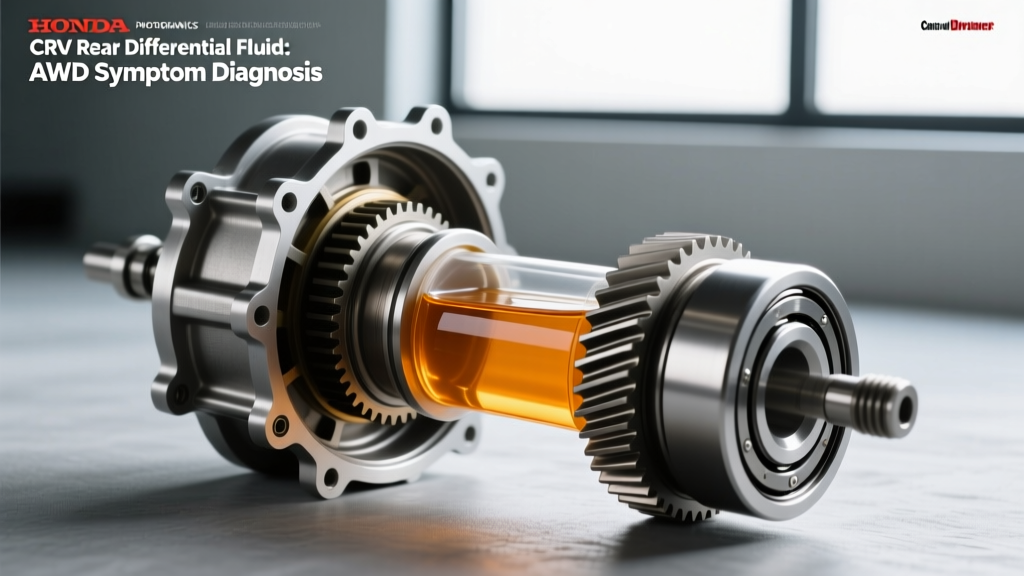
In traditional symmetrical AWD systems, such as those found in Subaru or older Audi Quattro models, a dedicated center differential resides within the transmission extension housing to distribute torque front-to-rear. The Honda CR-V, however, utilizes a completely different architectural philosophy. The front transaxle houses a Power Transfer Unit (PTU) that sends a constant mechanical link via a propeller shaft to the rear assembly. The 'center differential' logic—deciding when and how much torque to route rearward—is actually executed inside the rear differential housing itself.
Depending on your CR-V’s generation, this rear assembly contains either a Dual Pump hydraulic system (1997–2014) or an electronically controlled Intelligent Control System clutch pack (2015–2026). In both designs, the rear differential is not merely a gear reduction housing; it is a complex hydraulic valve body and clutch actuator. Consequently, the fluid inside is not a standard GL-5 gear oil. It is a highly specialized, friction-modified hydraulic fluid. When this fluid degrades, its friction coefficients shift, leading to the hallmark symptoms of AWD binding.
Symptom Diagnosis Matrix: AWD Binding, Groaning, and Judder
Diagnosing drivetrain noise requires isolating the variable. Because the CR-V's rear differential houses the AWD engagement clutches, hydraulic fluid degradation mimics mechanical gear failure. Use the following diagnostic matrix to cross-reference your vehicle's symptoms against known fluid-related failure modes.
| Symptom Profile | Operational Trigger | Probable Root Cause | Diagnostic Action |
|---|---|---|---|
| Low-pitch groaning or howling | Slow, tight turns (e.g., parking lots, Figure-8s) | Sheared friction modifiers in DPF-II/DPSF causing clutch pack chatter | Perform Figure-8 test; execute Double-Flush protocol |
| Physical binding or 'hopping' sensation | Full-lock steering on dry pavement at low speeds | Clutch plates failing to disengage due to contaminated hydraulic galleries | Fluid flush; inspect relief valve if symptom persists |
| AWD Warning Light Illumination | Highway speeds or sudden acceleration | Overheating fluid triggering the rear diff temperature sensor logic | Scan for OBD-II codes (e.g., P0848); check fluid level and condition |
| Whining that scales with vehicle speed | Coasting or steady-state cruising (40+ MPH) | Ring and pinion gear wear or bearing failure (unrelated to clutch fluid) | Stethoscope diagnostic on diff housing; inspect gear oil for glitter |
Fluid Evolution: DPF-II vs. DPSF Chemistry
A critical error made by independent shops and DIYers is treating the Honda CRV rear differential fluid as a generic hypoid gear oil. Pouring 75W-90 GL-5 into a Honda Real Time AWD rear differential will destroy the clutch pack friction materials within a few hundred miles. Honda engineers two distinct fluids for these systems, and understanding their tribology is essential for 2026 diagnostic standards.
- Honda Dual Pump Fluid II (DPF-II) - P/N 08200-9003: Used in 1997–2014 models. This fluid relies on the viscosity difference between two internal hydraulic pumps (one driven by the front axle, one by the rear). When wheel slip occurs, the pressure differential opens a pilot valve, which engages a ball-cam mechanism that locks the clutch pack. DPF-II contains specific anti-foaming agents and friction modifiers designed for the ball-cam ramp angles.
- Honda DPSF (Dual Pump System Fluid) - P/N 08200-9007: Introduced for the 2015+ Intelligent Control System and standard through the 2026 model year. This system abandons the mechanical pump differential in favor of an electronically controlled hydraulic solenoid that actuates the clutch pack. DPSF has a completely different viscosity index and friction modifier package tailored for rapid, computer-controlled solenoid response and high-temperature shear stability.
According to tribology analyses documented on Bob Is The Oil Guy, the friction modifiers in Honda's OEM fluids are highly volatile and deplete rapidly under high-shear cornering loads, which is why the fluid often looks clean but still causes binding noises.
The Figure-8 Diagnostic Test
Before draining any fluid, you must verify the clutch chatter symptom using the industry-standard Figure-8 test. This test forces a speed differential between the front and rear axles, demanding the rear differential's clutch pack to slip and modulate.
- Locate a large, empty, dry asphalt parking lot.
- Ensure the vehicle is at operating temperature (driven for at least 15 minutes).
- Turn the steering wheel to full lock (left or right).
- Drive the vehicle in a continuous circle at 5–10 MPH. Listen for groaning from the rear.
- Without stopping, smoothly transition into a Figure-8 pattern, crossing the center point while maintaining light throttle.
- Diagnosis: If a distinct groan, shudder, or binding sensation occurs precisely at the apex of the turn where wheel speed differentiation is highest, the clutch pack is chattering due to depleted friction modifiers in the fluid.
The Mandatory Double-Flush Protocol
A single drain-and-fill of the Honda CRV rear differential fluid only replaces approximately 60% of the total system volume. The remaining 40% is trapped inside the clutch pack galleries, hydraulic pump housings, and solenoid valves. To properly reset the friction coefficients, you must perform the Honda-mandated Double-Flush protocol. Enthusiasts on the CR-V Owners Club Technical Forums consistently report that a single drain rarely cures the parking lot groan, whereas the double-flush succeeds over 90% of the time.
Step-by-Step Execution:
- Initial Drain: Level the vehicle. Remove the 18mm fill plug first (always verify you can open the fill hole before draining). Remove the 18mm drain plug. Drain the fluid into a calibrated pan to verify the ~1.2L (1.27 qt) capacity.
- First Fill: Reinstall the drain plug with a new crush washer. Fill with exactly 1.2L of the correct OEM fluid (DPF-II or DPSF) until it weeps from the fill hole.
- The Agitation Drive: Drive the vehicle for 10–15 miles. Include multiple tight turns, Figure-8s, and moderate acceleration to force the AWD system to engage, cycle the hydraulic pumps, and flush the old fluid out of the clutch pack galleries into the main sump.
- Second Drain & Fill: Return to the shop, drain the fluid again (it will likely look darker now as it has pulled contaminants from the clutch pack), and perform the final fill.
Torque Specifications and Hard Parts
Stripping the aluminum threads on the rear differential housing is a costly mistake. Adhere strictly to the torque specifications outlined in the Honda Official Service Portal.
- Drain Plug Torque: 32 lb-ft (43 Nm)
- Fill Plug Torque: 32 lb-ft (43 Nm)
- Crush Washer P/N: 90471-PX4-000 (18mm ID) - Never reuse the aluminum crush washer.
- Fluid Capacity: 1.2 Liters (1.27 US Quarts)
When Fluid Changes Fail: Mechanical Edge Cases
If the Double-Flush protocol and fresh OEM fluid fail to eliminate the binding and groaning, you have crossed the threshold from fluid maintenance into mechanical failure. At this stage, the diagnostic focus shifts to internal hard parts.
1. Worn Clutch Friction Material: If the vehicle was driven for tens of thousands of miles with degraded fluid, the clutch plates may have glazed or worn past their tolerance. The friction material sheds into the sump, creating a sludge that clogs the hydraulic pickup screen. This requires dropping the rear differential, splitting the case, and installing a new clutch pack assembly.
2. Failed Relief Valve or Solenoid: In the 2015+ Intelligent Control System, the external electronic solenoid controls hydraulic pressure. If the solenoid screen is clogged with clutch debris, or the internal relief valve sticks in the 'engaged' position, the rear wheels will bind continuously on dry pavement. Testing requires a bidirectional OBD-II scanner capable of commanding the AWD solenoid duty cycle while monitoring hydraulic pressure feedback.
3. PTU and Propeller Shaft Bind: Rarely, the issue is not in the rear differential at all. The front-mounted Power Transfer Unit (PTU) contains its own hypoid gear oil, which is notorious for degrading and causing bearing failure. If the groaning is accompanied by metallic clicking or vibration under the center console, diagnose the PTU and propeller shaft U-joints before condemning the rear AWD coupling.