The Silent Horsepower Killer: Understanding Drivetrain Loss
When building a high-performance vehicle, enthusiasts and professional tuners often obsess over crank horsepower. However, the only horsepower that actually moves the vehicle forward is what reaches the contact patch of the tires. The difference between crank horsepower and wheel horsepower is known as parasitic drag, or drivetrain loss. This loss is generated by the rotational mass, internal friction, and fluid shearing inherent in your transmission, driveshaft, differential, and axles.
As we navigate the 2026 performance landscape, modern engineering has drastically improved baseline efficiency. For instance, the ZF 8HP70 eight-speed automatic boasts an impressive mechanical efficiency of nearly 88%, meaning it only suffers from a 12% parasitic loss. Conversely, older or heavily modified manual setups, like a built Ford MT82 or a ruggedized Dana 60 axle, can rob upwards of 20% to 25% of your engine's output if left unoptimized. Reclaiming this lost power requires a targeted approach to drivetrain modifications and upgrades.
Baseline Parasitic Drag by Layout
Before investing in aftermarket components, it is critical to understand the baseline efficiency of your specific drivetrain configuration. Each layout introduces unique friction points and rotational mass penalties.
| Drivetrain Layout | Average Loss % | Primary Friction Points | Typical WHP Loss (per 500 Crank HP) |
|---|---|---|---|
| FWD (Front-Wheel Drive) | 10% - 12% | Transaxle gears, CV joints, short axles | 50 - 60 HP |
| RWD (Rear-Wheel Drive) | 15% - 17% | Longitudinal trans, U-joints, ring & pinion | 75 - 85 HP |
| AWD / 4WD (All-Wheel Drive) | 20% - 25% | Transfer case, front/rear diffs, 4 CV axles | 100 - 125 HP |
Rotational Mass Reduction: The First Line of Defense
The most effective way to minimize drivetrain loss and improve throttle response is by reducing rotational mass. A rotating pound of weight requires exponentially more energy to accelerate than a static pound of vehicle weight. Upgrading your heavy OEM steel components to lightweight alternatives yields immediate, seat-of-the-pants results and measurable dyno gains.
Lightweight Flywheels and Flexplates
For manual transmission vehicles, the flywheel represents a massive chunk of rotational inertia. OEM dual-mass or heavy cast-iron flywheels can weigh between 35 and 50 lbs. Upgrading to a billet aluminum or chromoly flywheel from manufacturers like Fidanza or ACT can drop that weight to 12–18 lbs. This reduction not only frees up trapped horsepower (typically 5 to 8 WHP) but drastically improves the engine's ability to rev and drop RPMs between shifts.
Expert Note on NVH: When installing a solid aluminum flywheel, expect an increase in Noise, Vibration, and Harshness (NVH). You will likely hear gear rattle at idle due to the lack of dampening springs found in OEM dual-mass units. For dedicated track cars, this is an acceptable trade-off; for daily drivers, consider a lightweight chromoly option that retains a sprung hub.
Carbon Fiber and Aluminum Driveshafts
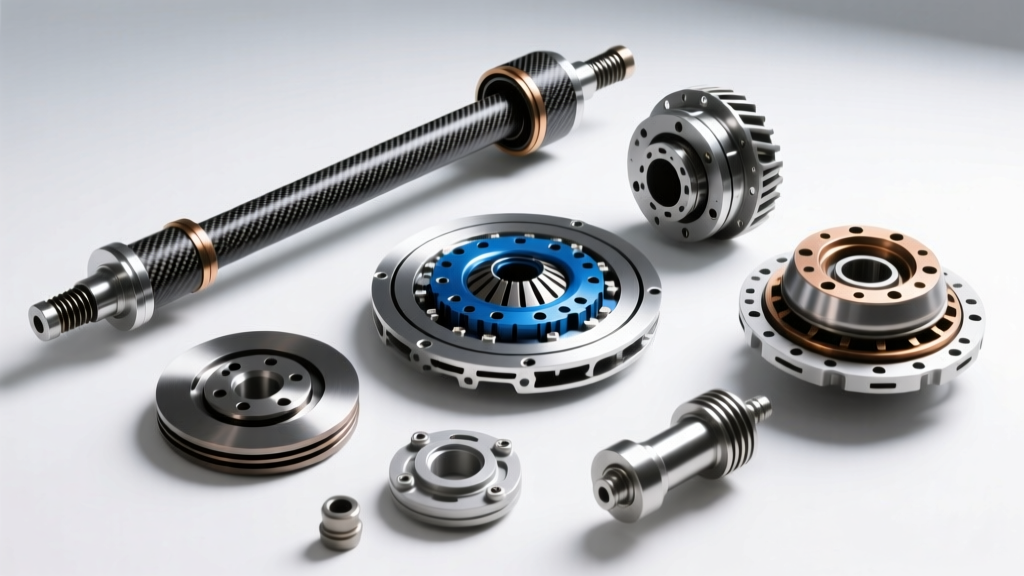
The driveshaft acts as the primary rotational link between the transmission and the differential. A stock steel two-piece driveshaft with a carrier bearing can weigh over 45 lbs and is prone to harmonic vibrations at high RPMs. Upgrading to a one-piece aluminum or carbon fiber driveshaft from QA1 Engineering reduces weight by up to 50% while increasing critical speed limits.
When installing an aftermarket driveshaft, proper fastener torque is non-negotiable to prevent catastrophic failure and binding, which induces parasitic drag. For standard Spicer 1310 U-joint strap bolts, torque to 18-22 lb-ft. If your build requires the heavier duty Spicer 1350 series U-joints, torque the strap bolts to 25-30 lb-ft and apply a medium-strength threadlocker.
Internal Transmission Upgrades for Maximum Efficiency
While external bolt-ons yield great results, internal transmission modifications target the core of mechanical friction. Whether you are rebuilding a classic Tremec T56 Magnum or optimizing a modern GM 10L90, internal clearances and surface finishes dictate efficiency.
Cryogenic Treatment and Micro-Polishing
Cryogenic treatment involves slowly cooling transmission gears, shafts, and synchros to roughly -300°F and slowly returning them to room temperature. This process realigns the molecular structure of the steel, relieving internal stresses and creating a denser, more uniform surface. When paired with micro-polishing, cryo-treated gears exhibit a 15% to 20% reduction in surface friction. This is a highly recommended upgrade for the Ford MT82 manual transmission, which is notorious for internal drag and notchy shift feel when hot.
High-Efficiency Bearing Kits
Standard tapered roller bearings and ball bearings create significant rolling resistance. Upgrading to low-drag, high-precision bearings from SKF or Timken reduces rotational friction inside the transmission case. For the Tremec T56 Magnum, which holds 3.8 quarts of fluid, ensuring the bearing preloads are set to the absolute minimum specification (while maintaining zero axial play) will free up noticeable horsepower on the dyno.
Fluid Dynamics: Synthetics and Friction Modifiers
Lubricants serve two purposes: protecting metal surfaces and managing heat. However, the fluid itself creates viscous drag as gears churn through it. Using the correct high-performance synthetic fluid is a cheap and highly effective drivetrain modification.
- Manual Transmissions: Avoid heavy gear oils in synchromesh manuals. Use dedicated fluids like Motul 300V or Red Line MT-90. These fluids possess high shear stability and specific friction modifiers that allow synchros to grab smoothly without creating excessive fluid drag.
- Differentials and Automatics: For hypoid gear sets in differentials, AMSOIL Severe Gear 75W-90 provides a tenacious film strength that prevents metal-on-metal contact while maintaining a low pour point, reducing cold-start parasitic loss.
Pro-Tip: Do not overfill your differentials or manual transmissions. Overfilling causes the ring gear to act as a paddle, churning the fluid and generating massive amounts of heat and drag. Fill exactly to the bottom of the fill plug hole, or slightly below it for high-speed track applications to account for fluid expansion.
Differential and Axle Optimizations
The ring and pinion gear set in your differential is a major source of friction, particularly in solid-axle RWD and 4WD configurations. The setup procedure directly dictates how much power is lost to heat and binding.
Precision Gear Setup
When installing a new Motive Gear or Richmond ring and pinion, the setup must be flawless. The two most critical measurements are pinion depth and backlash. For most performance street and track applications, you want to target a backlash of 0.006 to 0.008 inches. Setting the backlash too tight (under 0.005) will cause the gears to bind under thermal expansion, skyrocketing drivetrain loss and destroying the gear set. Setting it too loose (over 0.010) will result in impact loading, noise, and shattered teeth under hard launch conditions.
Furthermore, upgrading from a standard open differential or a heavy clutch-type limited-slip differential (LSD) to a helical gear-based LSD (like a Torsen or Wavetrac) can reduce internal friction. Clutch-type LSDs require constant friction between the clutch packs, generating heat and drag even when driving in a straight line. Helical gear diffs operate with near-zero parasitic drag until slip is detected.
Real-World ROI: Cost vs. Wheel Horsepower Gains
To help you prioritize your build budget, we have compiled a data table outlining the expected return on investment for common drivetrain loss reduction modifications. Note that WHP gains are cumulative and scale based on the total horsepower output of the engine.
| Modification | Estimated Cost (USD) | Expected WHP Recovery | Secondary Benefits |
|---|---|---|---|
| Lightweight Aluminum Flywheel | $450 - $750 | 5 - 9 WHP | Faster revving, improved shift feel |
| 1-Piece Carbon Driveshaft | $1,200 - $1,800 | 7 - 12 WHP | Eliminates high-RPM vibration, NVH reduction |
| Cryo & Micro-Polish Gears | $300 - $600 | 3 - 6 WHP | Increased gear lifespan, smoother operation |
| High-Performance Synthetic Fluids | $80 - $150 | 2 - 4 WHP | Lower operating temps, extended service intervals |
| Helical Gear LSD Upgrade | $800 - $1,300 | 4 - 7 WHP | Superior traction, zero clutch-pack drag |
Final Thoughts on Drivetrain Efficiency
Reducing drivetrain loss is not about adding power; it is about honoring the power your engine has already worked hard to create. By systematically addressing rotational mass, internal friction, and fluid dynamics, you can transform a sluggish, power-robbing chassis into a highly responsive, efficient performance machine. Whether you are tuning a dedicated track car or optimizing a weekend cruiser, these targeted drivetrain modifications ensure that every ounce of torque makes it directly to the pavement.