Executive Summary: In 2026, the complexity of 8-speed and 10-speed automatic transmissions has rendered the traditional "build it and bolt it in" methodology financially dangerous. This cost analysis breaks down the economics of post-rebuild validation, comparing the capital expenditure of a transmission rebuild bench and dynamometer against the catastrophic costs of in-vehicle warranty comebacks.
The Economics of Post-Rebuild Validation
When a customer invests $3,500 into a remanufactured or custom-rebuilt transmission, they are paying for reliability. However, the modern automatic transmission is a highly pressurized, computer-controlled hydraulic network. Installing a freshly rebuilt unit without rigorous pre-installation testing is a massive financial gamble for both the consumer and the repair facility. A single cross-leak in a valve body or an improperly calibrated solenoid can result in immediate clutch pack failure, forcing the shop to absorb the Remove and Replace (R&R) labor costs.
This is where the financial justification for advanced testing equipment comes into play. Understanding the cost breakdown between sub-assembly testing on a dedicated transmission rebuild bench and full-load dynamometer (dyno) testing is critical for shop owners calculating ROI, and for consumers trying to understand the itemized labor on their repair invoices.
Rebuild Bench vs. Dynamometer: What is the Difference?
Before analyzing the costs, we must distinguish between the two primary testing phases:
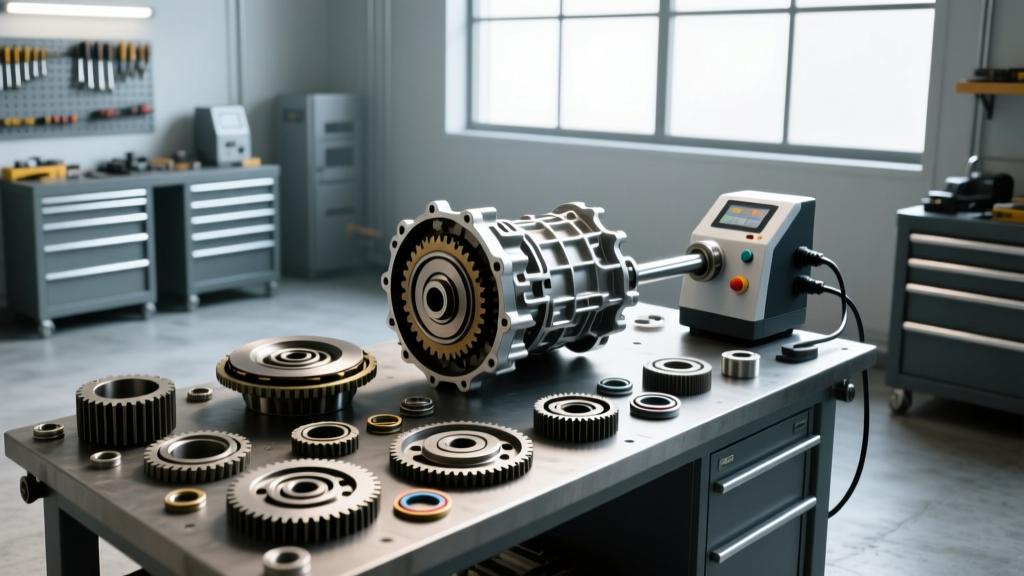
- Transmission Rebuild Bench (Sub-Assembly Testing): This refers to specialized hydraulic and pneumatic test stations used during the assembly process. Examples include valve body test benches (like the Sonnax Super VBX) and air-pressure leak-down rigs. These benches verify that sub-assemblies hold pressure, that checkballs are seated, and that valve bore clearances are within specification before the unit is bolted together.
- Transmission Dynamometer (Full-Unit Load Testing): A dyno is a massive, floor-mounted machine that bolts to the fully assembled transmission. It uses an electric motor or engine to drive the input shaft while applying hydraulic resistance to the output shaft, simulating real-world road load, shift points, and line pressures across all gears.
Consumer Cost Breakdown: What Are You Paying For?
For the consumer, dyno testing is rarely listed as a separate line item on a standard repair invoice; it is usually baked into the "Rebuild and Calibration" labor rate. However, when sourcing a crate transmission from a specialized builder, dyno testing is often an itemized premium service. In the current 2026 market, shop hourly rates range from $145 to $195 per hour. Here is how the testing costs break down for the end-user:
| Transmission Model | Bench Test Focus | Dyno Test Focus | Itemized Testing Cost | Potential R&R Savings |
|---|---|---|---|---|
| GM 4L60E / 4L65E | Servo pin depth, 3-4 clutch air check | Shift timing, TV cable pressure simulation | $250 - $350 | $850 - $1,100 |
| GM 6L80 / 6L90 | TEHCM solenoid characterization, VB leak-down | Adaptive shift pressure, torque converter lockup | $400 - $550 | $1,200 - $1,500 |
| ZF 8HP (BMW/Audi/FCA) | Mechatronic sleeve seal test, clutch clearance | High-pressure line validation, shift drum mapping | $500 - $750 | $1,500 - $2,200 |
| Ford 10R80 | Solenoid body assembly flow, C-clutch air test | 2-3 / 3-4 shift overlap, thermal management | $450 - $650 | $1,400 - $1,900 |
Note: The "Potential R&R Savings" represents the out-of-pocket labor cost a shop would lose (or a customer would face out-of-warranty) if the unit failed upon initial installation and had to be pulled back out of the vehicle.
Shop Capital Expenditure: The True Cost of Testing Equipment
For a transmission repair facility, investing in testing infrastructure is a major capital expenditure (CapEx). According to industry data from ATSG (Automatic Transmission Service Group), the baseline for a reputable shop in 2026 requires both bench and dyno capabilities to remain profitable on late-model units.
1. The Valve Body & Sub-Assembly Bench Investment
A high-quality valve body test bench allows a builder to verify hydraulic integrity before final assembly. The industry standard, such as those produced by Sonnax Industries, utilizes heated fluid and calibrated flow meters to detect microscopic cross-leaks in worn valve bores.
- Equipment Cost: $5,500 - $9,000
- Fluid & Maintenance Setup: $1,200 (Heated ATF reservoir, filtration, plumbing)
- Shop Space Footprint: 4x6 feet
2. The Full Transmission Dynamometer Investment
Full dynamometers, like the systems engineered by SuperFlow Dynamometers or Axiline, are heavy industrial machines. They require significant facility upgrades, including reinforced concrete pads, high-volume fluid drainage systems, and specialized electrical feeds.
- Equipment Cost: $45,000 - $95,000+ (depending on torque capacity and software integration)
- Facility Prep (3-Phase 220V/480V Power, Plumbing): $12,000 - $25,000
- Software & OEM Scan Tool Integration: $3,000 - $6,000 annually
While a $100,000+ total investment seems staggering, the math justifies the expense. If a shop rebuilds just 15 transmissions a month, and the dyno prevents one catastrophic comeback (saving $1,500 in unpaid R&R labor, $300 in ruined ATF, and $400 in replacement hard parts), the machine pays for its monthly financing and operational costs immediately.
Model-Specific Testing Parameters & Hidden Savings
The true value of the transmission rebuild bench and dyno is found in the microscopic details that differentiate a standard rebuild from a master-crafted unit. Let us examine three highly common platforms and the specific financial risks mitigated by proper testing.
GM 6L80 / 6L90: TEHCM Validation
The 6L80 and 6L90 transmissions utilize a Transmission Electro-Hydraulic Control Module (TEHCM) bolted directly to the valve body inside the pan. The torque specification for the valve body to case bolts is a highly specific 8 Nm (71 lb-in). If a builder over-torques these bolts on the bench, the valve body casting can warp, causing internal cross-leaks that result in harsh 2-3 shifts or flared 3-4 shifts.
Furthermore, the TEHCM solenoids must be characterized and programmed to the specific flow rates of the rebuilt valve body. A dyno test verifies that the adaptive shift pressures learned by the TEHCM actually translate to smooth, timed gear changes under load. Catching a faulty pressure control solenoid on the dyno costs $45 in parts and 30 minutes of labor. Catching it after the transmission is installed in a Chevrolet Silverado requires dropping the crossmember, draining the fluid, and removing the pan in a highly awkward, time-consuming process.
ZF 8HP: High-Pressure Mechatronic Checks
The ZF 8HP (found in BMW, Audi, Dodge, and Jaguar vehicles) operates at incredibly high line pressures—often exceeding 12 bar (174 PSI) under heavy load. The most common failure point on a high-mileage ZF unit is the plastic mechatronic adapter sleeve, which degrades and causes internal fluid leaks, triggering a "Gearbox Malfunction" limp-mode code.
On a specialized transmission rebuild bench, a master builder will use a pneumatic leak-down tester to verify the integrity of the newly installed adapter sleeve and the sealing sleeves on the clutch drums. Once assembled, the dyno is used to verify that the transmission can hold peak line pressure without the pump cavitating or the pressure regulator valve binding. Skipping this step almost guarantees a comeback on European luxury vehicles where R&R labor often exceeds $2,000 due to complex subframe and exhaust removal requirements.
Ford 10R80: Thermal and Overlap Testing
The Ford 10R80 is notorious for harsh shifts and premature C-clutch pack wear if the clutch clearances are not set to exact OEM specifications (typically 0.040" to 0.060" depending on the specific clutch and snap-ring selection). On the dyno, the builder can monitor the thermal management system and the shift overlap timing. If the 3-4 shift overlap is too aggressive, the dyno software will show a torque spike that indicates impending clutch burn-up. Adjusting the shift solenoid flow rates via the TCM tuning software while the unit is on the dyno saves the consumer from destroying the transmission during their first highway tow.
The ROI of Bench and Dyno Testing: Avoiding the "Comeback"
In the transmission repair industry, a "comeback" is the ultimate profit killer. When a rebuilt transmission fails or shifts poorly within the first 100 miles, the shop must diagnose the issue, remove the unit, tear it down, replace damaged friction materials, and reinstall it—all for free under warranty.
Consider the math of a single 6L80 comeback:
- R&R Labor (8 hours @ $165/hr): $1,320 (Lost revenue / unpaid time)
- Fluid & Filter (12 Quarts of Dexron ULV): $180
- Burnt Clutch Packs & Steel Plates: $350
- Total Comeback Cost: $1,850
Conversely, the operational cost of running a unit on a transmission dynamometer for 45 minutes is roughly $35 in electricity, fluid degradation, and technician time. The ROI is staggering. For the consumer, paying a premium for a builder who utilizes a transmission rebuild bench and dyno testing guarantees that the unit has been subjected to the mechanical and hydraulic stresses of the open road before it ever leaves the shop. In 2026, with labor rates continuing to climb and vehicle architectures becoming increasingly dense, pre-installation testing is no longer a luxury—it is a mandatory financial safeguard.