The Core Question: Time vs. Fluid Condition
Finding a puddle of oil on your driveway directly beneath the rear axle is a heart-sinking moment for any vehicle owner. The immediate, panic-driven question is always: How long can you drive with a rear differential leak? The internet is full of vague answers suggesting '50 miles' or 'a few days,' but as an automotive drivetrain specialist, I can tell you that mileage and time are the wrong metrics entirely. The true answer depends entirely on the leak rate and the condition and color of the differential fluid.
A slow seep of clean, amber 75W-90 gear oil from a weeping pinion seal gives you a generous window to schedule a repair. Conversely, a leak expelling milky, chocolate-milk-colored emulsion or glittering metallic paste means your axle is actively destroying itself, and driving it another five miles could turn a $25 seal replacement into a $2,500 complete axle rebuild. In this 2026 preventive maintenance guide, we will decode your differential fluid's color, texture, and smell to give you an exact diagnostic timeline.
Baseline Diagnostics: What Healthy Gear Oil Looks (and Smells) Like
Before you can diagnose a leak, you must understand the baseline of healthy differential fluid. Most modern solid rear axles (from the ubiquitous Ford 8.8-inch and GM 10-bolt to heavy-duty Dana 60s) require an API GL-5 rated gear oil, typically in a 75W-90 or 80W-90 viscosity.
- Color: Fresh GL-5 synthetic or conventional gear oil is translucent, ranging from pale straw to deep honey-amber.
- Texture: Smooth, viscous, and clingy. It should feel slick between your fingers, not gritty.
- Smell: Pungent, sulfurous, and reminiscent of rotten eggs. Do not be alarmed by this. According to the AMSOIL Technical Blog, this distinct odor comes from the sulfur-phosphorus extreme pressure (EP) additives required to protect hypoid gear sets from the extreme sliding friction inherent in ring and pinion designs.
If the fluid leaking from your axle matches this baseline, your internal components are likely safe, and the issue is strictly external sealing.
The Differential Fluid Color & Condition Matrix
Wipe the leak with a clean white shop towel or paper towel. Use the matrix below to identify the fluid's condition and determine your immediate action plan.
| Fluid Color & Appearance | Texture & Smell | Diagnostic Meaning | How Long Can You Drive? |
|---|---|---|---|
| Translucent Amber / Honey | Smooth, strong sulfur smell | Healthy fluid. Leak is isolated to a failed external seal (pinion, axle shaft, or cover). | Weeks/Months. Safe to drive if you monitor and top off the fluid level weekly. |
| Dark Brown / Opaque Black | Thick, sludgy, burnt smell | Severe oxidation, overheating, or friction modifier depletion. Internal wear is accelerating. | Days. Schedule a fluid flush and leak repair immediately to prevent gear scoring. |
| Milky / Chocolate Milk | Frothy, mayonnaise-like, sour | Water intrusion. Oil has emulsified, completely losing its hydrodynamic load-bearing properties. | STOP DRIVING. Tow the vehicle. Driving will pit bearings and spall gears within miles. |
| Grey Paste / Glittering | Gritty, metallic flakes on towel | Catastrophic internal failure. Ring/pinion teeth are chipping or tapered roller bearings are disintegrating. | STOP DRIVING. The axle requires a complete teardown and rebuild. |
Scenario Breakdown: Timelines and Repair Realities
Let us break down the three most common leak scenarios you will encounter and exactly how to handle them based on the fluid evidence.
Scenario A: The Slow Pinion Seal Seep (Clean Amber Fluid)
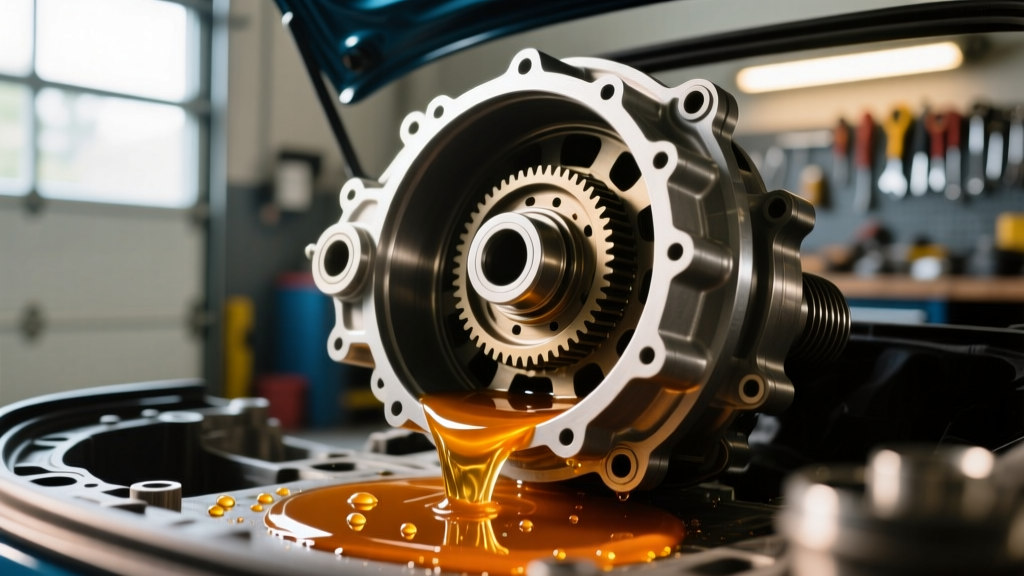
The Situation: You notice a few drops of clean, honey-colored 75W-90 on the floor, originating from the front yoke of the differential where the driveshaft connects.
The Timeline: You can safely drive the vehicle for weeks or even months, provided you check the fluid level every 1,000 miles. The differential fill plug is located on the housing cover or pumpkin. Remove it (vehicle must be on level ground, not lifted with hanging suspension) and ensure the fluid is level with the bottom of the fill hole.
The Fix: A pinion seal (e.g., Timken 710128 for a Ford 8.8) costs between $15 and $30. However, if you ignore it and the fluid drops below the pinion gear centerline, the pinion bearing will starve, overheat, and seize, leading to a $1,500+ rebuild.
Scenario B: The Milky Emulsion (Water Intrusion)
The Situation: The leaking fluid looks like a coffee creamer or chocolate milk. This happens when water enters the axle housing—usually through a submerged axle during off-roading, a compromised axle shaft seal, or a cracked breather tube—and the churning of the ring gear whips the oil and water into an emulsion.
The Timeline: Zero miles. Emulsified oil cannot maintain the microscopic fluid film required to separate the hypoid gear teeth under high torque. Metal-on-metal contact occurs immediately.
The Fix: The axle must be drained, flushed with a cheap GL-5 oil or specialized axle flush, and refilled. All seals must be inspected, and the breather tube must be replaced and routed higher up into the chassis frame.
Scenario C: The Glitter Bomb (Metallic Contamination)
The Situation: The leak is accompanied by a howling or clunking noise, and the fluid on your towel contains distinct metallic glitter or actual chunks of steel. Many differentials feature a magnetic fill plug designed to catch microscopic 'fuzz' from normal break-in wear. However, visible flakes or chunks indicate spalling (chipping) of the ring gear teeth or the disintegration of the tapered roller bearing cages.
The Timeline: Stop driving immediately. Continuing to drive will cause a gear tooth to break off and jam between the ring and pinion, resulting in hydrostatic lock and a shattered differential housing (the dreaded 'grenade' effect).
The Fix: Complete differential rebuild or replacement with a remanufactured unit. As of 2026, labor for a professional ring and pinion setup (requiring precise backlash and gear pattern shimming) averages $800 to $1,200, plus parts.
Preventive Maintenance: Stopping Leaks Before They Start
Answering 'how long can you drive' is moot if you practice proper preventive maintenance to ensure the leak never happens in the first place.
The Overlooked Culprit: Axle Breather Vents
The number one cause of premature pinion and axle seal failure is a clogged breather vent. As the differential operates, friction generates immense heat, causing the air and fluid inside the sealed housing to expand. The breather vent (usually a small plastic or metal cap on the driver's side axle tube) allows this pressure to escape. If the vent becomes clogged with mud, ice, or debris, the internal pressure will blow past the weakest seal—almost always the pinion seal. Rule of thumb: Never replace a leaking pinion seal without first verifying the axle breather vent is clear and functioning. For detailed housing ventilation specs, refer to the Spicer Parts Axle Maintenance Guidelines.
Proper Sealing: RTV vs. Pre-Cut Gaskets
When servicing the differential cover to check fluid condition or stop a cover leak, the sealing method is critical.
- Pre-Cut Gaskets: Rubber or cork gaskets (like the Fel-Pro RDS55340) are excellent for stamped steel covers. They allow for easy future removal without scraping.
- RTV Silicone: For cast-iron or aluminum housings (like the GM AAM 11.5-inch), high-temp RTV like Permatex Ultra Black (85265) or 'The Right Stuff' is mandatory. Apply a continuous 3mm bead, ensuring you circle the inside of all bolt holes to prevent oil from wicking out through the bolt threads.
Torque Warning: Never use an impact wrench on differential cover bolts or fill plugs. Over-torquing a 3/8-inch NPT fill plug can easily crack a cast-aluminum differential housing. Use a calibrated torque wrench set to 25-30 lb-ft for most standard steel plugs, and follow the star-pattern torque sequence (typically 20-25 lb-ft) for cover bolts to prevent warping the mating surface.
Final Verdict: Don't Gamble with the Ring and Pinion
So, how long can you drive with a rear differential leak? If your diagnostic wipe reveals clean, amber, sulfur-scented fluid, you have the luxury of time to order parts and schedule a weekend repair. If the fluid is milky or metallic, your timeline has expired, and the tow truck is your only safe option. By regularly inspecting your fluid's color and condition, and maintaining your axle breather vents, you ensure your drivetrain survives the long haul. Always consult your vehicle's specific OEM service manual or the Mobil 1 Synthetic Gear Lubricant PDS for exact fluid capacities and friction modifier requirements for your specific limited-slip or open differential setup.