The Diagnostic Power of Rear Differential Fluid Color
The rear differential is one of the most abused yet neglected components in modern drivetrains. Whether you are driving a daily-driven half-ton pickup, a modified off-road rig, or a performance SUV, the hypoid ring and pinion gear set relies entirely on a thin film of extreme-pressure (EP) gear oil to survive immense sliding friction and shear forces. While most enthusiasts wait for the tell-tale whine or howl of a failing bearing to take action, the earliest and most accurate indicator of internal axle health is often hidden behind the differential cover: the rear differential fluid color.
By performing a visual and tactile inspection of your gear oil during routine rear differential service and maintenance, you can diagnose thermal breakdown, water ingress, limited-slip differential (LSD) clutch degradation, and catastrophic gear spalling long before a complete rebuild is required. In this comprehensive diagnostic guide, we decode what your fluid is trying to tell you and provide the exact torque specifications and service procedures required to correct the underlying issues.
Fluid Color Spectrum: Decoding the Drain Pan
When you remove the differential cover or extract fluid via a syringe pump, the visual and olfactory characteristics of the oil provide a direct window into the operating environment of your axle. Below is the primary diagnostic matrix for gear oil condition.
| Fluid Color / Appearance | Primary Diagnosis | Required Action |
|---|---|---|
| Clear, Honey to Amber | Healthy, minimal oxidation, normal operating temps. | None. Reinstall cover and monitor mileage. |
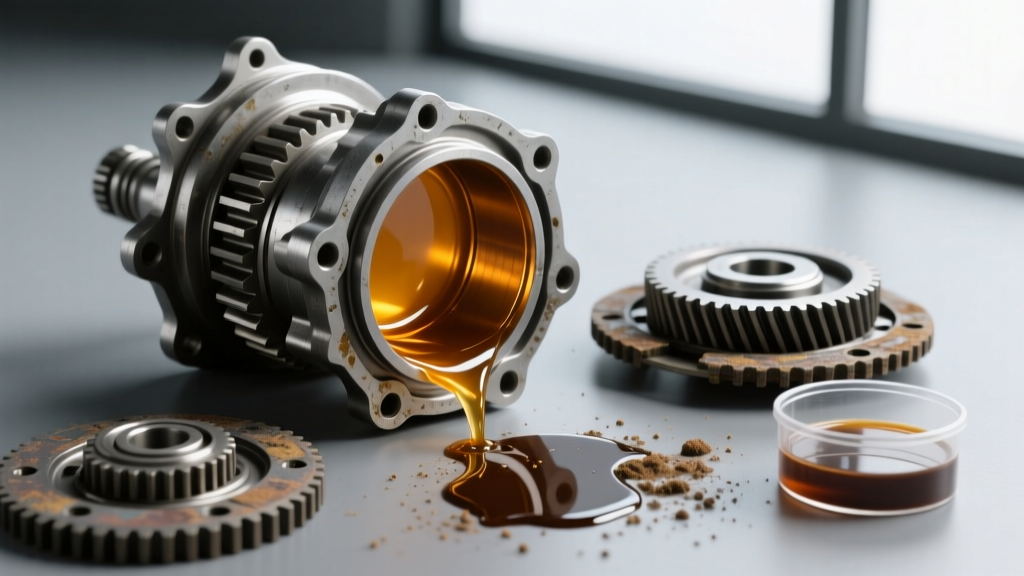
| Dark Brown / Opaque | Thermal breakdown, sulfur-phosphorus additive depletion. | Schedule immediate fluid and friction modifier service. |
| Black with Acrid/Burnt Smell | Severe overheating, LSD clutch pack glazing or dust. | Flush axle, inspect clutch packs, upgrade to 75W-140. |
| Milky / Chocolate Milk | Water emulsification, failed axle seal, or clogged breather. | Immediate service, replace seals, clear breather valve. |
| Grey Sludge with Glitter | Bearing cage wear, needle roller disintegration. | Tear-down inspection; carrier and pinion bearing replacement. |
| Chunky Metallic Flakes | Catastrophic ring/pinion tooth spalling or spider gear failure. | Complete differential rebuild or axle assembly replacement. |
Amber to Honey: The Baseline of Health
Fresh synthetic GL-5 gear oil typically presents as a clear, translucent amber or honey color. Modern 2026 synthetic formulations, such as those utilizing polyalphaolefin (PAO) base stocks, resist shear thinning and oxidation far better than conventional petroleum-based oils. If your fluid looks like this after 15,000 miles, your axle is operating within safe thermal limits, and the boundary lubrication film remains intact.
Dark Brown to Black: Thermal Breakdown and LSD Clutch Dust
When gear oil turns dark brown or black, it indicates that the fluid has exceeded its thermal threshold. Hypoid gears generate extreme localized heat at the contact patch. Over time, the EP additives (zinc, phosphorus, and sulfur) deplete, and the base oil begins to oxidize.
If your vehicle is equipped with a clutch-type Limited-Slip Differential (such as the Ford Trac-Lok, GM G80 Eaton locker, or Auburn LSD), black fluid is often accompanied by a pungent, burnt odor. This is the result of the friction modifier breaking down and the cellulose or carbon-fiber clutch discs wearing into a fine, abrasive dust. According to Spicer/Dana support resources, running degraded fluid in an LSD will cause permanent chatter, groaning during low-speed turns, and eventual locking of the side gears. If you pull a black, gritty sample, a complete flush with a high-detergent synthetic is mandatory to suspend and remove the clutch material before it scores the carrier bearing journals.
Milky or "Chocolate Milk": Water Ingress and Emulsification
Water and gear oil do not mix; they emulsify. When fluid takes on a milky, frothy, or "coffee with creamer" appearance, water has breached the axle housing. This is a critical failure state. Water destroys the hydrodynamic wedge required to keep the ring and pinion gears separated, leading to rapid metal-on-metal contact and rust formation on the precision-ground bearing races.
Common Entry Points:
- Axle Shaft Seals: Worn outer axle seals allow puddle water or mud to bypass the bearing retainer plates.
- Pinion Seal: A degraded rubber pinion seal will wick moisture from the road surface directly into the pinion bearing cavity.
- The Axle Breather Valve: This is the most overlooked culprit. As the axle heats up during driving, air expands and exits the breather. When the axle is submerged in cold water (or hit by a cold puddle), the housing rapidly cools, creating a vacuum. If the breather valve is clogged with dirt or stuck closed, the vacuum will pull water directly past the axle shaft seals. Always inspect and replace the axle breather cap (often a $4 part) during any differential service.
Metallic Glitter vs. Chunky Sludge: Evaluating Hard Parts
It is normal to find a fine, metallic "fuzz" on the magnetic fill plug of a new or recently rebuilt differential; this is standard wear-in material from the gears and bearings. However, if the drained fluid contains suspended metallic glitter (resembling metallic paint), your carrier or pinion bearings are disintegrating. The needle rollers and bearing cages are shedding material, which will eventually wedge between the ring and pinion gears, causing a catastrophic lockup.
If you find actual chunks or jagged flakes of steel in the housing, hard-part failure has already occurred. This is typically ring gear tooth spalling or spider gear shearing. No fluid change will fix this; the differential cover must come off for a full teardown and rebuild.
Corrective Maintenance: Service Intervals and Torque Specs
Diagnosing the fluid is only the first step. Proper rear differential service and maintenance requires strict adherence to torque specifications and sealing procedures to prevent future leaks and contamination. As outlined in AMSOIL technical guides, removing the differential cover is vastly superior to using a suction pump, as it allows you to clean the internal magnet and inspect the gear teeth for pitting.
Expert Sealing Tip: Never use standard silicone gasket maker on differential covers. Standard silicone swells when exposed to gear oil and can break off, clogging the oil pickup or pinion bearing galleries. Always use an oil-resistant RTV like Permatex Ultra Black (80050) or Ultra Grey, or stick to reusable rubber/cork composite gaskets where applicable.
Common Axle Cover Torque Specifications
Over-torquing differential cover bolts will warp the stamped steel covers or strip the threads in the aluminum/cast-iron housing. Always use a criss-cross tightening pattern and a calibrated inch-pound or low-range foot-pound torque wrench.
| Axle Model | Cover Bolt Torque Spec | Fluid Capacity (Approx.) | Recommended Viscosity |
|---|---|---|---|
| Ford 8.8-inch (Super 8.8 / IRS) | 32 lb-ft (285 in-lb) | 2.5 - 3.0 Quarts | 75W-140 Synthetic GL-5 |
| GM 8.6-inch (10-Bolt / Silverado) | 22 lb-ft (264 in-lb) | 2.1 - 2.4 Quarts | 75W-90 Synthetic GL-5 |
| Dana 44 (JK/JL Wrangler) | 25 lb-ft (300 in-lb) | 2.0 - 2.5 Quarts | 80W-90 or 75W-140 GL-5 |
| Chrysler 8.25 (C-Clip Eliminator) | 30 lb-ft (360 in-lb) | 2.2 Quarts | 75W-90 Synthetic GL-5 |
LSD Friction Modifiers: The Chatter Cure
If your vehicle features a clutch-type LSD, the gear oil alone is insufficient. You must add a specific friction modifier (e.g., Ford XL-3, GM EOS 1052358, or Mopar Friction Modifier). Without it, the clutch packs will bind and release rapidly during tight turns, causing a violent "chatter" or "thumping" sensation from the rear axle.
The Figure-8 Calibration Drive: After adding the modifier and topping off with Mobil 1 Synthetic Gear Lubricant or an equivalent premium synthetic, drive the vehicle in 10 slow, continuous figure-8 patterns in an empty parking lot. This forces the side gears to engage and disengage, working the friction modifier into the porous surface of the clutch discs. If chatter persists, add an additional 0.5 oz of modifier and repeat. Do not overfill the housing with modifier, or the LSD will slip excessively under heavy throttle.
Real-World Costs: DIY vs. Professional Service in 2026
Ignoring the warning signs found in your rear differential fluid color will inevitably lead to a complete axle failure. Understanding the financial stakes helps justify the effort of proactive maintenance.
- DIY Preventative Service: $50 - $85. This includes 3 quarts of premium synthetic 75W-90/140 gear oil ($14-$18/qt), a tube of Ultra Black RTV ($8), a new breather valve ($4), and a bottle of OEM friction modifier ($12).
- Professional Shop Service: $160 - $280. Most independent shops charge 1.5 hours of labor plus fluids. Dealerships often push this closer to $350 due to higher hourly rates and OEM-branded fluid markups.
- Complete Differential Rebuild: $900 - $1,800+. If you ignore milky fluid or metallic glitter, you will be paying for a master rebuild kit (Timken bearings, seals, crush sleeve, ring gear bolts), a new ring and pinion set, and 4-6 hours of specialized setup labor to dial in the gear backlash and pinion depth.
By treating your rear differential fluid color as a vital diagnostic tool rather than an afterthought, you ensure that your drivetrain continues to transfer power efficiently, quietly, and reliably for hundreds of thousands of miles.