The Catalyst: When Front Differential Repair Demands an Upgrade
Blown spider gears, a shattered cross-shaft, or a failing electronic axle disconnect actuator are common catalysts for a front differential repair. Whether you are tearing down a solid Dana 44 M210 in a modern Jeep Wrangler JL or servicing an Independent Front Suspension (IFS) Ford 8.8, a catastrophic open-differential failure presents a unique opportunity. Instead of simply replacing the carrier with another weak open unit or a viscous limited-slip, performance enthusiasts and off-road builders use this labor-intensive window to upgrade to a dedicated locking differential.
However, the front axle is an entirely different beast compared to the rear. While a rear locker simply dictates forward traction, a front locker directly interferes with your vehicle's steering geometry and Ackermann principles. Selecting the wrong locking differential for the front axle can result in dangerous understeer, binding drivetrains, and broken axle shafts. This guide details the engineering realities of front locker selection, precision assembly torque specs, and fluid protocols for your next front differential rebuild.
Front Axle Steering Dynamics: The Binding Dilemma
To understand front locker selection, you must understand steering dynamics. When a vehicle turns, the outside wheel travels a longer distance and must rotate faster than the inside wheel. An open differential accommodates this by allowing the wheels to spin independently. A fully locked front differential forces both wheels to turn at the exact same RPM.
If you engage a positive front locker on a high-traction surface (like dry pavement or hard-packed snow), the axle will "bind." The vehicle will aggressively push straight ahead regardless of steering input—a phenomenon known as severe understeer. Furthermore, the rotational tension must be absorbed by the weakest link in the driveline, which frequently results in sheared axle shaft splines or shattered ring gear teeth. Because of this, automatic lockers (like the Detroit Locker or Lockright lunchbox lockers) are highly controversial and generally not recommended for the front axle of any vehicle that sees snow, ice, or mixed-surface daily driving.
Selectable vs. Torque-Biasing: 2026 Front Locker Comparison Matrix
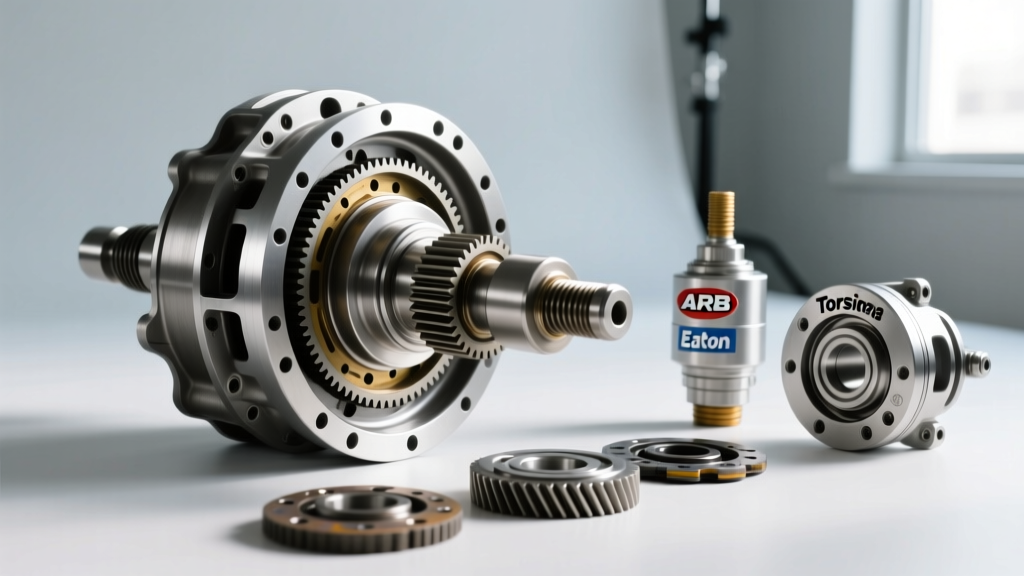
For a modern front differential repair, you generally have three viable paths: Selectable Air Lockers, Selectable Electronic Lockers, and Torque-Biasing (Torsen) differentials. Below is a technical comparison based on the popular Dana 44 M210/M220 front axle platform.
| Locker Type | Brand / Model | Part Number (M210 Example) | Mechanism | Est. Cost (Part Only) | Steering Impact |
|---|---|---|---|---|---|
| Selectable Air | ARB Air Locker | RD208 (3.73+ Ratio) | Pneumatic locking collar | $1,050 | Zero when disengaged (Open Diff) |
| Selectable Electric | Eaton ELocker | 19975-01 | Electromagnetic locking collar | $980 | Zero when disengaged (Open Diff) |
| Torque-Biasing | Torsen T-2 / TrueTrac | 916A373 (Dana 44) | Helical gear binding | $750 | Smooth, no binding, allows steering |
Deep Dive: ARB Air Locker (Pneumatic)
The ARB Air Locker remains the gold standard for hardcore front axle upgrades. When disengaged, it operates as a standard open differential, preserving factory steering feel and preventing driveline binding on the street. When you flip the dash switch, an onboard 12V compressor sends 100 PSI of air through a sealed bulkhead fitting into the axle housing, actuating a locking collar that physically binds the side gears to the carrier.
The Catch: The installation requires drilling the axle tube and routing a 5mm polyurethane air line. If the bulkhead fitting is installed poorly, or if metal shavings from drilling enter the differential fluid, the internal O-rings will fail, resulting in air leaks and a locker that refuses to engage.
Deep Dive: Eaton ELocker (Electronic)
The Eaton ELocker eliminates the need for an air compressor and air lines. It uses an electromagnetic coil mounted to the carrier to push a locking collar into the side gears. It is incredibly robust and features a simpler wiring harness (two wires passing through a sealed axle tube gland). However, the electromagnetic coil adds rotational mass to the carrier, and the internal wiring harness can be susceptible to chafing against the ring gear if the protective loom is not secured with high-temp zip ties during the front differential repair.
Deep Dive: Torsen T-2 (Torque-Biasing)
If your build is a daily-driven overlander or a snow-belt truck that requires front-end traction without the complexity of air lines or wiring, a Torsen (Torque-Sensing) helical gear differential is the ultimate choice. It never fully "locks," meaning it will never bind your steering. Instead, it multiplies torque up to a 2.5:1 ratio across the axle. If one wheel lifts completely off the ground (zero torque), a Torsen will not drive the grounded wheel unless you apply light brake pressure to the spinning wheel to create resistance. It requires zero switches, zero wiring, and zero maintenance.
Precision Assembly: Torque Specs and Backlash Tolerances
A front differential repair involving a locker upgrade requires meticulous attention to assembly tolerances. The front axle experiences severe shock loads when the locker is engaged on an incline. Improper assembly will result in catastrophic failure within the first 100 miles.
Ring Gear and Carrier Assembly
When transferring your existing ring gear to the new ARB or Eaton carrier (or installing a new Spicer ring and pinion set), you must adhere to strict torque specifications. For a standard Dana 44 / M210 front axle:
- Ring Gear Bolts: Use new 7/16"-20 x 1.25 Grade 8 bolts. Clean the threads with brake cleaner and apply Loctite 263 (Red). Torque in a star pattern to 80 lb-ft. Do not exceed 85 lb-ft, or you risk stretching the bolt and stripping the carrier threads.
- Carrier Bearing Preload: Use a dial indicator or inch-pound torque wrench. You want approximately 15 to 25 in-lbs of rotational drag (excluding pinion drag) to ensure the bearings are seated and will not loosen under lateral cornering loads.
- Carrier Bearing Cap Bolts: Torque to 90 lb-ft. Always reinstall the caps in their exact original locations and orientations (match the casting numbers). Swapping caps side-to-side will alter the bore diameter and destroy the carrier bearings.
- Backlash Tolerance: Target 0.006" to 0.010". Measure at three equidistant points around the ring gear. If the variance exceeds 0.002" between points, the ring gear is not seated flush against the carrier mating surface, or the carrier is warped.
Air Line Routing and Seal Preservation (ARB Specific)
If installing an ARB Air Locker, the bulkhead fitting installation is the most critical step of the front differential repair. 1. Drill a 1/2" hole in the top of the axle tube, at least 4 inches inward from the differential cover to avoid the oil splash zone. 2. Deburr extensively. Use a magnetic pickup tool and shop vac to ensure zero metal shavings remain inside the housing. 3. Install the bulkhead fitting using the provided O-ring and locknut. Do not use Teflon tape on the internal threads, as shredded tape can clog the internal air valve. 4. Route the 5mm air line up through the coil spring perch, securing it to the factory brake line brackets using Adel clamps. Keep the line at least 3 inches away from the exhaust crossover pipe.
Fluid Selection and the Break-In Procedure
Contrary to popular belief, selectable lockers (ARB, Eaton) and torque-biasing differentials (Torsen, TrueTrac) do not require friction modifiers. Friction modifiers are designed for clutch-pack limited-slip differentials (like the Trac-Lok) to prevent chatter. Adding a friction modifier to an ARB or Eaton locker can actually cause the internal O-rings to swell or the locking collars to slip under high torque.
For a 2026 front differential repair, fill the housing with a high-quality synthetic 75W-90 or 75W-140 gear oil (such as Amsoil Severe Gear or Red Line 75W90 NS). Use 75W-140 if the vehicle is dedicated to low-speed rock crawling or heavy mud bogging where axle housing temperatures spike. Use 75W-90 for mixed daily driving to reduce parasitic drag and improve cold-weather shifting.
The Break-In Protocol: New ring gears and bearings generate significant metallic particulate during the first 500 miles. Drive the vehicle normally on pavement for the first 20 miles to allow the gears to heat cycle. Then, for the next 480 miles, avoid engaging the front locker on high-traction surfaces. At exactly 500 miles, drain the differential fluid. You will likely find a thick, glittering sludge of metallic assembly paste and gear wear on the drain plug magnet. Refill with fresh synthetic gear oil to ensure the longevity of your carrier bearings and locking mechanism.