The Hidden Link Between Driveline Couplings and Differential Fluid
When enthusiasts and fleet managers look to improve the towing capacity and off-road durability of modern trucks and SUVs, the rear axle is a primary focal point. However, many overlook a critical bottleneck: the rear differential coupling. This component—the interface connecting the driveshaft to the differential pinion flange—dictates how torque and shock loads are transferred into the axle housing. As of 2026, with factory truck outputs routinely exceeding 500 lb-ft of torque, the OEM rubber flex discs and standard 1310-series U-joint couplings are frequent points of failure.
Upgrading to a heavy-duty rear differential coupling, such as a solid 1350-series Spicer flange or a reinforced CV-style coupling for independent rear suspension (IRS) SUVs, dramatically improves driveline reliability. But this mechanical upgrade fundamentally alters the internal physics of your differential. Eliminating the dampening effect of OEM couplings transfers 100% of the driveline shock directly into the ring and pinion gears. This makes your differential fluid selection and maintenance protocol more critical than ever to prevent catastrophic gear failure.
Driveline Physics: How Coupling Upgrades Alter Gear Stress
To understand why a coupling upgrade demands a fluid upgrade, we must examine elastohydrodynamic lubrication (EHL). Hypoid gears in truck differentials (like the GM AAM 11.5-inch or the Ford Sterling 10.5) rely on a microscopic film of gear oil to separate the sliding and rolling metal surfaces. Under smooth, steady-state torque, a standard 75W-90 synthetic fluid maintains this film perfectly.
However, when you upgrade your rear differential coupling to a solid, zero-lash setup, you eliminate the torsional wind-up that OEM rubber and smaller steel joints provide. When you mash the throttle from a stop or engage a locking differential on uneven terrain, the resulting shock load spikes the localized pressure between the gear teeth to over 300,000 PSI. If your differential fluid lacks the shear stability and extreme pressure (EP) additives to handle this instantaneous spike, the fluid film ruptures. This leads to micro-pitting, spalling, and eventual tooth shearing on the pinion gear.
OEM vs. Upgraded Coupling Dynamics
- OEM Flex Disc / 1310 U-Joint: Absorbs 15-20% of low-frequency driveline shock. Allows the use of lighter 75W-85 or 75W-90 fluids for better cold-weather fuel economy.
- Upgraded 1350 Solid Flange / Heavy-Duty CV: Transfers near 100% of torque instantaneously. Requires high-viscosity, high-film-strength 75W-140 fluids to prevent boundary lubrication conditions.
Fluid Viscosity and Capacity Matrix for Popular Truck Axles
Transitioning to a solid rear differential coupling means you must abandon factory fuel-economy gear oils in favor of high-shear synthetics. Below is a 2026 reference matrix for popular heavy-duty truck and SUV axles, detailing the required fluid upgrades post-coupling modification.
| Axle Model | Common Application | OEM Fluid Spec | Post-Coupling Upgrade Fluid | Capacity |
|---|---|---|---|---|
| GM AAM 11.5' 14-Bolt | 2020-2026 Silverado 2500HD | 75W-90 Synthetic | 75W-140 Synthetic + GM LSD Additive | 3.8 Quarts |
| Ford Sterling 10.5' | 2017-2026 F-250 / F-350 SRW | 75W-140 Synthetic | 75W-140 Severe Gear + Ford XL-3 | 3.7 Quarts |
| Dana 80 | Heavy Duty Tow Rigs / Swaps | 80W-90 Mineral | 75W-140 Full Synthetic | 4.0 Quarts |
| ZF / AAM IRS Module | 2021+ Ford F-150 / Bronco | 75W-85 Synthetic | 75W-90 Heavy-Duty Synthetic | 1.8 Quarts |
Note: Always verify exact capacities with your specific differential cover, as aftermarket deep-sump covers (e.g., Mag-Hytec) can add 1.5 to 2.5 quarts to the total system volume.
Step-by-Step: Coupling Installation and Fluid Service Protocol
Upgrading the rear differential coupling is not just a bolt-on affair; it requires precise pinion bearing preload management and a meticulous fluid service. Follow this protocol to ensure your upgraded driveline survives the added stress.
Step 1: Pinion Flange Swap and Solid Spacer Conversion
Most factory differentials use a crush sleeve to set pinion bearing preload. If you remove the factory pinion nut to swap the rear differential coupling flange, you risk over-crushing the sleeve upon re-torque, leading to premature pinion bearing failure.
The Expert Fix: Before installing your new 1350-series flange, drop the differential cover and replace the OEM crush sleeve with a solid pinion spacer (e.g., Ratech 1000-series or Yukon Gear solid spacer kit).
Torque Spec: With a solid spacer installed, you can safely torque the new pinion flange nut to 200-250 lb-ft while checking rotational torque. Your target rotational torque (measured at the pinion nut with an inch-pound torque wrench) should be 15-25 in-lbs for used bearings, or 25-35 in-lbs for new bearings.
Step 2: Evacuation and Internal Inspection
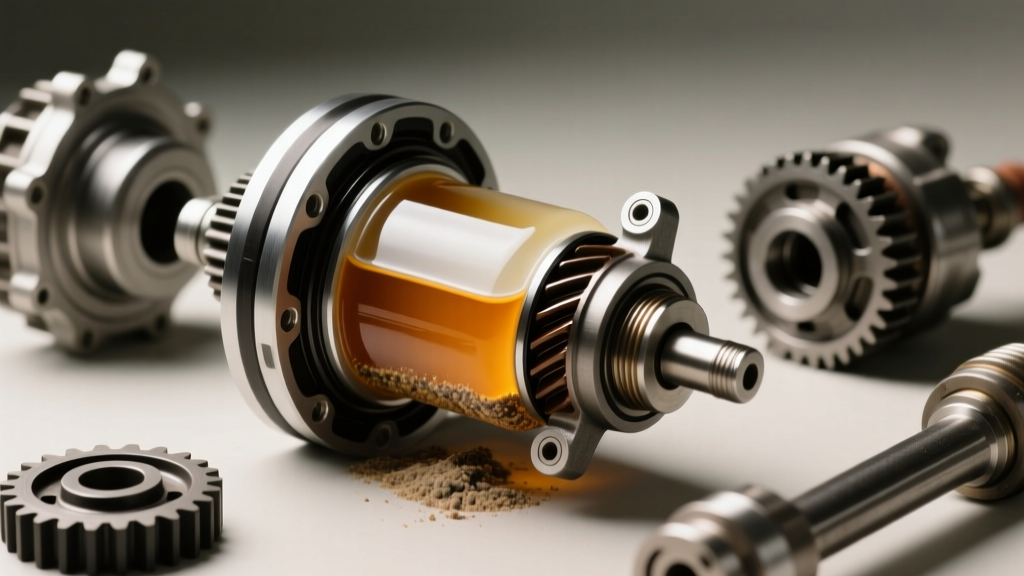
Before filling with new fluid, inspect the drained OEM oil. Because the factory coupling may have allowed slight misalignment or harmonic vibration, look for excessive brass-colored shavings (indicating spider gear wear) or chunky steel flakes. A fine, glitter-like metallic paste on the magnetic drain plug is normal for the first 50,000 miles. If you find chunks larger than a grain of rice, a tear-down is required before upgrading the coupling.
Step 3: The 75W-140 Fill and Friction Modifier Protocol
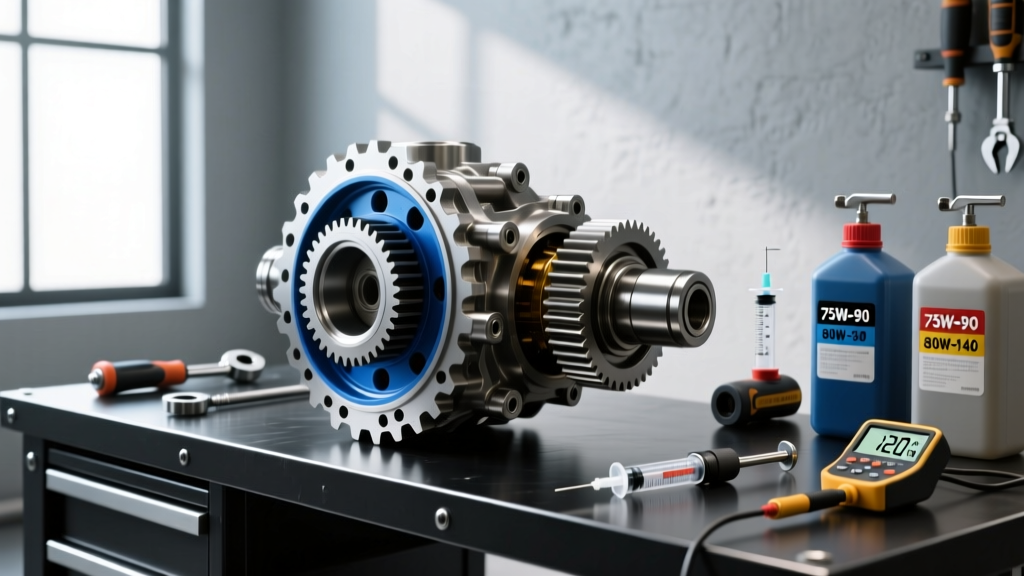
When upgrading to a 75W-140 synthetic fluid like AMSOIL Severe Gear or Royal Purple Max Gear, the fluid's high viscosity requires a specific filling technique to avoid air pockets in the upper pinion bearing.
1. Pump the fluid slowly into the fill hole until it reaches the bottom edge of the plug threads.
2. If your truck features a clutch-type limited-slip differential (LSD), the heavy 75W-140 base oil can mask the friction modifier. Add exactly 2 oz of OEM friction modifier (GM Part #88900338 or Ford XL-3) before the final top-off.
3. Jack up both rear wheels and spin them by hand for 3 minutes to distribute the modifier into the clutch packs before sealing the plug. Torque the fill plug to 25-30 lb-ft using a new crush washer.
Post-Upgrade Break-In and NVH Troubleshooting
After upgrading the rear differential coupling and switching to a heavier fluid, the first 500 miles are a critical break-in period. The heavier 75W-140 fluid will cause a slight increase in parasitic drag, which may result in a 0.5 to 1.0 MPG drop during cold-weather driving until the axle reaches operating temperature (typically 180°F to 200°F under load).
Diagnosing Post-Upgrade Noise
A solid coupling upgrade often unmasks underlying axle issues that were previously hidden by OEM rubber dampeners. Use this diagnostic framework:
- High-Pitched Whine on Deceleration: Often caused by the solid coupling transmitting driveline coasting loads directly to the pinion. If the fluid level is correct, check your pinion bearing preload. A rotational torque below 12 in-lbs indicates a loose pinion nut.
- Clunk on Engagement: If you still experience lash after upgrading the coupling, the issue is likely excessive backlash inside the differential (ring and pinion clearance exceeding 0.012 inches) or worn side-gear thrust washers.
- LSD Chatter on Tight Turns: The 75W-140 fluid is too thick to allow rapid friction modifier absorption. Perform three figure-8 maneuvers in an empty lot to force the fluid through the clutch packs.
Long-Term Maintenance Intervals for Upgraded Drivelines
Standard manufacturer recommendations suggest differential fluid changes every 150,000 miles under 'normal' conditions. However, an upgraded rear differential coupling on a truck used for towing or off-roading shifts your rig into 'severe' duty. According to drivetrain specialists at Yukon Gear & Axle, the increased shock loads break down the long-chain polymers in synthetic gear oils faster than steady-state highway driving.
The 2026 Best Practice Interval: Drain and refill your upgraded differential with fresh 75W-140 synthetic fluid every 50,000 miles or every 3rd engine oil change. If you frequently tow loads exceeding 10,000 lbs in mountainous terrain, install a differential cover with integrated cooling fins or a fluid pump loop to keep sump temperatures below 230°F, which is the threshold where extreme pressure (EP) additives begin to rapidly degrade.
For more technical specifications on U-joint angles and driveline geometry, refer to the engineering resources available at Spicer Parts. By pairing a robust rear differential coupling with the correct high-shear fluid and strict maintenance intervals, your truck's axle will reliably handle the extreme torque demands of modern heavy-duty performance.