Understanding Rear Differential Leaks and Service Costs
If you have noticed a thick, pungent-smelling oil slung across the undercarriage of your truck or SUV, you are likely dealing with a failing pinion seal. Because replacing this seal requires draining the axle, it naturally pairs with a mandatory gear oil service. As of 2026, understanding the rear differential pinion seal replacement cost alongside the proper differential fluid change procedure is critical for maintaining the longevity of your ring and pinion gears, bearings, and limited-slip clutches.
In this comprehensive guide, we break down the real-world costs of pinion seal replacement, outline manufacturer versus severe-duty service intervals, and provide a master technician-level, step-by-step differential fluid change procedure.
Breaking Down the Rear Differential Pinion Seal Replacement Cost
The pinion seal sits where the driveshaft yoke meets the differential housing, keeping gear oil inside the axle tube and contaminants out. When it fails, the financial impact depends heavily on whether the leak is caused by simple rubber degradation or underlying mechanical wear.
2026 Pricing and Labor Estimates
According to current industry data and parts suppliers like SKF USA and Timken, the seal itself is relatively inexpensive. The bulk of the expense comes from labor and the requisite gear oil.
| Cost Factor | Light-Duty SUV (e.g., GM 10-Bolt) | Heavy-Duty Truck (e.g., Dana 80 / AAM 11.5) |
|---|---|---|
| Pinion Seal Part (Timken/SKF) | $18 - $35 | $35 - $65 |
| Synthetic Gear Oil (75W-90 / 75W-140) | $60 - $90 | $110 - $160 |
| Labor (1.5 to 3.0 Hours @ $165/hr) | $247 - $330 | $330 - $495 |
| Total Estimated Cost | $325 - $455 | $475 - $720 |
Expert Warning: If the pinion seal failed due to excessive pinion bearing runout or a worn yoke sealing surface, simply pressing in a new seal will result in another leak within 5,000 miles. A full pinion bearing and crush sleeve replacement will push the cost closer to $900–$1,200.
Differential Fluid Change Intervals: When to Service
While many modern owner's manuals claim differential fluid is 'lifetime' or recommend intervals up to 150,000 miles, drivetrain experts universally reject this for vehicles that tow, off-road, or operate in extreme temperatures. Gear oil degrades, losing its extreme-pressure (EP) additives and shear stability over time.
- Normal Commuter Duty: Every 60,000 to 100,000 miles.
- Severe Duty (Towing/Off-Road/Snow Plowing): Every 15,000 to 30,000 miles. If you submerge your axles in water, the fluid must be changed immediately to prevent emulsification and catastrophic bearing failure.
- Break-In Service: Always change the factory gear oil after the first 3,000 miles to remove microscopic metallic shavings from the initial ring and pinion gear mating process.
Step-by-Step Guide: Rear Differential Fluid Change Procedure
Whether you are addressing a leak or performing routine maintenance, follow this exact procedure to ensure a clean, leak-free service. High-quality synthetic fluids, such as those detailed by AMSOIL, are highly recommended for their superior thermal stability.
Tools and Materials Required
- 3/8' and 1/2' drive torque wrenches
- Sockets for cover bolts and fill/drain plugs (typically 13mm, 15mm, or 3/8' square drive)
- Gasket scraper or razor blade
- Brake parts cleaner and lint-free shop towels
- Permatex Ultra Black RTV Silicone (Part #81173) or OEM stamped steel gasket
- Gear oil pump and correct viscosity fluid (e.g., 75W-90 or 75W-140)
- Friction Modifier (if equipped with a clutch-type Limited Slip Differential)
Step 1: Remove the Fill Plug FIRST
This is the golden rule of differential service. Always break the fill plug loose before draining the fluid or removing the cover. If your fill plug is seized or stripped, you do not want to discover this after your differential is completely empty and covered in RTV sealant. Once the fill plug is loose, remove it entirely.
Step 2: Drain the Old Gear Oil
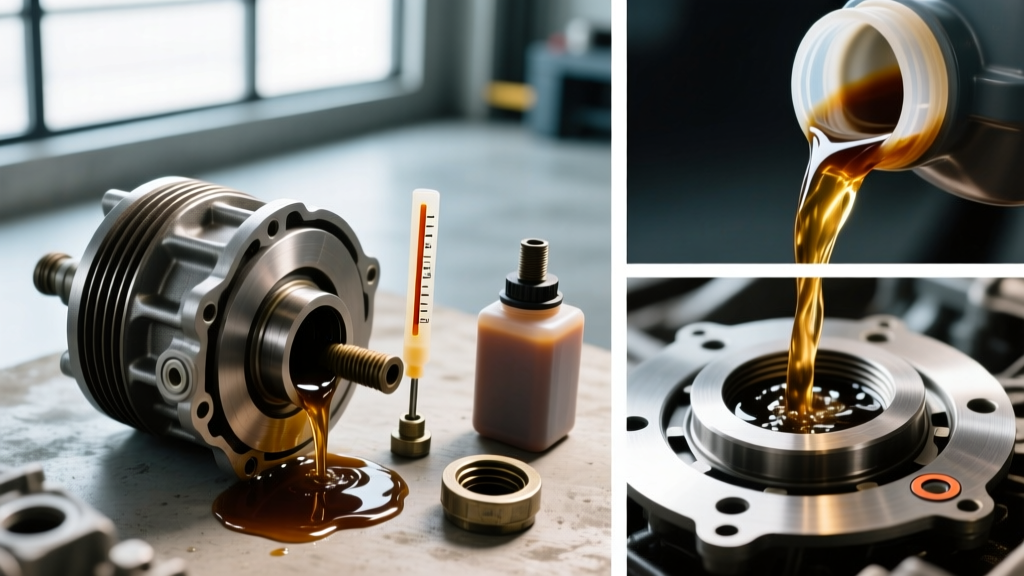
If your differential has a dedicated drain plug at the bottom of the housing, remove it and let the fluid drain into a catch pan. If your axle relies on a 'dry' housing (like the Ford 8.8' or GM 10-bolt), place your catch pan underneath and carefully break the seal on the differential cover using a flathead screwdriver. Allow the fluid to drain completely. Inspect the old fluid: a slight metallic glitter is normal, but large chips or a milky appearance indicates severe internal damage or water intrusion.
Step 3: Clean the Housing and Inspect the Pinion Seal
While the cover is off, wipe out the interior of the axle housing. Pay special attention to the ring gear teeth and the differential carrier magnets. Clean the magnets thoroughly; they are designed to capture ferrous wear particles.
Pinion Seal Inspection: Take a flashlight and look deep into the pinion snout area. If you see active weeping or a heavy buildup of sludge around the pinion yoke, your research into the rear differential pinion seal replacement cost is about to pay off. You will need to remove the driveshaft, mark the yoke for re-alignment, remove the pinion nut, and use a seal puller to extract the old seal before tapping in a new, lubricated Timken or SKF seal.
Step 4: Prep the Cover and Apply Sealant
Scrape all old RTV or gasket material from both the differential cover and the housing mating surface. Wipe both surfaces with brake cleaner until completely oil-free. Apply a continuous 3mm bead of Permatex Ultra Black RTV to the cover. Ensure you circle all bolt holes completely to prevent vacuum leaks or oil seepage.
Step 5: Reinstall Cover and Torque to Spec
Place the cover onto the housing and thread all bolts in by hand to prevent cross-threading. Tighten the bolts in a crisscross, star-pattern sequence to ensure even clamping force. Torque the bolts to the manufacturer's exact specification (see reference table below). Allow the RTV to cure for at least 1 hour before refilling.
Step 6: Refill with Gear Oil and Additives
If your vehicle has a clutch-type Limited Slip Differential (LSD), add the required bottle of friction modifier (e.g., Motorcraft XL-3 or GM 88900338) into the fill hole before pumping in the thick gear oil. This ensures the modifier mixes thoroughly. Using a hand pump, fill the differential with synthetic gear oil until it begins to weep out of the bottom edge of the fill hole. Reinstall the fill plug and torque it to 15-25 lb-ft.
Axle Torque Specs & Fluid Capacity Reference Chart
Always verify specifications with your specific vehicle's factory service manual. The table below represents common baseline specifications for popular light-duty and heavy-duty axles.
| Axle Model | Fluid Capacity (Approx.) | Recommended Viscosity | Cover Bolt Torque | Fill Plug Torque |
|---|---|---|---|---|
| Ford 8.8' (Super 8.8) | 1.8 - 2.1 Quarts | 75W-140 Synthetic | 28 - 38 lb-ft | 15 - 22 lb-ft |
| GM 9.5' / 10.5' (AAM) | 2.7 - 3.2 Quarts | 75W-90 Synthetic | 25 - 35 lb-ft | 22 - 30 lb-ft |
| Dana 44 (JK/JL Wrangler) | 1.8 - 2.0 Quarts | 75W-140 Synthetic | 30 - 40 lb-ft | 25 - 35 lb-ft |
| GM 10-Bolt / 12-Bolt | 2.0 - 2.5 Quarts | 75W-90 Synthetic | 20 - 25 lb-ft | 15 - 25 lb-ft |
Final Thoughts on Drivetrain Longevity
Ignoring a minor pinion seal leak will eventually lead to low fluid levels, resulting in extreme friction, overheating, and the total destruction of your ring and pinion set. By understanding the true rear differential pinion seal replacement cost and pairing the repair with a meticulous, step-by-step differential fluid change procedure, you protect your drivetrain investment. Whether you are wrenching in your driveway or auditing a shop's invoice, adhering to precise torque specs, using high-quality synthetic lubricants, and respecting severe-duty service intervals will keep your axles turning smoothly for hundreds of thousands of miles.