The 'Differential Pressure Level Transmitter' Misconception
If you have found yourself searching for a differential pressure level transmitter while researching your truck or SUV's axle maintenance, you have likely crossed wires between industrial instrumentation and automotive mechanics. In the industrial sector, a differential pressure level transmitter is a highly calibrated IoT sensor used to measure liquid levels in pressurized chemical or water tanks by comparing hydrostatic pressure at the bottom to the vapor pressure at the top.
Your vehicle’s automotive differential, however, does not use electronic pressure transmitters to monitor gear oil levels. Instead, automotive axle systems rely on mechanical sight plugs, dipsticks, or simple fill-to-overflow methods. While modern 2026 powertrain control modules (PCMs) can estimate differential fluid life based on thermal modeling and towing load algorithms, there is no physical pressure transmitter inside your Dana 44 or Ford 10.5-inch axle housing. To maintain your ring and pinion gears, you must rely on physical inspection and manual fluid service.
Below is your definitive, step-by-step how-to guide for automotive differential fluid change procedures, severe-duty intervals, and precise torque specifications for popular truck and SUV platforms.
Understanding Gear Oil Chemistry and Service Intervals
Before turning a wrench, it is critical to understand why differential fluid degrades. Automotive axles require API GL-5 certified gear oils. These oils are packed with sulfur-phosphorus Extreme Pressure (EP) additives designed to protect hypoid gear sets—where the pinion gear sits below the centerline of the ring gear, creating massive sliding friction.
Over time, thermal cycling and mechanical shear break down these EP additives. When the additives deplete, micropitting occurs on the gear teeth, leading to catastrophic ring and pinion failure. According to the American Petroleum Institute (API), maintaining the correct GL-5 viscosity and additive package is the single most important factor in axle longevity.
Normal vs. Severe Duty Service Intervals
Many OEM owner's manuals claim differential fluid is 'lifetime' or only requires changes every 150,000 miles. However, this applies strictly to light-duty highway driving. If you tow, off-road, or operate in extreme temperatures, you must follow the severe duty schedule.
| Duty Cycle | Definition | Recommended Interval | Fluid Type |
|---|---|---|---|
| Normal | Highway commuting, empty bed, mild climates | 100,000 - 150,000 Miles | Synthetic 75W-90 / 75W-140 |
| Severe (Towing) | Towing >5,000 lbs, frequent mountain grades | 30,000 - 50,000 Miles | Synthetic 75W-140 GL-5 |
| Severe (Off-Road) | Water crossings, deep mud, rock crawling | 15,000 Miles or Annually | Synthetic 75W-140 + Marine Grease on Breathers |
For vehicles like the Ford F-150 or Jeep Wrangler, Ford's official towing guides and Mopar service documentation explicitly mandate dropping the interval to 30,000 miles when the vehicle is used for sustained trailer towing.
Step-by-Step Differential Fluid Change Procedure
This procedure covers the most common axle configurations: the Dana 44 (found in Jeep Wrangler JL/Gladiator) and the Sterling 10.5-inch (found in Ford F-150s).
Step 1: Preparation and Fluid Extraction
Tools Required: Floor jack, jack stands, drain pan, 3/8-inch and 1/2-inch drive sockets, Mityvac fluid extractor (if no drain plug is present), and a gear oil pump bottle.
- Level the Vehicle: Park on a perfectly level surface. An inclined driveway will result in an under-filled differential, leading to pinion bearing starvation.
- Remove the Fill Plug FIRST: Never remove the drain plug or differential cover before removing the fill plug. If the fill plug is seized or stripped, you will be stranded with an empty axle and no way to refill it.
- Extract the Fluid: Many modern axles (like the GM 9.5-inch 14-bolt and Ford Sterling) do not feature a bottom drain plug to prevent catastrophic fluid loss from off-road impacts. Use a Mityvac pneumatic or manual fluid extractor to suck the old 75W-140 gear oil out through the fill hole. If your Dana 44 has a removable cover, place a catch pan underneath and break the bottom seal of the cover with a flathead screwdriver to let it drain.
Step 2: Inspection and Surface Prep
Once the fluid is drained, you have a critical diagnostic opportunity. Inspect the old fluid and the magnetic fill plug (or drain plug).
- Normal Wear: A fine, gray metallic 'fuzz' on the magnet is completely normal. This is the byproduct of initial gear lapping and normal clutch-pack wear.
- Abnormal Wear: If you find metallic chunks larger than a grain of rice, or if the fluid has a glittery, metallic sheen, your ring and pinion or carrier bearings are failing and require a teardown.
- Water Intrusion: If the fluid looks like a chocolate milkshake, water has bypassed your axle seals or breather valve. You must flush the axle with cheap mineral gear oil before refilling with premium synthetic.
RTV vs. Gaskets: If you removed a differential cover, scrape the old RTV silicone off the housing and cover using a plastic gasket scraper (never steel, which gouges the mating surface). Clean both surfaces with brake cleaner. Apply a 3mm bead of high-temp RTV (like Permatex Ultra Black) to the cover, wait 10 minutes for it to skin over, and reinstall.
Step 3: Refilling and the Friction Modifier Debate
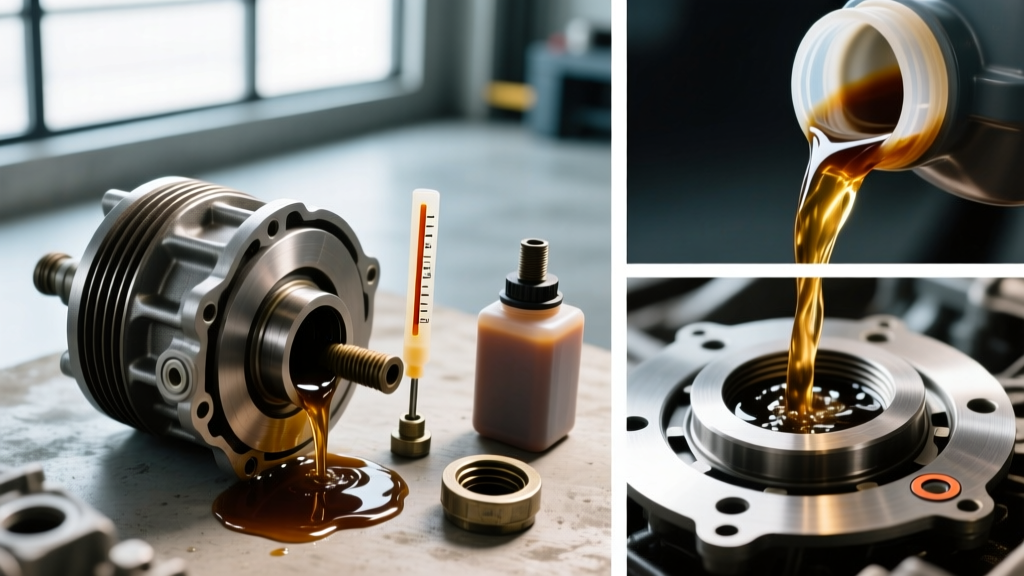
Pump the new synthetic gear oil into the fill hole until it reaches the exact bottom edge of the fill plug threads. This is the 'fill-to-overflow' method. However, you must account for your specific differential type.
Do you need a Friction Modifier?
- Clutch-Type LSD (Trac-Lok, Auburn, OEM Torsen-style clutch packs): YES. You must add 2 to 4 ounces of Limited Slip Friction Modifier. This alters the coefficient of friction to prevent 'stick-slip' chatter during low-speed cornering. Without it, the clutch packs will bind and shatter.
- Open Differentials & Lockers (Detroit Locker, ARB Air Locker): NO. Friction modifiers are unnecessary and can reduce the protective film strength of the GL-5 oil.
- Helical Gear LSDs (True Torsen, TrueTrac): NO. These operate on worm-gear torque biasing, not friction clutches. Standard GL-5 is all they require.
Torque Specifications and Capacity Chart (2026 Reference)
Always use a calibrated torque wrench when reinstalling fill plugs and differential covers. Over-torquing can crack cast aluminum axle housings or distort stamped steel covers, leading to immediate leaks.
| Axle Model | Common Vehicles | Fluid Capacity | Fill/Cover Torque Spec | OEM Fluid Spec |
|---|---|---|---|---|
| Dana 44 M220 (Rear) | 2018-2026 Jeep Wrangler JL | 2.0 Liters (68 oz) | Cover Bolts: 30 lb-ft | Mopar 75W-85 GL-5 |
| Sterling 10.5-inch | 2015-2026 Ford F-150 (Heavy Payload) | 2.4 Liters (82 oz) | Fill Plug: 22 lb-ft | Motorcraft 75W-140 Synthetic |
| GM 9.5-inch 14-Bolt | 2019-2026 Chevy Silverado 1500 | 2.7 Liters (92 oz) | Cover Bolts: 25 lb-ft | ACDelco 75W-90 Synthetic |
By ignoring industrial sensor terminology and focusing on mechanical best practices, precise torque specs, and correct API GL-5 chemistry, you can easily extend the life of your axle assembly well past 200,000 miles, even under severe towing conditions.