Rear axle noise is one of the most misunderstood drivetrain symptoms in automotive repair. When a whine, clunk, or chatter emanates from the rear of your vehicle, the immediate instinct is often to assume catastrophic gear failure. However, as any seasoned drivetrain specialist will tell you, the root cause frequently traces back to degraded, contaminated, or incorrectly specified differential fluid. In 2026, with modern synthetic lubricants pushing service intervals further than ever, owners and technicians alike are caught off guard when hypoid gear sets begin to vocalize their distress.
Before you order a $300 master rebuild kit or authorize $1,500 in shop labor, you must perform a systematic diagnosis. This guide bridges the gap between auditory symptom diagnosis and physical fluid analysis, helping you determine whether a simple drain-and-fill will save your axle, or if the ring and pinion are already headed for the scrap bin.
The Auditory Diagnostic Matrix: Decoding Axle Noises
Differentials speak to you if you know how to listen. The pitch, timing, and load condition under which a noise occurs will point you toward either a fluid-related issue or a hard-part mechanical failure. Use the matrix below to cross-reference your symptoms.
| Symptom | Load Condition | Probable Mechanical Cause | Fluid / Service Action |
|---|---|---|---|
| High-pitched whine | Deceleration (coasting) | Pinion bearing wear / Loss of preload | Inspect fluid for fine metallic paste. Check pinion nut torque. |
| Low-frequency howl | Acceleration (under load) | Ring and pinion gear wear / Improper backlash | Fluid change will not fix. Rebuild required. Inspect for chunky metal. |
| Clunk or knock | Shifting from Reverse to Drive | Excessive backlash / Worn side gear thrust washers | Check fluid level. Inspect spider gears and cross-pin for galling. |
| Chatter or binding | Tight, low-speed turns | Limited-slip clutch pack stick-slip | Drain fluid, replace friction modifier additive, and perform figure-8 burnish. |
| Rhythmic clicking | Constant speed, one side only | Damaged axle shaft bearing or C-clip wear | Fluid service irrelevant. Pull axle shaft and inspect bearing race. |
The Chemistry of Failure: Why Differential Fluid Degrades
To understand why a fluid change might cure a whine, you must understand the extreme environment inside a hypoid gear housing. Unlike standard spur gears that roll, hypoid ring and pinion gears experience massive sliding friction. To survive this, GL-5 differential fluid is packed with sulfur-phosphorus extreme pressure (EP) additives.
Under immense localized heat and shearing forces, these EP additives react with the metal surfaces to form a microscopic, sacrificial boundary layer of iron sulfide and iron phosphide. This layer prevents metal-to-metal contact. However, over tens of thousands of miles of thermal cycling, these additives deplete. Once the boundary layer fails, micropitting occurs on the gear faces, creating the audible whine associated with worn differentials. Catching this depletion early via a fluid service can halt the progression of micropitting.
Visual Inspection: Glitter vs. Chunks
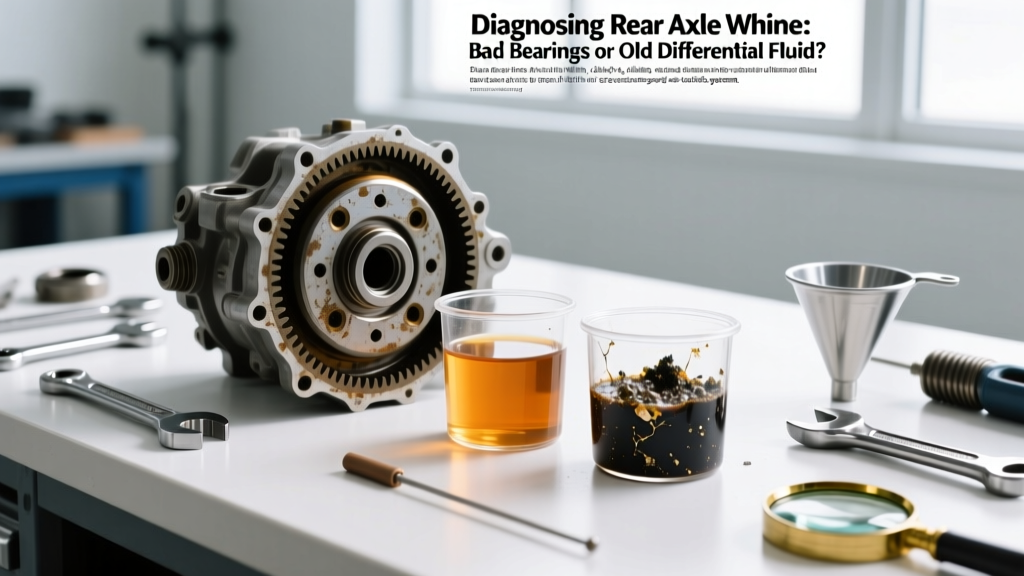
When you pull the differential cover or drain plug, the visual state of the fluid is your most reliable diagnostic tool. According to Yukon Gear & Axle technical guidelines, analyzing the debris on the drain plug magnet and the bottom of the housing tells the true story of the axle's health.
Acceptable Wear (The "Glitter" Phase)
- Appearance: The fluid looks dark grey or metallic silver, resembling metallic paint.
- Magnet: Covered in a fine, fuzzy metallic paste.
- Diagnosis: Normal clutch pack and gear wear for a unit with 60,000+ miles.
- Action: A standard differential fluid service will restore proper lubrication and EP boundary protection.
Catastrophic Failure (The "Chunk" Phase)
- Appearance: Fluid is black, smells severely burnt (like sulfur and scorched oil), and contains visible flakes.
- Magnet: Holds distinct metal shards, needle bearing fragments, or pieces larger than a grain of rice.
- Diagnosis: Bearing cage failure, spider gear tooth shear, or ring gear spalling.
- Action: Do not waste money on a fluid change. The differential requires a complete teardown, hot-tanking, and a master rebuild kit (typically $180-$350 for parts, plus $800-$1,200 in machine shop labor).
Pro-Tip on Limited-Slip Chatter: If your vehicle is equipped with a clutch-type limited-slip differential (LSD) like the Eaton Posi or Ford Traction-Lok, chatter during tight turns is rarely a sign of mechanical failure. It almost always indicates that the friction modifier additive in the differential fluid has oxidized and depleted. Adding 2-4 oz of a high-quality modifier (e.g., Ford XL-3 or GM EOS) and performing ten figure-8 maneuvers in an empty lot will usually cure the issue instantly.
Service Specifications for Common Rear Axles
Using the correct viscosity and meeting the precise API GL-5 specification is non-negotiable. Referencing AMSOIL Severe Gear technical data, modern synthetic 75W-90 offers vastly superior cold-weather flow and high-temperature shear stability compared to conventional 80W-90. Below are the baseline specifications for the most popular light-truck and SUV rear axles.
| Axle Model | Fluid Capacity | Recommended Viscosity | Cover Bolt Torque |
|---|---|---|---|
| GM 8.5" / 8.6" 10-Bolt | 2.1 Quarts | 75W-90 Synthetic GL-5 | 25 lb-ft |
| Ford 8.8" (Super 8.8) | 2.5 - 3.0 Pints | 75W-140 (Towing) / 75W-90 | 28 - 38 lb-ft |
| Dana 44 (JK/JL Wrangler) | 2.0 Quarts | 75W-140 Synthetic GL-5 | 30 - 40 lb-ft |
| Chrysler 8.75" (Sure-Grip) | 2.25 Quarts | 75W-90 GL-5 + Modifier | 30 lb-ft |
The Professional Service Procedure: RTV vs. Gaskets
A frequent point of failure in DIY differential service is improper sealing, leading to fluid starvation and subsequent bearing death. While some axles (like the Dana 44) utilize a stamped steel gasket, most modern corporate axles (GM 10-bolt, Ford 8.8) rely on RTV silicone. Follow this exact sequence to ensure a leak-free seal:
- Prep and Drain: Remove the fill plug before removing the cover. (If the fill plug is seized or strips, you do not want to be left with an open, drained differential and no way to refill it).
- Cover Removal: Loosen cover bolts in a cross-pattern. Leave the top two bolts loosely threaded to act as a hinge, allowing the fluid to drain into a catch pan controlled.
- Surface Mating: Use a plastic gasket scraper and brake cleaner to remove all old RTV. Never use a metal razor blade or Scotch-Brite pad on aluminum or soft steel housings, as scoring the mating surface guarantees a permanent leak.
- RTV Application: Apply a continuous 3mm bead of high-temp RTV (such as Permatex Ultra Black or The Right Stuff) to the cover. Ensure you circle every bolt hole.
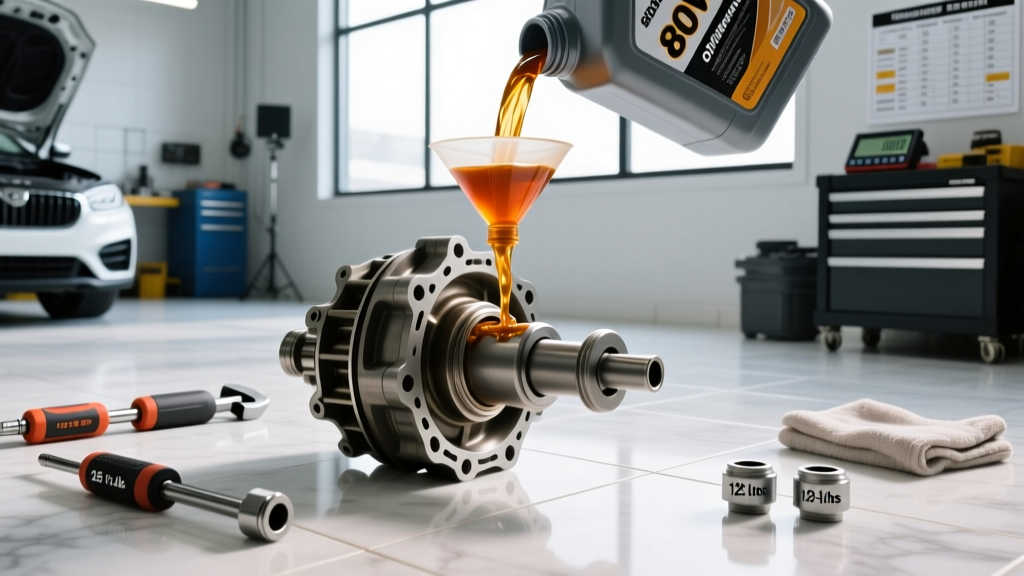
- Torque Sequence: Reinstall the cover and torque the bolts in a star pattern to the manufacturer's specification (e.g., 25 lb-ft for GM). Wait 1 hour for the RTV to skin over before filling.
- Fill and Verify: Pump in the new differential fluid until it reaches the exact bottom lip of the fill plug hole. If equipped with an LSD, inject the friction modifier first so the incoming gear oil mixes it thoroughly.
When Differential Fluid Service Fails: Rebuild Territory
If you have performed a fluid service, verified the friction modifier levels, and the whine or howl persists, the damage to the hypoid gear set is permanent. According to Ring & Pinion technical archives, once the metallurgical surface hardening of a ring and pinion is compromised by micropitting or spalling, no viscosity of oil can quiet the noise.
At this stage, troubleshooting moves from fluid analysis to precision measurement. A technician must measure gear backlash (typically 0.006" to 0.010" for street applications) and check pinion bearing preload using an inch-pound beam torque wrench. If you are facing a rebuild, expect to invest in a high-quality master kit (like Yukon Gear or Motive Gear, part numbers varying by axle ratio) which includes new Timken bearings, crush sleeves, shims, and ring gear bolts. The cost of premium synthetic differential fluid is roughly $20-$25 per quart—a minor insurance policy compared to the $1,500 reality of a neglected axle rebuild.