The Critical Role of Rear Differential Fluid in LSDs
When servicing a solid rear axle, many technicians treat the differential as a simple gear-reduction box. However, if your vehicle is equipped with a Limited Slip Differential (LSD), the rear differential fluid is not merely a lubricant; it is an active hydraulic and friction-management component. In clutch-type LSDs, the fluid dictates the slip-to-lock transition, manages thermal loads across the clutch packs, and prevents the catastrophic stick-slip friction known as 'chatter.' Understanding the mechanical nuances of your specific LSD is mandatory before draining a single drop of gear oil.
Mechanics of Clutch-Type Limited Slip Differentials
Clutch-type LSDs (found in the Ford 8.8, Dana 44, and Chrysler 8.25 axles) utilize a set of spider and side gears interlaced with alternating steel and friction-material clutch packs. A preload spring—often an S-shaped or V-shaped Belleville washer—applies constant clamping force to these packs.
- Straight-Line Driving: Both axle shafts spin at the same speed. The clutch packs rotate as a single solid unit, and the rear differential fluid primarily cools the ring and pinion gears.
- Cornering: The outside wheel must spin faster than the inside wheel. The spider gears force the side gears to slip against the clutch packs. Here, the fluid's friction-modifier additive package prevents the clutches from grabbing and releasing violently (stick-slip), allowing a smooth, controlled slip.
Over time, the preload springs fatigue and lose their clamping force. When this occurs, the clutch packs slip excessively under heavy throttle, generating immense heat. This heat degrades the rear differential fluid, boiling off the vital friction modifiers and leading to glazed clutch discs that require a complete differential rebuild.
Helical (Torsen) vs. Clutch-Pack: Fluid Requirements
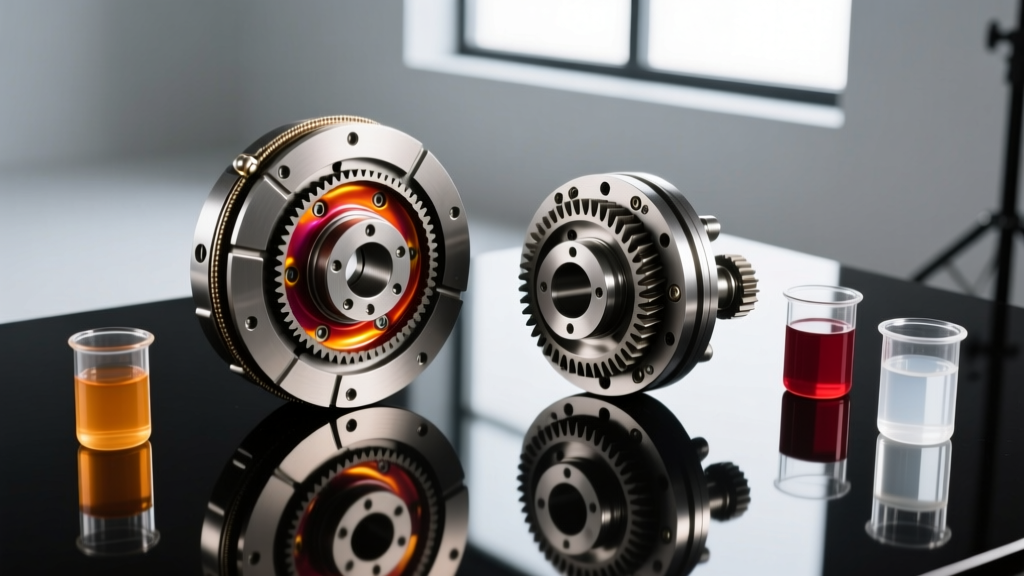
Not all limited slip differentials require the same chemical formulation. Misapplying friction modifiers to a helical gear-based LSD can cause erratic torque biasing and premature wear.
| LSD Type | Mechanism | Friction Modifier Required? | Typical Fluid Viscosity | Common Applications |
|---|---|---|---|---|
| Clutch-Type (Posi, Trac-Lok) | Friction discs and preload springs | Yes (Mandatory) | 75W-90 or 75W-140 GL-5 | Ford 8.8, Dana 44, GM 10-Bolt |
| Helical (Torsen, Truetrac) | Worm gears and side gears | No (Detrimental) | 75W-90 GL-5 | ZF axles, Hummer, aftermarket upgrades |
| Viscous / Electronic (eLSD) | Shear-thickening fluid or electronic clutches | Specific OEM fluid only | OEM Specific (e.g., DCT fluid) | Modern BMW M, Corvette C8 eLSD |
As noted by drivetrain engineering experts at Eaton Performance, helical units like the Detroit Truetrac rely on gear separation forces and friction between the gear teeth and the differential casing to multiply torque. Adding a friction modifier designed for clutch packs reduces this necessary gear friction, effectively 'neutering' the LSD's torque-biasing capabilities.
Selecting the Correct Rear Differential Fluid & Additives
For clutch-type LSDs, you must use an API GL-5 rated gear oil. GL-5 contains high levels of extreme pressure (EP) additives, typically zinc dialkyldithiophosphate (ZDDP) or sulfur-phosphorus compounds, which protect the hypoid ring and pinion gears from wiping under heavy shock loads. However, standard GL-5 fluid lacks the specific organic friction modifiers required for LSD clutch packs.
OEM Friction Modifier Part Numbers
If your chosen rear differential fluid does not explicitly state 'Limited Slip' on the bottle, you must add a dedicated friction modifier (FM). The standard dosage is typically 4 fluid ounces per axle.
- Ford Motorcraft XL-3: Part # XC-3Z-19546-A (Required for all Ford 8.8 and 9.75 Trac-Lok axles)
- GM ACDelco: Part # 88900338 (Required for GM 10-bolt and 12-bolt Positraction axles)
- Mopar Limited Slip Additive: Part # 4318060AB (Required for Chrysler 8.25 and Dana axles)
- Aftermarket Alternative: Red Line Limited Slip Friction Modifier (Part # 60104)
Expert Insight: Synthetic rear differential fluids (like Amsoil Severe Gear or Royal Purple Max Gear) offer vastly superior shear stability compared to conventional petroleum-based oils. According to AMSOIL Technical Services, the hypoid gear contact patch generates immense shearing forces that can permanently break down the viscosity of conventional oils. A synthetic 75W-90 will maintain its protective film strength far longer under high-torque towing or track conditions.
Step-by-Step LSD Rear Differential Fluid Service
Performing a fluid service on a clutch-type LSD requires specific procedures to ensure the friction modifier properly integrates into the clutch packs.
1. Drain, Clean, and Inspect
Remove the differential cover (or drain plug). Inspect the fluid for a burnt smell, which indicates glazed clutches. Check the magnetic drain plug or the RTV sealant ridge for excessive metallic fuzz. Fine gray paste is normal wear; chunky metal shards indicate ring and pinion or bearing failure.
2. Refill and Torque Specifications
Reinstall the cover using a high-quality RTV silicone (like Permatex Black or The Right Stuff) or a new gasket. Allow RTV to cure for the manufacturer's specified time before filling. Fill the axle with the correct volume of gear oil and friction modifier until the fluid level is exactly at the bottom of the fill plug hole.
| Axle Model | Fluid Capacity | Fill Plug Torque | Drain Plug Torque (if equipped) |
|---|---|---|---|
| Ford 8.8-inch | 3.75 Pints (1.8 Qt) | 15 - 30 lb-ft | 15 - 30 lb-ft |
| Dana 44 | 4.0 Pints (2.0 Qt) | 25 - 35 lb-ft | 25 - 35 lb-ft |
| Chrysler 8.25 | 4.0 Pints (2.0 Qt) | 25 - 35 lb-ft | N/A (Cover drain only) |
| GM 10-Bolt (8.5/8.6) | 4.2 Pints (2.1 Qt) | 15 - 25 lb-ft | N/A (Cover drain only) |
3. The Mandatory 'Figure-8' Break-In Procedure
This step is where most amateur mechanics fail. If you simply drain, fill, and drive onto the highway, the friction modifier will pool at the bottom of the differential housing. The clutch packs will chatter violently the first time you turn.
The Fix: Immediately after filling, drive the vehicle to a large, empty, dry parking lot. Perform 10 to 12 slow, tight 'Figure-8' maneuvers. This forces the spider gears to rotate and the clutch packs to slip and grab repeatedly, effectively pumping the friction modifier into the porous material of the clutch discs. If chatter persists after 12 Figure-8s, add 1 additional ounce of friction modifier and repeat.
Diagnosing LSD Chatter and Fluid Degradation
If your vehicle exhibits low-speed chatter during turns despite a recent fluid change, diagnose the root cause before condemning the differential:
- Insufficient FM: The most common cause. Add 1-2 oz of friction modifier and repeat the Figure-8 procedure.
- Over-Application of FM: Too much friction modifier will cause the clutches to slip continuously under hard acceleration, resulting in a loss of locking capability and excessive heat. This requires a complete drain and refill with fresh fluid and the exact OEM-specified FM dosage.
- Glazed Clutch Packs: If the fluid was run too low or too hot, the friction material may have glazed over. No amount of rear differential fluid or additive will fix glazed clutches; the differential cover must be removed, and the clutch packs replaced.
- Fatigued Preload Springs: High-mileage LSDs often suffer from collapsed S-springs. Upgrading to a thicker aftermarket clutch pack with higher-rate springs (available from manufacturers like Ring & Pinion) is the only permanent fix.
Summary
Maintaining a limited slip differential requires more than just swapping out old oil for new. By understanding the mechanical differences between clutch-type and helical LSDs, utilizing high-shear synthetic rear differential fluids, strictly adhering to OEM friction modifier formulations, and executing the Figure-8 break-in procedure, you ensure maximum traction, eliminate driveline chatter, and extend the operational life of your axle assembly.