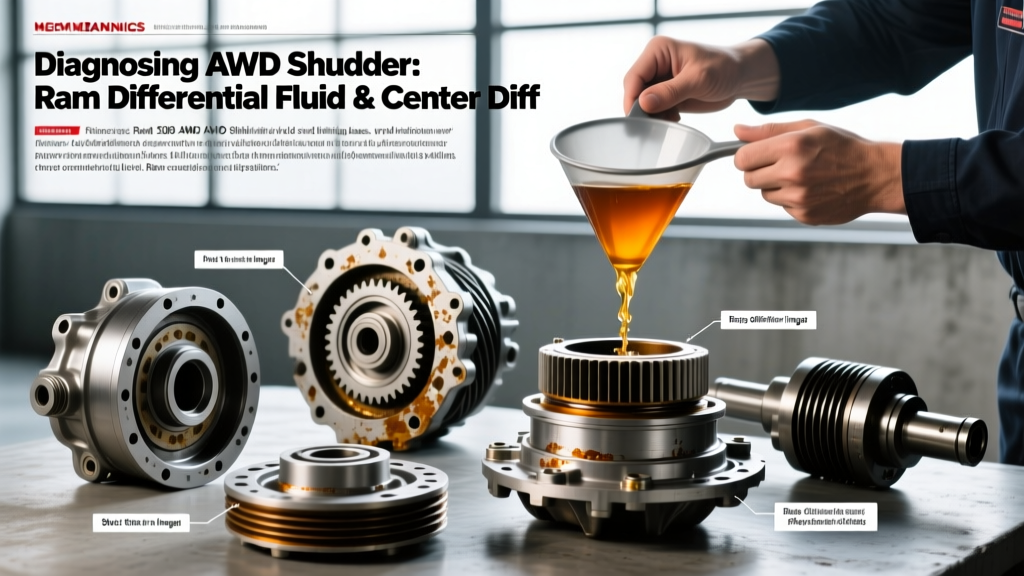
When a driver experiences a pronounced whine from the rear of their vehicle, a vibration at highway speeds, or a harsh clunk upon shifting into gear, the immediate question is often: what is differential service on a car, and why does my rear axle suddenly need it? In the modern automotive landscape of 2026, where factory-fill synthetic lubricants are marketed as 'lifetime' fluids, rear differential neglect is a leading cause of catastrophic drivetrain failure. Unlike the transmission or engine, the rear differential operates under extreme sliding friction and hypoid gear pressures, often entirely ignored until metallic debris begins circulating through the gear oil.
Demystifying the Drivetrain: What Is Differential Service on a Car?
At its core, differential service involves draining degraded gear oil, inspecting the internal components for metallurgical wear, and refilling the housing with fresh lubricant that meets precise API GL-5 or OEM-specific standards. For the rear axle, this service is critical because the hypoid ring and pinion gears do not simply roll against one another; they slide. This sliding action generates immense heat and shears the molecular bonds of standard gear oils. Over time, the extreme pressure (EP) additives—typically sulfur-phosphorus compounds—deplete, leaving the gear teeth vulnerable to micropitting, spalling, and eventual catastrophic tooth shear.
Rear differential maintenance is not merely a fluid swap; it is a vital diagnostic window into the health of your axle bearings, limited-slip clutch packs, and gear lash tolerances. Ignoring the early symptoms of differential degradation will turn a $150 fluid service into a $2,500 ring-and-pinion rebuild.
Auditory & Physical Symptom Diagnosis Matrix
Diagnosing rear differential issues requires a trained ear and an understanding of hypoid gear geometry. The noise profile changes depending on whether the gears are loaded (acceleration) or unloaded (coasting). Use the following diagnostic matrix to pinpoint the exact failure mode before removing the differential cover.
| Symptom / Noise Profile | Operating Condition | Probable Failure Mode | Required Action |
|---|---|---|---|
| High-pitched whine or howl | Deceleration (Coast side) | Pinion bearing wear or coast-side gear polishing | Check pinion preload; inspect gear pattern |
| Low-frequency rumble | Acceleration (Drive side) | Differential carrier bearing failure or low fluid | Replace carrier bearings; verify fluid level |
| Sharp clunk or backlash slap | Shifting from Reverse to Drive | Excessive ring gear backlash or worn spider gears | Measure backlash with dial indicator (Spec: 0.006'-0.010') |
| Chatter or binding sensation | Low-speed tight turns | Limited-slip friction modifier depletion | Drain fluid, add OEM LSD modifier, perform figure-8 burn-in |
| Rhythmic knocking at speed | Constant highway cruising | Chipped ring gear tooth or spalled pinion bearing race | Immediate teardown; replace damaged hard parts |
The Teardown: Visual Inspection & Metallurgical Clues
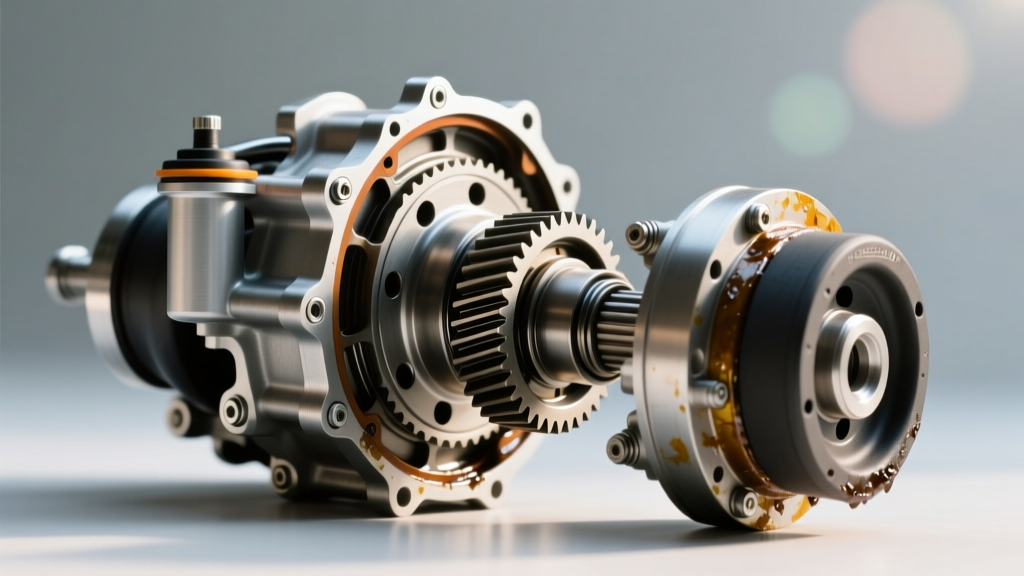
Once the symptoms point to the rear axle, the physical inspection begins. When you remove the rear differential cover (or drain plug on sealed units like the Ford 10.5-inch or modern ZF axles), the condition of the fluid and the magnet will tell the story of the axle's internal health.
Analyzing the Drain Plug Magnet
- Fine, silvery paste: Normal wear. The EP additives are doing their job, and the magnet is capturing microscopic metallic dust from the thrust washers and bearing cages.
- Chunky, jagged metal shards: Critical failure. This indicates active spalling on the ring gear teeth or a disintegrating pinion bearing race. A simple fluid change will not save this axle; a full rebuild is required.
- Brass or copper flakes: Synchro or thrust washer degradation. While more common in manual transmissions, some limited-slip differentials utilize brass clutch drums or bronze thrust washers that shed material when starved of lubrication.
Inspecting the Ring and Pinion Teeth
With the cover removed, rotate the pinion yoke by hand and inspect the gear teeth. You are looking for spalling (flaking of the surface metal due to fatigue), pitting (small craters caused by inadequate lubrication film strength), and stepping (a physical ridge worn into the tooth profile). According to engineering guidelines from Ring & Pinion Service, any visible stepping on the drive side of the gear tooth mandates a complete gear set replacement, as the metallurgical hardening layer has been breached.
Rear Differential Service: Fluids, Additives, and Capacities
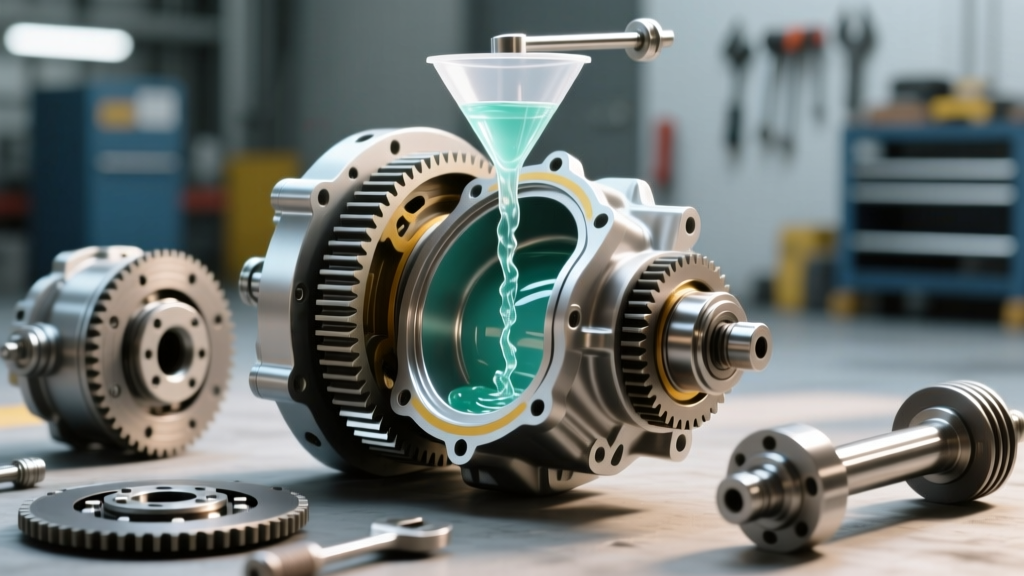
Understanding what differential service on a car requires means selecting the exact fluid chemistry. Modern rear axles demand API GL-5 rated synthetic gear oils. GL-5 fluids contain high levels of sulfur-phosphorus EP additives designed to withstand the extreme sliding pressures of hypoid gears. Never use GL-4 fluid in a hypoid rear differential; it lacks the shear stability required and will lead to rapid gear wipe-out.
Furthermore, if your vehicle is equipped with a clutch-type Limited Slip Differential (LSD), such as the Ford Traction-Lok or Dana Trac-Lok, you must add a specific friction modifier. Without it, the clutch packs will bind during cornering, resulting in severe axle hop and chatter.
| Axle Model | Fluid Capacity | Recommended Viscosity | Cover Bolt Torque | LSD Modifier Required? |
|---|---|---|---|---|
| Ford 8.8-inch (Solid Axle) | 2.5 - 3.0 Pints | 75W-140 Synthetic | 25 - 30 lb-ft | Yes (if equipped w/ Traction-Lok) |
| Dana 44 (Jeep/Truck) | 3.5 - 4.0 Pints | 75W-90 or 80W-90 GL-5 | 30 - 35 lb-ft | Yes (if equipped w/ Trac-Lok) |
| GM 8.6' / 9.5' (10/14-Bolt) | 4.2 - 5.5 Pints | 75W-90 Synthetic | 22 - 27 lb-ft | Yes (if equipped w/ G80 Locker) |
| Chrysler 8.25' (C-Clip Eliminator) | 3.5 Pints | 75W-90 GL-5 | 30 lb-ft | Yes (if equipped w/ Trac-Lok) |
Precision Reassembly: Torque Specs and Backlash Verification
A proper rear differential service extends beyond the fluid. If you are diagnosing a clunk or whine, you must verify the gear setup. This requires specialized tools and adherence to strict torque specifications.
Measuring Backlash and Pinion Preload
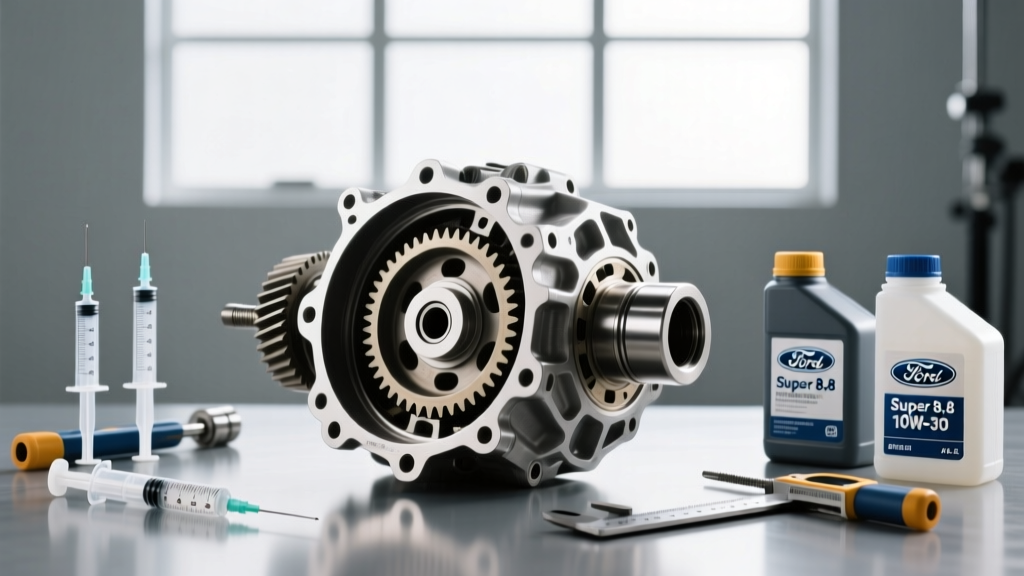
Backlash is the amount of 'slop' or rotational play between the ring gear and the pinion gear. Using a magnetic base dial indicator mounted to the axle housing, place the probe perpendicular to the ring gear tooth face. Hold the pinion yoke stationary and rock the ring gear back and forth.
- Target Backlash: Most OEM street axles (like the Dana 44 or Ford 8.8) require between 0.006 and 0.010 inches of backlash. According to Spicer Parts engineering data, running backlash tighter than 0.005 inches will cause the gears to overheat and seize under thermal expansion, while backlash over 0.012 inches will cause the damaging 'clunk' on load reversal.
- Pinion Bearing Preload: Measured in inch-pounds of rotational torque using a beam-style torque wrench on the pinion nut. Used bearings typically require 15-25 in-lbs of rotational drag, while new crush sleeves require 200+ lb-ft of impact torque to crush the sleeve and set the preload.
The 2026 Upgrade: Solid Pinion Spacers
For trucks and SUVs subjected to heavy towing or off-road abuse, the factory crush sleeve is a known weak point. If overtightened, it over-preloads the pinion bearings, leading to premature whining and failure. During a major rear differential service or rebuild, upgrading to a solid pinion spacer with precision shim packs is highly recommended. This eliminates the crush sleeve entirely, allowing for infinite adjustability and ensuring the pinion bearings maintain perfect preload even under extreme thermal cycling.
Cost Expectations and Professional Service Intervals
For standard maintenance, a professional rear differential fluid service typically costs between $150 and $275 at an independent drivetrain shop, depending on fluid capacity and whether a silicone RTV seal or reusable gasket is used. If your diagnosis points to a failing pinion seal (evidenced by gear oil slung onto the rear differential cover and brake backing plates), expect to add $120 to $180 for seal extraction, yoke polishing, and re-torquing.
While many OEMs claim their synthetic rear differential fluid is a 'lifetime' fill, independent tribology studies from additive manufacturers like Lubrizol demonstrate that the sulfur-phosphorus EP packages begin to oxidize and lose efficacy after 60,000 to 80,000 miles of severe thermal cycling. To maximize the lifespan of your ring and pinion, severe-duty intervals (towing, off-roading, or frequent short trips) demand a fluid change every 30,000 miles, while standard highway driving should see service every 60,000 miles.
Ultimately, understanding what differential service on a car truly involves shifts the perspective from a simple maintenance chore to a critical diagnostic procedure. By listening to the axle, analyzing the metallurgical debris, and utilizing precise GL-5 fluids and torque specs, you ensure the rear drivetrain remains quiet, efficient, and reliable for hundreds of thousands of miles.