The Critical Role of Differential Fluid in Heavy-Duty Towing
When you put a Ram 2500 to work towing a 15,000-pound fifth-wheel trailer up a 6% grade, the drivetrain is subjected to immense mechanical stress. The ring and pinion gears inside your axles generate extreme friction and localized heat spikes that can easily exceed 250°F. Selecting the correct Ram 2500 differential fluid is not merely a routine maintenance checkbox; it is a vital defense against catastrophic gear wear, bearing failure, and costly drivetrain downtime. In this comprehensive 2026 buyer's guide, we break down the exact specifications, viscosity debates, and top-tier synthetic gear oils required to keep your heavy-duty truck performing at its peak.
Understanding the Ram 2500 Axle Architecture
To choose the right lubricant, you must first understand the hardware it protects. Modern Ram 2500 trucks are equipped with robust American Axle & Manufacturing (AAM) differentials. The rear axle is typically the massive AAM 11.5-inch ring gear unit, designed to handle the immense torque output of the 6.7L Cummins turbodiesel or the 6.4L HEMI V8. The front axle houses the AAM 9.25-inch IFS (Independent Front Suspension) unit.
While these axles are incredibly strong, their fluid volume is relatively small compared to the rotational mass and torque they transmit. The rear 11.5-inch AAM axle holds approximately 3.4 quarts of fluid, while the front 9.25-inch axle holds roughly 1.3 quarts. Because the fluid volume is low and the thermal load is high, the shear stability and thermal oxidation resistance of your gear oil are paramount.
OEM Specifications and API Classifications
Stellantis (the parent company of Ram) specifies gear oils that meet the API GL-5 service classification. GL-5 oils contain high levels of extreme pressure (EP) additives, typically zinc dialkyldithiophosphate (ZDDP) or sulfur-phosphorus compounds, which are necessary to protect the sliding contact of hypoid gears found in the AAM axles. Furthermore, Mopar's internal material standard for heavy-duty applications is often MS-8985. According to the API GL-5 Service Classifications, this standard ensures the fluid can withstand the high-pressure, high-shear environment of a loaded truck.
Viscosity Showdown: 75W-90 vs. 75W-140 vs. 80W-140
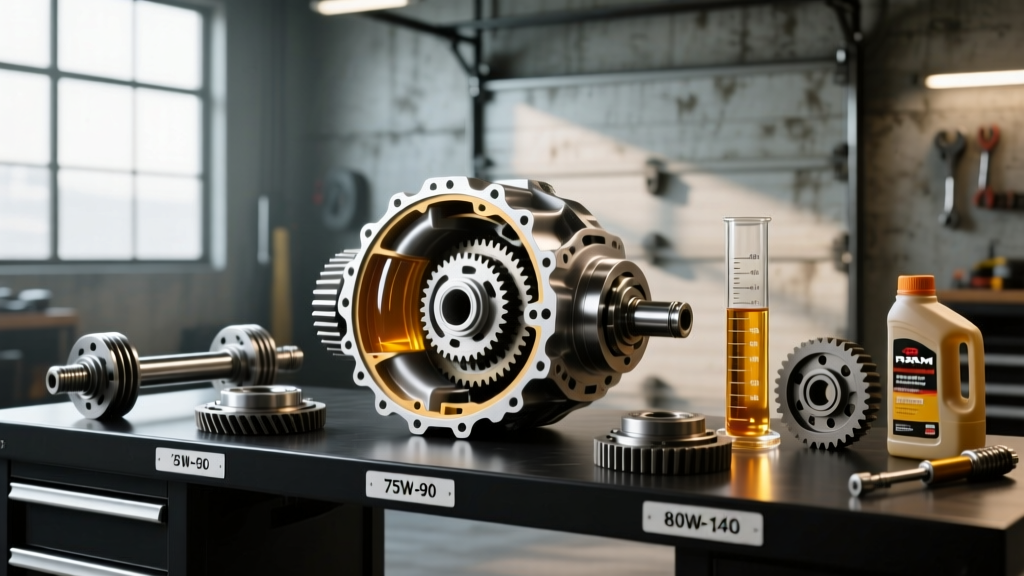
One of the most common debates among Ram HD owners is whether to stick with the factory-recommended 75W-90 or step up to a heavier 75W-140 or 80W-140 viscosity. The right choice depends entirely on your Gross Combined Weight Rating (GCWR) and operating environment.
| Viscosity Grade | Base Stock Type | Best Application Scenario | Operating Temp Range | Shear Stability |
|---|---|---|---|---|
| 75W-90 | PAO / Ester Synthetic | Daily driving, light towing (< 8,000 lbs), cold climates | -40°F to 250°F | Excellent |
| 75W-140 | PAO / Ester Synthetic | Heavy 5th wheel towing, steep grades, commercial use | -30°F to 300°F+ | Superior |
| 80W-140 | Mineral / Synthetic Blend | Extreme off-road, continuous heavy hauling in warm climates | 10°F to 300°F+ | Good |
The Verdict on Viscosity: If your Ram 2500 is a dedicated heavy-hauler that frequently tows near its maximum capacity in mountainous terrain, stepping up to a full synthetic 75W-140 is highly recommended. The thicker high-temperature film prevents metal-on-metal contact when the differential fluid thins out under extreme heat. However, for a daily-driven truck that only occasionally tows a boat or camper, a premium 75W-90 offers better cold-weather flow and marginal fuel economy benefits.
2026 Buyer's Guide: Top Ram 2500 Differential Fluid Picks
We have evaluated the top synthetic gear oils on the market based on shear stability, thermal breakdown resistance, and additive packages. Here are the best options for your AAM axles.
1. Amsoil Severe Gear 75W-90 (SVG) & 75W-140 (SVT)
Amsoil Severe Gear remains the gold standard for heavy-duty diesel trucks. Formulated with a high percentage of ester base stocks, it exhibits exceptional film strength and clings to gear teeth even under extreme shock loading. According to Amsoil's Technical Data, the Severe Gear line is engineered specifically to resist thermal runaway in towing applications. It also contains built-in friction modifiers, making it compatible with clutch-type limited-slip differentials without needing an additive. Estimated Cost: $22 - $26 per quart.
2. Mobil 1 Synthetic Gear Lube 75W-90
For owners who prefer widely available, proven formulations, Mobil 1 Synthetic Gear Lube is a stellar choice. It utilizes a PAO (Polyalphaolefin) base stock that provides outstanding low-temperature fluidity, ensuring your front AAM 9.25 axle is lubricated instantly during freezing winter starts. While it may not have the extreme ester content of boutique brands, its Product Data Sheet confirms it easily exceeds API GL-5 and MIL-PRF-2105E standards. Estimated Cost: $14 - $18 per quart.
3. Royal Purple Max Gear 75W-140
Royal Purple's Max Gear line features their proprietary Synerlec additive technology, which creates a micro-thin, high-strength boundary film on the ring and pinion gears. This is particularly beneficial for the AAM 11.5-inch rear axle when subjected to the sudden shock loads of a heavy diesel engine spooling up and grabbing traction. It is an excellent choice for trucks that see a mix of heavy towing and aggressive off-road use. Estimated Cost: $24 - $28 per quart.
4. Mopar OEM Synthetic Gear Lubricant 75W-140
For warranty purists and fleet managers who want to maintain strict OEM compliance, the genuine Mopar Synthetic Gear Lubricant is the safest bet. While it is often a rebranded formulation from a major petroleum company (historically Pennzoil/Shell), it is guaranteed to meet all MS-8985 requirements and will never cause a dispute during a powertrain warranty claim at a Ram dealership. Estimated Cost: $18 - $22 per quart (dealer pricing varies).
Critical Service Data: Capacities, Torque Specs, and RTV
Performing a differential service on a Ram 2500 requires precision. Unlike older trucks that used reusable cork or rubber gaskets, modern AAM axles rely on RTV (Room Temperature Vulcanizing) silicone sealant for the rear cover. Using the wrong sealant or improper torque can lead to slow leaks that destroy the pinion bearing over time.
- Rear Axle (AAM 11.5-inch): Capacity is approximately 3.4 quarts (3.2 liters). Fill until the fluid level is exactly at the bottom of the fill plug hole.
- Front Axle (AAM 9.25-inch): Capacity is approximately 1.3 quarts (1.2 liters). Fill to the bottom of the fill plug.
- Drain/Fill Plug Torque: 25 ft-lbs. Do not overtighten, as the threads are cut into the cast aluminum or steel housing and can strip easily.
- Cover Bolt Torque (if removed): 35 ft-lbs for stamped steel covers; 45 ft-lbs for cast aluminum covers. Always use a crisscross torque sequence.
- Sealant Specification: Use Mopar RTV or Permatex Ultra Black. Apply a continuous 3mm bead, allow 1 hour of tack time before reassembly, and wait 24 hours before filling with fluid to ensure a complete cure.
The Limited-Slip Additive Debate: Do You Need It?
Ram 2500 trucks are equipped with various limited-slip differentials (LSD) depending on the model year and trim. Many modern Ram HDs utilize a helical gear-type LSD (similar to a Torsen or TracRite GT). Helical differentials operate on gear bias and do not require a friction modifier additive. In fact, adding a friction modifier to a helical LSD can reduce its torque-biasing efficiency.
However, if your truck is equipped with a traditional clutch-pack limited-slip differential, you may experience 'chatter' or 'clunking' during low-speed tight turns. Most premium synthetic gear oils (like Amsoil Severe Gear) already contain a baseline friction modifier. If chatter persists after a fluid change, you can add a small 4 oz bottle of Mopar Limited Slip Additive, but do so sparingly. Over-adding friction modifier will cause the clutch packs to slip excessively, generating heat and accelerating wear.
Final Thoughts for 2026
Upgrading your Ram 2500 differential fluid is one of the highest-ROI maintenance tasks you can perform. By matching the correct viscosity to your towing habits and strictly adhering to AAM torque and sealing specifications, you ensure that your truck's drivetrain remains reliable for hundreds of thousands of miles. Whether you choose the extreme ester protection of Amsoil or the reliable cold-flow of Mobil 1, prioritizing high-quality synthetic gear oil is essential for protecting your heavy-duty investment.