Expert Troubleshooting: Rear Differential Noise and Heavy-Duty Axle Service
The 2021 Ram 2500 is a cornerstone of heavy-duty towing and hauling, relying on robust American Axle & Manufacturing (AAM) rear differentials to transfer massive torque to the pavement. However, even the most durable drivetrain components are susceptible to wear, fluid degradation, and improper servicing. When a heavy-duty axle begins to whine, howl, or clunk, many owners immediately fear a catastrophic ring and pinion failure. As an automotive drivetrain specialist, I can tell you that a significant percentage of differential noise complaints can be traced back to fluid starvation, incorrect viscosity, or degraded limited-slip friction modifiers.
Before authorizing a $3,000 axle teardown, a systematic acoustic and fluid diagnostic protocol is mandatory. In this guide, we will break down the exact acoustic signatures of failing differential components, outline advanced mechanical verification tests, and detail the critical fluid specifications—including the precise 2021 Ram 2500 rear differential fluid capacity—to ensure your axle operates silently and reliably through 2026 and beyond.
The Baseline: Fluid Specifications and Capacity Data
Fluid is the lifeblood of the hypoid gear set. Hypoid gears operate under extreme sliding friction, requiring specialized extreme pressure (EP) additives to prevent the gear oil film from shearing. When diagnosing noise, your first step is always to verify the fluid level and condition. Running an AAM 11.5-inch or 12.0-inch axle even half a quart low will starve the pinion bearings during highway cruising, leading to premature brinelling and a high-pitched coast whine.
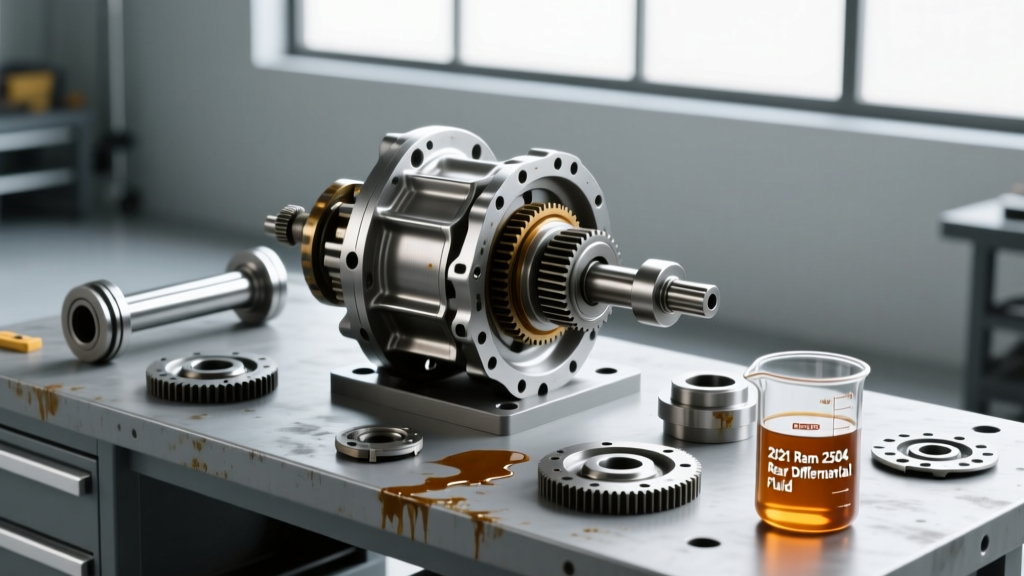
When performing an acoustic diagnostic reset, verifying the exact 2021 Ram 2500 rear differential fluid capacity is your baseline step. Overfilling can cause aeration and foaming, which leads to overheating and fluid expulsion through the breather tube, while underfilling causes immediate starvation.
| Axle Configuration | Common Application | Fluid Capacity (Approx.) | Recommended OEM Fluid Spec | Fill/Drain Plug Torque |
|---|---|---|---|---|
| AAM 11.5" (Standard) | 6.4L HEMI V8 / Standard Cummins | 3.4 Quarts (3.2L) | Mopar 75W-85 Synthetic (P/N 05083810AB) | 25 lb-ft (34 Nm) |
| AAM 12.0" (Heavy Duty) | High Output Cummins / Max Tow Pkg | 3.8 Quarts (3.6L) | Mopar 75W-140 Synthetic (P/N 05083810AB) | 25 lb-ft (34 Nm) |
Note: Always fill to the bottom edge of the fill plug hole. If your truck is equipped with an aftermarket differential cover, capacities will vary significantly, and you must rely on the manufacturer's specific fill-level indicators.
Acoustic Diagnostic Matrix: Decoding the Noise
Differential noise is highly directional and load-dependent. To accurately diagnose the failure point, you must isolate the noise based on throttle position and vehicle speed. According to AA1Car's Differential Noise Guide, mapping the sound to the gear's load state is the most reliable way to pinpoint the failing component without opening the housing.
1. Drive Whine (Noise on Acceleration)
If the axle whines only when you are applying throttle, the issue is isolated to the drive side of the ring and pinion gear teeth. This is often caused by improper gear backlash, incorrect pinion depth, or wear on the drive face of the hypoid gears. If the fluid is full and the correct viscosity, a drive whine usually indicates that the gear set has exceeded its wear limits and requires a professional setup with a new ring and pinion.
2. Coast Whine (Noise on Deceleration)
A whine that appears when you lift off the throttle (engine braking) points to the coast side of the gear teeth or, more commonly, the pinion bearings. The pinion bearing supports the rotational load of the driveshaft. When the bearing races develop microscopic pitting, they emit a steady, high-frequency whine that changes pitch with vehicle speed, not engine RPM.
3. Chatter or Shudder (Low-Speed Turns)
If your Ram 2500 shudders or chirps the rear tires during tight, low-speed turns (like pulling into a driveway), your limited-slip differential (LSD) clutch packs are binding. This is rarely a mechanical failure; it is almost always a chemical one. The friction modifier additive in the gear oil has degraded. Draining the fluid and refilling with fresh synthetic oil and a dedicated bottle of Mopar Limited Slip Additive (P/N 04318060AB) resolves this issue 95% of the time.
4. Clunk on Engagement (Shifting into Drive/Reverse)
A heavy metallic clunk when shifting from Park to Reverse or Drive indicates excessive rotational backlash. This can be caused by worn spider gears inside the differential case, a loose pinion nut (allowing the pinion yoke to shift axially), or severely worn slip yoke splines on the driveshaft.
The Diagnostic Reset: Drain, Inspect, and Refill
Before condemning the hard parts, perform a complete fluid service. This serves as a diagnostic reset and provides a window into the internal health of the axle via metallurgical inspection.
Step 1: Extraction and Visual Inspection
Remove the fill plug first (always do this before the drain plug to ensure you don't drain a differential you cannot refill). Then, remove the drain plug. Catch the fluid in a clean, light-colored pan.
- Fine, Silvery Glitter: This is normal wear for an axle with 50,000+ miles. The EP additives in the gear oil are designed to handle microscopic metallic particulates suspended in the fluid.
- Dark, Burnt Smelling Fluid: Indicates severe overheating. The fluid has lost its shear stability. Check for dragging parking brakes or undersized gear oil for your towing application.
- Large Metal Chunks or Shards: This is a critical failure indicator. If you find pieces larger than a grain of rice, a bearing cage has likely disintegrated, or a gear tooth has sheared. A full teardown and differential rebuild is mandatory.
Step 2: Refill and Additive Protocol
Using a pneumatic or manual fluid pump, refill the axle with the exact 2021 Ram 2500 rear differential fluid capacity specified for your axle size. If you are using an aftermarket 75W-140 synthetic oil (such as Valvoline or Amsoil), verify whether it already contains friction modifiers. If your truck has a Track-Lok or helical LSD, you must still add the OEM friction modifier to prevent clutch pack chatter. Reinstall the fill plug and torque to 25 lb-ft.
Advanced Mechanical Verification: When Fluid Isn't Enough
If the noise persists after a fresh fluid service, you must move to mechanical verification. This requires lifting the truck on a hoist, supporting the rear axle on jack stands (allowing the suspension to hang freely), and running the vehicle in gear at 30-40 MPH.
Pinion Bearing Rotational Torque Test
To verify pinion bearing health without removing the yoke, you can measure the rotational torque of the pinion. With the rear wheels off the ground and the brake calipers removed to eliminate drag, use an inch-pound torque wrench on the pinion nut. A healthy, broken-in AAM pinion bearing should require between 15 to 25 inch-pounds of continuous rotational force. If the reading is erratic (spiking and dropping as the shaft turns), the bearing races are pitted, confirming the source of your coast whine.
Ring Gear Runout and Backlash
If you suspect gear wear, you must pull the differential cover (or drop the third member, depending on the exact AAM variant) to mount a dial indicator. Ring gear runout should not exceed 0.003 inches. If runout is excessive, the ring gear is warping under load, or the differential carrier bearings are collapsing, allowing the gear set to move away from the pinion under heavy towing loads. For a comprehensive look on OEM drivetrain components and replacement part numbers, consult the Mopar Official Parts Catalog.
Preventative Maintenance for the 2026 Work Truck
The modern heavy-duty truck operates under higher thermal and mechanical stress than ever before. To prevent differential noise from developing in the first place, adhere to a severe-duty maintenance schedule. If your 2021 Ram 2500 is used for towing trailers over 10,000 lbs, operating in mountainous terrain, or idling extensively on job sites, you must treat the axle fluid as a severe-duty consumable.
Change the rear differential fluid every 30,000 miles under severe conditions, rather than waiting for the 60,000-mile standard interval. Additionally, consider installing an aftermarket aluminum differential cover with integrated cooling fins and a magnetic drain plug. The magnetic plug will capture ferrous metals before they circulate through the pinion bearings, drastically extending the lifespan of your AAM axle assembly.
By combining precise acoustic diagnostics with strict adherence to fluid capacities and torque specifications, you can accurately diagnose rear axle noise, avoid unnecessary rebuilds, and keep your heavy-duty Ram operating at peak efficiency.