When performing preventive maintenance on high-performance, off-road, or heavy-duty trucks, the ability to execute a rapid drain-and-fill is invaluable. A quick change rear differential setup—whether utilizing a modular Winters-style center section, a Ford 9-inch with a quick-disconnect third member, or a Dana 60 equipped with an aftermarket quick-drain cover—saves time on the lift. However, the speed of the service must never compromise the most critical diagnostic step: reading the fluid. As of 2026, modern synthetic GL-5 gear oils are engineered to withstand extreme shear and thermal loads, but their visual and olfactory degradation provides a direct telemetry link to the internal health of your ring and pinion, bearings, and limited-slip clutch packs.
The Anatomy of a Quick-Change Fluid Analysis
The primary advantage of a quick change rear differential is accessibility. Because these systems are frequently serviced to swap gear ratios for different racing environments or towing requirements, the fluid is often exposed to the atmosphere more frequently than in standard passenger vehicles. This makes the fluid highly susceptible to environmental contamination and thermal cycling. Before you drop the center section or pull the drain plug, you must understand the baseline chemistry of your gear oil. Most premium axle lubricants, such as Lubegard or Mobil 1 Synthetic Gear Lube (Part #104361), rely on sulfur-phosphorus Extreme Pressure (EP) additives. When subjected to the hypoid sliding friction of a ring and pinion gear set, these additives sacrifice themselves to form a protective tribofilm on the metal surfaces. Monitoring the color and condition of the fluid tells you exactly how hard that tribofilm is working, and when it has failed.
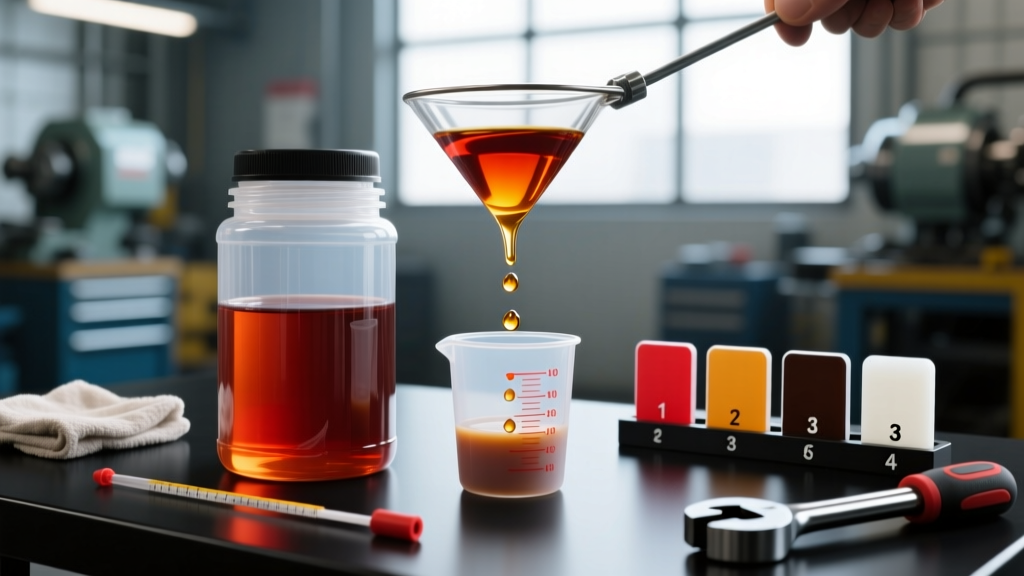
Diagnostic Matrix: Decoding Fluid Color and Texture
Use the following matrix to cross-reference the visual and tactile condition of your drained gear oil against internal axle health. This data is derived from decades of drivetrain teardown analysis and metallurgical failure forensics.
| Visual Appearance | Tactile & Odor Profile | Probable Internal Condition | Corrective Action Required |
|---|---|---|---|
| Translucent Amber / Honey | Smooth, slight sulfur (rotten egg) scent. | Normal operation. EP additives are active and intact. | Standard refill. No mechanical intervention needed. |
| Opaque Black / Dark Brown | Acrid, burnt smell. Fluid feels thin or degraded. | Severe thermal breakdown. EP additives depleted due to overloading or lack of cooling. | Install an aluminum finned differential cover or auxiliary cooler. Upgrade to 75W-140. |
| Milky / Chocolate Milk | Emulsified, mayonnaise-like texture. No sulfur scent. | Water intrusion via submerged breather tube or failed axle shaft seal. | Flush axle with cheap 80W-90. Relocate breather tube to the frame rail. |
| Silver / Grey Sheen | Glitter-like suspension. Visible under LED light. | Micron-level ferrous wear. Normal ring/pinion break-in or early bearing spalling. | Magnetic plug inspection. If glitter persists after 5,000 miles, check pinion depth. |
| Black with Metallic Chunks | Visible shards or teeth fragments in the pan. | Catastrophic gear spalling, side gear failure, or shattered pinion bearing cage. | Complete teardown required. Do not drive the vehicle. |
Deep Dive: Water Intrusion and Emulsification
One of the most common issues discovered during a quick change rear differential service on 4x4 trucks is water contamination. When gear oil mixes with water, the mechanical shearing action of the hypoid gears turns the fluid into a thick, milky emulsion. This emulsion completely destroys the load-bearing capability of the GL-5 fluid, leading to rapid scoring on the ring and pinion teeth. If you drain your differential and observe a chocolate-milk consistency, the water likely entered through the axle breather tube during water fording, or through a compromised inner axle seal where pressurized axle tubes forced water past the O-rings. According to Ring & Pinion technical guidelines, running emulsified fluid for even a few hundred miles can cause irreversible pitting on the gear faces. The immediate fix is to flush the housing with a low-cost 80W-90 mineral oil, drain it, and install an extended breather kit routed high into the engine bay or bed of the truck.
Ferrous Wear: Distinguishing Glitter from Shrapnel
Not all metallic particles in your gear oil indicate impending doom. When you install a new ring and pinion—such as a 4.56 ratio set from Yukon or Motive Gear—the gears undergo a micro-polishing process during the first 1,000 to 3,000 miles. This creates a fine, silver "glitter" that remains suspended in the fluid. A quick change setup with a magnetic drain plug is perfect for capturing this normal break-in material. However, you must differentiate between micron-level glitter and larger, jagged shards. If you can feel distinct metallic flakes between your thumb and forefinger, or if the magnetic plug is covered in needle-like splinters, you are likely witnessing the early stages of pinion bearing cage failure or thrust washer disintegration. In limited-slip differentials (LSD), excessive metallic debris can also originate from the clutch packs. As the friction material wears down, it suspends in the oil, turning it a dark, muddy brown and eventually clogging the fluid journals in the cross-pin.
Limited-Slip Clutch Pack Degradation and Additive Breakdown
If your quick change rear differential houses a clutch-type limited-slip unit (like the Eaton Truetrac, Auburn, or Dana Trac-Lok), fluid condition directly correlates to chatter and binding. Clutch-type LSDs require specialized friction modifiers (such as Lubegard Limited Slip Friction Modifier, Part #71902) to allow the clutches to slip smoothly during tight cornering. Over time, the intense heat generated by clutch engagement bakes the friction modifier out of the suspension. You will not necessarily see a drastic color change, but you will notice a harsh, burnt odor, and the fluid will leave a heavy, dark carbon residue on the differential cover. If the fluid smells burnt and the vehicle exhibits low-speed rear-end chatter during parking lot maneuvers, the clutch packs have glazed, and the fluid's frictional properties are exhausted. A drain, flush, and precise re-application of the friction modifier is mandatory to restore quiet operation.
Service Specifications: Torque, Capacity, and Sealants
Executing a quick change service requires adherence to strict torque specifications and sealant protocols to prevent leaks that could ruin your new fluid analysis baseline. Below are the benchmark specifications for the most common performance and heavy-duty axles serviced in 2026:
- Dana Spicer 60 (HD Trucks/Off-Road):
- Fluid Capacity: 3.5 to 4.0 pints (depending on cover depth).
- Cover Bolt Torque: 35 lb-ft (in a crisscross pattern).
- Recommended Fluid: Red Line 75W140 (Part #50304) for severe towing.
- GM 14-Bolt (10.5" Semi-Floating):
- Fluid Capacity: 4.1 pints.
- Cover Bolt Torque: 30 lb-ft.
- Sealant: If using a reusable gasket, ensure mating surfaces are perfectly dry. If using RTV, apply a continuous 1/8" bead of Permatex Ultra Black (Part #81182) and allow 1 hour of cure time before filling.
- Ford 9-Inch (Quick-Change Third Member):
- Fluid Capacity: ~3.0 pints (varies by housing depth).
- Third Member Stud Nut Torque: 25 to 35 lb-ft.
- Note: Many racing quick-change centers use paper gaskets (Part #G401) rather than RTV to allow for immediate teardowns without waiting for silicone to cure.
The Preventive Maintenance Protocol
To maximize the diagnostic value of your quick change rear differential, always extract a fluid sample before the vehicle is lifted. Draining the fluid while the axle is at operating temperature ensures that any suspended particulates, water, or degraded additives are captured in your sample, rather than settling at the bottom of the housing. Inspect the fluid under a bright, cool-white LED light to accurately assess the metallic sheen. By treating every fluid swap as a forensic diagnostic opportunity, you can catch pinion bearing preload loss, seal failures, and EP additive depletion long before they result in a catastrophic drivetrain failure on the trail or the track.
For further technical documentation on hypoid gear metallurgy and lubrication requirements, consult the engineering whitepapers provided by Dana Incorporated and your specific axle manufacturer's service manual.