The Hidden Cost Driver: Clutch Disc Thickness and Specifications
When planning a clutch pressure plate replacement, most enthusiasts and independent mechanics focus heavily on the clamping load of the diaphragm spring or the friction coefficient of the disc material. However, the exact thickness of the clutch disc—and its underlying engineering specifications—is the primary variable that dictates both the immediate cost of the job and the long-term financial viability of the manual drivetrain. Ignoring disc thickness tolerances during a pressure plate swap is a leading cause of premature release bearing failure, clutch chatter, and catastrophic spline wear.
In this comprehensive cost analysis, we break down how clutch disc specifications influence part selection, machine shop requirements, and overall labor costs for a clutch pressure plate replacement in 2026. Whether you are refreshing a daily-driven Honda K-Series or rebuilding a high-torque Ford Mustang T56 Magnum, understanding the financial impact of micrometer-level measurements is critical.
Decoding Clutch Disc Specifications: What You Are Actually Paying For
The price variance between a $150 economy clutch kit and an $850 performance kit is not just about brand names; it is rooted in precise manufacturing specifications. To understand the cost breakdown, we must first define the three critical thickness and dimensional specs of a clutch disc:
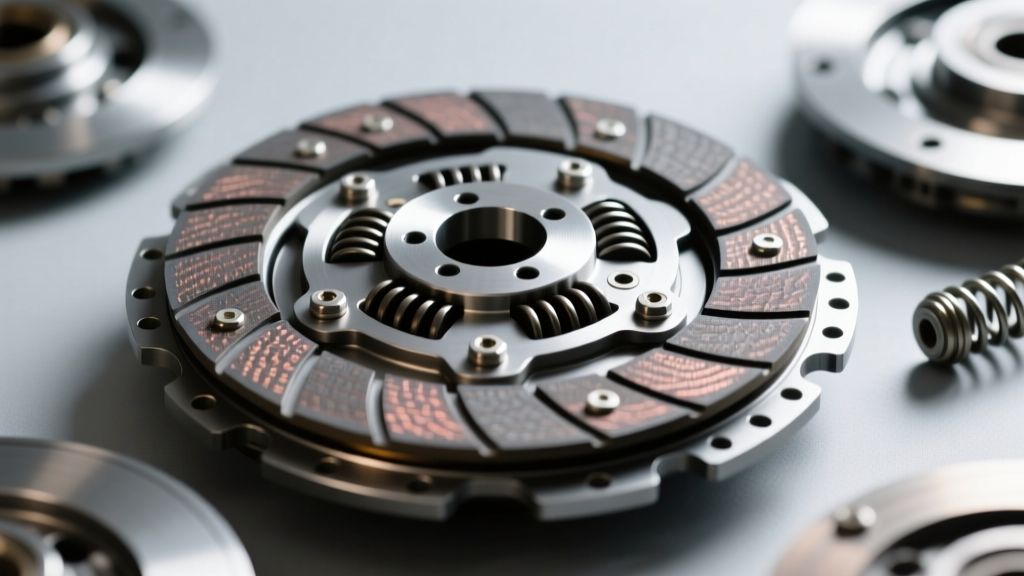
- Friction Material Thickness: A standard organic disc typically features 3.5mm to 4.5mm of friction material per side. High-performance cerametallic or sintered iron discs can range from 4.8mm to 6.0mm per side. Thicker materials require a pressure plate with a correspondingly adjusted diaphragm spring height to maintain proper clamp load and release bearing preload.
- Marcel Spring Wave Height: Beneath the friction material lies the marcel spring, a wavy steel leaf that provides progressive engagement. Standard street discs use a wave height of 0.6mm to 0.9mm. Aggressive race discs eliminate the marcel spring entirely (0.0mm), resulting in an on/off engagement that reduces overall disc thickness and alters the pressure plate's finger geometry.
- Hub Torsion Spring Travel and Spline Profile: While not a 'thickness' metric, the hub assembly's depth and spline count (e.g., 10-spline 1-1/8" vs. 26-spline 1-1/8") dictate compatibility. Forcing a mismatched hub depth against a new pressure plate will result in the disc binding against the flywheel step or the transmission input shaft bearing.
2026 Cost Breakdown: Parts and Labor by Specification
The following table illustrates the real-world costs associated with a clutch pressure plate replacement, categorized by the disc specification and material type. Labor rates are calculated based on a 2026 national average of $145 per hour for a standard rear-wheel-drive manual transmission R&R (Remove and Replace).
| Component Specification | Avg. Kit Cost (Disc + Plate) | Flywheel Machining Cost | Est. Labor Hours | Total Job Cost |
|---|---|---|---|---|
| Standard OEM Organic (LuK/Sachs) | $220 - $350 | $75 - $120 (Resurface) | 4.5 - 6.0 | $950 - $1,340 |
| Performance Cerametallic (Exedy/ACT) | $450 - $700 | $150 - $250 (Step Cut) | 5.0 - 6.5 | $1,325 - $1,890 |
| Twin-Disc Sintered Iron (Tilton/CM) | $1,200 - $2,100 | $250 - $400 (Precision Step) | 6.5 - 8.0 | $2,380 - $3,660 |
As the data shows, upgrading from an organic to a cerametallic disc specification doesn't just increase the parts cost; it frequently mandates more precise flywheel machining (specifically cutting a new step height) and slightly more labor time for clearance checking and driveline alignment.
The Financial Penalty of Ignoring Thickness Tolerances
Why does disc thickness matter so much during a clutch pressure plate replacement? The answer lies in the diaphragm spring's operating window. According to Schaeffler REP (LuK) technical bulletins, the diaphragm spring fingers must sit at a specific height relative to the release bearing when the clutch is fully engaged.
If a mechanic installs a new pressure plate but reuses a worn clutch disc that has thinned from a new specification of 8.5mm down to a worn 6.8mm, the diaphragm spring fingers will over-extend toward the transmission. This eliminates the necessary air gap between the fingers and the release bearing, causing the bearing to spin constantly under load. The result? A $150 release bearing failure within 3,000 miles, requiring a $900 transmission removal to fix a mistake made during the initial assembly.
This is why reputable transmission shops will refuse to perform a pressure plate replacement without simultaneously replacing the disc and measuring the assembly stack-up. The 'cost savings' of reusing a marginal disc is entirely negated by the secondary labor costs of a warranty teardown.
Critical Measurement Protocols
Before bolting on the new pressure plate, a qualified technician will use a micrometer and a dial indicator to verify the following:
- New Disc Thickness: Measured at four equidistant points on the friction ring to ensure manufacturing consistency (variance should not exceed 0.05mm).
- Flywheel Step Height: The distance between the friction surface and the pressure plate mounting pad. For example, GM LS-series engines typically require a precise 0.010" step, whereas many Ford Modular V8s utilize a 0.000" flat step. If the step is incorrect, the clamping load will be severely compromised regardless of the pressure plate's rated torque capacity.
- Runout: Flywheel lateral runout must be kept under 0.005" to prevent uneven disc wear and clutch pedal pulsation.
Real-World Application: LS-Swap T56 vs. Honda K-Series
To contextualize these costs, let us examine two highly popular platforms for manual transmission work, referencing data from Exedy USA Technical Information and aftermarket drivetrain specialists.
GM LS-Swap with Tremec T56 Magnum
In a typical LS V8 swap utilizing a Tremec T56 Magnum (26-spline input), the clutch disc thickness and flywheel step are notorious pain points. Many aftermarket aluminum flywheels are machined with a generic step that does not account for the specific thickness of the chosen aftermarket disc. If you purchase an Exedy Stage 1 organic kit ($380) but the flywheel step is off by 0.020", the pressure plate will either slip under high torque or fail to fully disengage, grinding the T56's carbon-fiber synchronizers. Correcting this requires pulling the engine or transmission, removing the flywheel, and paying a machine shop $200 to cut a custom step based on the exact measured thickness of your specific disc and pressure plate combination.
Honda K-Series (Civic Si / Accord Euro)
Conversely, the Honda K-Series utilizes a pull-type clutch release mechanism in some OEM configurations, though most aftermarket conversions use a push-type setup. The OEM clutch disc is exceptionally thin, prioritizing rapid engagement and low rotational mass. When performing a clutch pressure plate replacement on a K-Series to handle forced induction, enthusiasts often upgrade to a thicker cerametallic disc. However, the thicker disc alters the geometry of the clutch fork and the pivot ball. To correct the geometry and prevent the fork from binding against the bellhousing, an adjustable pivot ball ($45 - $80) and a longer slave cylinder pushrod ($60) must be added to the parts list, adding roughly $120 to the overall hardware cost of the replacement.
Torque Specifications and Assembly Best Practices
The final phase of the clutch pressure plate replacement involves securing the assembly. The cost of a warped pressure plate cover or a sheared flywheel bolt far exceeds the time it takes to use a calibrated torque wrench.
- Pressure Plate to Flywheel Bolts: Typically M8x1.25. These must be torqued to 22 - 26 lb-ft (consult specific OEM manuals, as some heavy-duty diesel applications require up to 35 lb-ft). They must be tightened in a strict crisscross star pattern, incrementally increasing torque by 5 lb-ft per pass to ensure the pressure plate cover seats evenly without distorting the diaphragm spring housing.
- Clutch Disc Alignment: While plastic alignment tools come free in most kits, investing in a $40 CNC-machined steel alignment tool ensures the disc is perfectly centered. A misaligned disc by just 0.5mm can cause the transmission input shaft to bind during installation, potentially cracking the bellhousing or damaging the pilot bearing—a mistake that turns a $1,200 job into a $3,000 nightmare.
Conclusion: ROI on Precision
A clutch pressure plate replacement is an investment in drivetrain reliability. By prioritizing exact clutch disc thickness specifications, verifying flywheel step heights, and adhering to strict torque protocols, you protect your financial investment. While opting for a premium, spec-matched clutch kit and paying for professional flywheel machining may add $300 to $500 to your initial invoice, it entirely eliminates the risk of premature release bearing failure, spline galling, and the devastating labor costs of a secondary transmission removal. In the world of manual transmissions, precision is always cheaper than a re-do.