The Great Automotive Debate: Powertrain vs. Drivetrain
If you have ever browsed a vehicle window sticker, read an owner's manual, or listened to a service advisor, you have likely heard the terms 'powertrain' and 'drivetrain' used interchangeably. For the everyday driver, this confusion is harmless. But when it comes to understanding your vehicle's mechanics, diagnosing a strange noise, or deciphering a warranty contract, knowing the exact distinction is critical.
To put it simply: all drivetrains are part of the powertrain, but not all powertrain components are part of the drivetrain. Think of the powertrain as the entire restaurant kitchen—including the stove, the chef, and the ingredients. The drivetrain is the waiter and the tray, responsible solely for delivering the finished meal to your table. In automotive terms, the powertrain generates the power, while the drivetrain routes it to the pavement.
In this beginner-friendly explainer, we will break down these definitions with a specific focus on the most common layout on the road today: the front-wheel drive drivetrain. We will also dive into the hard mechanical data, torque specifications, and real-world maintenance costs that separate casual car owners from true automotive enthusiasts.
Defining the Boundaries: What Goes Where?
Before we dissect the front-wheel drive (FWD) layout, we need to establish the hard boundaries of these two systems. According to engineering standards outlined by SAE International, the powertrain encompasses every component involved in generating power and delivering it to the road surface. The drivetrain, however, strictly covers the components that transfer that power from the engine's output shaft to the drive wheels.
The Powertrain Roster
- The Engine: The internal combustion block, cylinder heads, pistons, fuel injection system, and engine control module (ECM).
- The Transmission/Transaxle: The gearbox that multiplies torque and manages gear ratios.
- The Drivetrain Components: Everything downstream of the engine flywheel/flexplate.
The Drivetrain Roster (FWD Specific)
- The Transaxle Gears & Differential: The internal gearing that splits torque to the left and right wheels.
- CV Axles (Half-Shafts): The rotating shafts that connect the transaxle to the wheel hubs.
- Constant Velocity (CV) Joints: The flexible pivots that allow the axles to move with the suspension and steering.
- Wheel Hubs & Bearings: The final mounting points that transfer rotational force into linear motion.
Notice the overlap? The transmission (or transaxle in an FWD car) is the bridge. It is technically a drivetrain component, but it is universally covered under the broader 'powertrain' umbrella.
Anatomy of a Front-Wheel Drive Drivetrain
In a rear-wheel-drive (RWD) vehicle, the transmission and the differential are separated by a long driveshaft. In a front-wheel drive drivetrain, space and weight constraints require a more compact solution: the transaxle.
The Transaxle: Where the Magic Happens
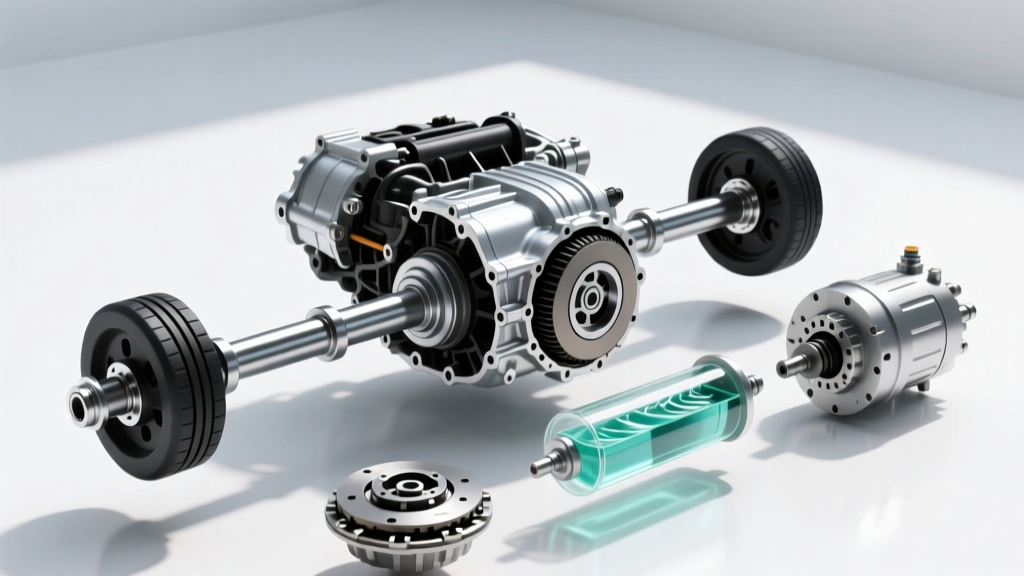
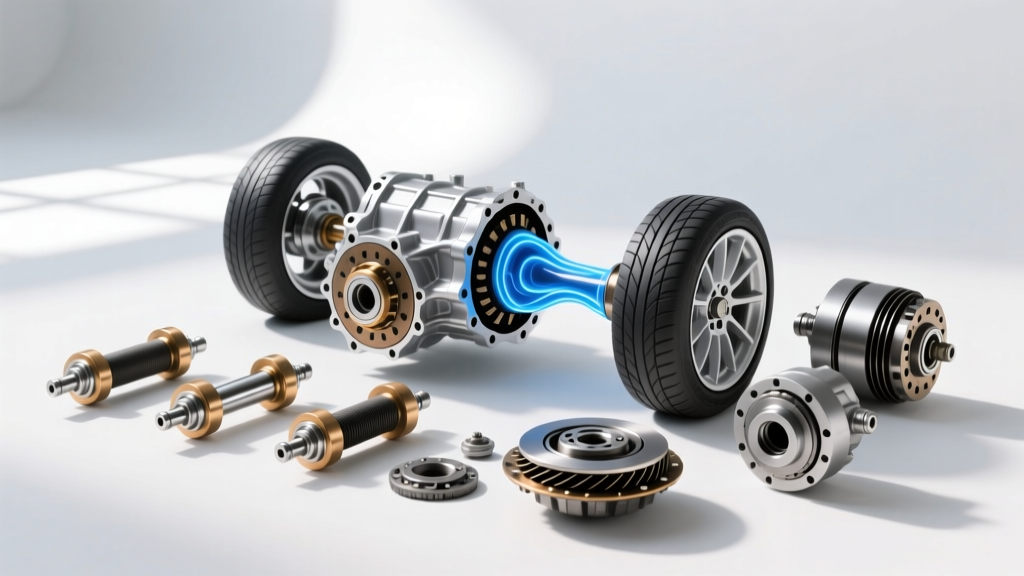
A transaxle integrates the transmission gearsets, the torque converter, and the final drive differential into a single, unified housing. Take the ubiquitous GM 6T40 6-speed automatic or the Aisin TF-80SC found in countless Toyota and Volvo applications. These units sit transversely (sideways) in the engine bay. Power flows from the engine crankshaft, into the torque converter, through the planetary gearsets, and directly into an integrated helical limited-slip or open differential. From there, power is immediately handed off to the CV axles.
CV Axles and Joints: Delivering the Twist
Because the front wheels of an FWD vehicle must simultaneously steer left and right while also moving up and down over bumps, rigid shafts will not work. The front-wheel drive drivetrain relies on Constant Velocity (CV) axles.
- Inner CV Joints: Typically a 'tripod' style joint (three trunnion bearings on a spider gear) that slides in and out of a cup attached to the transaxle. This allows for the plunge (in-and-out movement) required when the suspension compresses.
- Outer CV Joints: Usually a 'Rzeppa' style joint (a cage holding six steel ball bearings between an inner and outer race). This joint handles the extreme angular changes required when you turn the steering wheel.
Component Breakdown: Powertrain vs. Drivetrain
To visualize how these systems overlap and diverge, refer to the diagnostic mapping table below. This is highly useful when pinpointing the source of a vibration or noise.
| Component | System Classification | Primary Function | Common Failure Symptom |
|---|---|---|---|
| Engine Block & Internals | Powertrain Only | Combustion & Torque Generation | Misfires, oil consumption, knocking |
| Torque Converter | Powertrain & Drivetrain | Fluid Coupling & Torque Multiplication | Shudder at 40-50 mph, slipping |
| Transaxle Gearsets | Powertrain & Drivetrain | Gear Ratio Selection | Harsh shifts, flaring, whining |
| CV Axle Shaft | Drivetrain Only | Torque Transfer to Hubs | Vibration under acceleration |
| Outer CV Joint | Drivetrain Only | Angular Power Delivery | Clicking/popping on tight turns |
| Wheel Hub Assembly | Drivetrain / Chassis | Bearing & ABS Sensor Mounting | Humming/growling that changes with speed |
Real-World Maintenance: Torque Specs, Fluids, and Costs
Understanding the difference between a powertrain and a drivetrain is not just academic; it dictates your maintenance schedule and repair budget. Let us look at the hard numbers for servicing a modern front-wheel drive drivetrain.
Transaxle Fluid Service
Because the transaxle houses both the transmission clutches and the differential gears, fluid degradation affects both shift quality and gear longevity. For an Aisin TF-80SC transaxle, the dry-fill capacity is roughly 7.4 quarts (7.0 liters), though a standard drain-and-fill will only yield about 3.5 to 4 quarts. You must use the exact specified fluid, such as Toyota WS or Aisin AW-1. Using generic 'multi-vehicle' ATF can lead to torque converter shudder and valve body clogging due to incompatible friction modifiers.
CV Axle Replacement & Torque Specifications
CV axle boots are made of thermoplastic elastomer. Over time, heat and ozone cause them to crack, slinging grease onto the underside of your car and allowing water to destroy the joint bearings. When replacing a front-wheel drive drivetrain CV axle, precision torque is non-negotiable.
- CV Axle Nut (Hub Nut): Typically a 32mm or 34mm staked nut. On most GM and Ford FWD applications, this requires a massive 155 lb-ft to 200 lb-ft (210 - 270 Nm) of torque. Under-torquing this will destroy the wheel bearing within 1,000 miles.
- Transaxle Bellhousing to Engine Block: If you are pulling the transaxle, the M10x1.5 bellhousing bolts generally require 37 lb-ft (50 Nm), while the lower brace bolts may require 74 lb-ft (100 Nm).
Cost Reality Check: A standard aftermarket CV axle assembly costs between $90 and $250. Labor adds $150 to $300. Conversely, a complete transaxle rebuild or replacement (a major powertrain/drivetrain crossover repair) will easily range from $2,800 to $5,500 depending on the vehicle.
Warranty Implications: Why the Distinction Matters
When your vehicle breaks down, the semantic difference between a powertrain and a drivetrain can save—or cost—you thousands of dollars. The Federal Trade Commission (FTC) and National Highway Traffic Safety Administration (NHTSA) note that consumers must carefully read warranty booklets, as manufacturer definitions vary.
The 'Powertrain' Warranty (Usually 5-Year/60,000 Miles)
This is the big one. It covers the engine block, cylinder heads, internal engine parts, the transmission/transaxle case, and internal gearsets. If your transaxle's planetary gearset shatters, you are covered.
The 'Drivetrain' or 'Bumper-to-Bumper' Gap
Here is where consumers get caught off guard. Many manufacturers classify CV axles, CV joints, wheel bearings, and engine mounts as 'wear items' or chassis components rather than core powertrain parts. If your outer CV joint starts clicking at 65,000 miles, your 5-year/60,000-mile powertrain warranty likely will not cover it, even though the CV axle is undeniably a drivetrain component. It would only be covered if you had purchased an extended 'drivetrain-specific' or comprehensive bumper-to-bumper warranty.
Summary for the Everyday Driver
To master the basics of your vehicle's layout, remember this rule of thumb: The powertrain makes the power (engine + transmission), while the drivetrain moves the wheels (transmission + axles + hubs). In a front-wheel drive drivetrain, this entire system is packaged tightly in the front of the vehicle via the transaxle and CV axles. By understanding these boundaries, you can better diagnose strange vibrations, adhere to strict torque specs during DIY repairs, and navigate the often-confusing world of automotive warranties with absolute confidence.