The Heavyweight Challenge: Clutch Fork and Pivot Diagnostics
In the classic muscle car and restomod community, a "Clutch Cargo" Pontiac refers to a heavyweight, high-torque street machine. Think of a 4,000-pound 1969 Pontiac GTO Judge, a 1977 Trans Am stuffed with a 550-hp 455ci V8, or a modern supercharged LS-swapped Firebird. These builds demand massive clutch clamping forces to handle the torque without slipping. However, when you bolt a 3,200-pound pressure plate (like a McLeod Street Twin or Ram Twin-Disc) to a classic Muncie 4-speed or a BorgWarner T-56 Magnum bellhousing, the weak link is rarely the friction disc. Instead, the clutch fork and pivot ball assembly become the primary failure points.
As we navigate the 2026 restoration and restomod landscape, the availability of CNC-machined billet components has made upgrading these high-wear parts more accessible than ever. Yet, many builders still overlook the geometry and deflection limits of the clutch actuation system. This expert guide dives deep into diagnosing, upgrading, and properly torquing the clutch fork and pivot components in high-horsepower Pontiac applications.
Why High-Torque Pontiacs Destroy Stock Forks and Pivots
To understand the failure mode, you must look at the physics of clutch actuation. A stock cast-iron Muncie clutch fork was designed to handle the 2,200 to 2,400-pound clamp loads of a factory 10.5-inch Borg & Beck or diaphragm pressure plate. When you upgrade to a high-performance dual-disc setup, the pedal effort and clamp load can easily exceed 3,500 pounds.
Under this immense load, a stock cast-iron fork will physically bend (deflect). This deflection robs the throwout bearing (TOB) of its forward travel, resulting in incomplete clutch disengagement, gear grinding, and premature synchronizer wear. Furthermore, the hardened steel pivot ball acts as a fulcrum. Under high pressure, the dimple on the back of the clutch fork wears a deep groove into the pivot ball, leading to a "notchy" pedal feel and inconsistent engagement.
The Pontiac Torque Roll Factor
Pontiac V8s, particularly the 400ci and 455ci blocks, are notorious for severe torque roll under hard acceleration. Because the engine mounts are relatively soft and the block is massive, the engine twists violently on its axis. In a mechanical Z-bar linkage setup, this torque roll physically moves the bellhousing—and the pivot ball attached to it—relative to the frame-mounted Z-bar. If your clutch fork and pivot clearances are not set with this dynamic movement in mind, the linkage will bind at wide-open throttle (WOT), making it nearly impossible to push the clutch pedal in while the car is under load.
5 Telltale Symptoms of Fork and Pivot Degradation
Before tearing into the bellhousing, look for these specific diagnostic symptoms that point directly to fork deflection or pivot wear:
- The "Floating" Bite Point: The clutch engagement point moves higher and higher up the pedal travel as the transmission and engine heat up, indicating the fork is flexing and the pivot ball is slipping in its worn groove.
- High-RPM Chirp and Squeal: A chirping noise that only occurs when the clutch pedal is depressed slightly (taking up the slack). This is often the throwout bearing collar rubbing against the fork fingers due to improper pivot geometry.
- Mechanical Binding at WOT: The pedal becomes stiff or locks up during hard acceleration. This is a classic Pontiac torque-roll issue where the Z-bar binds against the pivot ball stud.
- Incomplete Disengagement (Gear Crunch): Even with the pedal pinned to the floor, the input shaft continues to spin, causing grinding when shifting into first or reverse. The fork is bending, preventing the TOB from traveling the required 0.450 to 0.550 inches.
- Visible Pivot Groove Wear: Upon inspection through the bellhousing inspection cover, you can see a shiny, polished trench worn into the spherical surface of the pivot ball.
Stock vs. Heavy-Duty Clutch Fork & Pivot Components
When rebuilding a Clutch Cargo Pontiac, selecting the right materials is critical. Below is a comparison of common clutch fork and pivot setups used in GM Muncie and T-56 bellhousings.
| Component Type | Material | Max Clamp Load | Deflection @ 3000 lbs | Est. Cost (2026) |
|---|---|---|---|---|
| OEM Muncie Fork | Cast Iron | 2,400 lbs | 0.045" (Excessive) | $45 (Used/NOS) |
| Heavy-Duty Stamped Fork | Thick Steel | 3,200 lbs | 0.020" | $85 - $110 |
| Ram Billet Fork (P/N 14-1011) | 7075-T6 Aluminum | 5,000+ lbs | < 0.003" | $215 - $245 |
| OEM Pivot Ball | Hardened Steel | N/A (Wears Groove) | N/A | $15 |
| McLeod Adj. Pivot (P/N 1650) | Steel w/ Bronze Insert | 5,000+ lbs | Zero Deflection | $65 - $85 |
Expert Upgrades: Fixing the Geometry and Deflection
To properly support a high-torque Pontiac build, you must eliminate deflection and manage friction. Here are the best-practice upgrades recommended by transmission specialists.
1. Billet Aluminum Clutch Forks
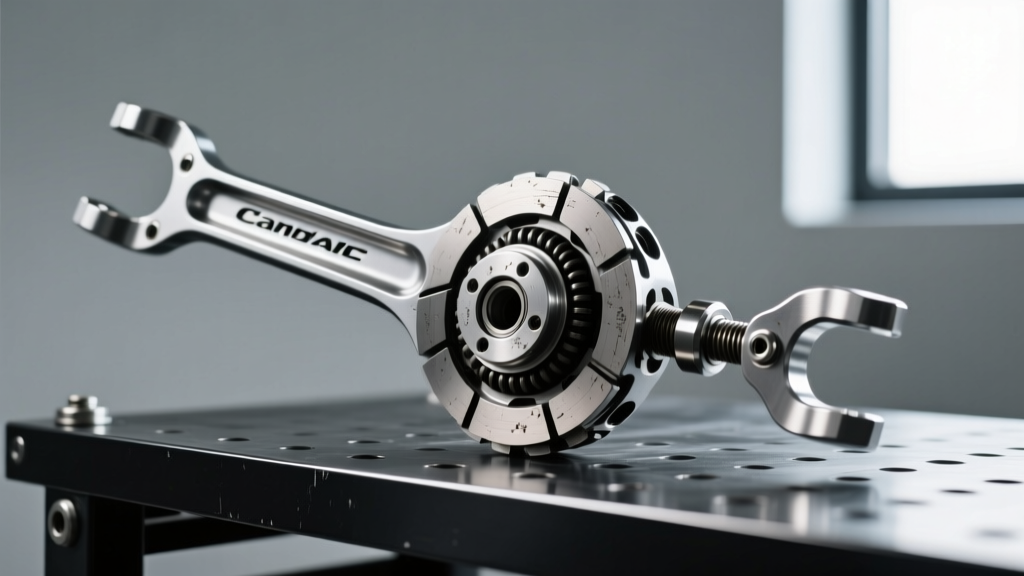
Upgrading to a CNC-machined billet aluminum fork, such as the Ram Automotive P/N 14-1011, is mandatory for any build exceeding 600 lb-ft of torque. Unlike cast iron, which can harbor microscopic porosity and snap under shock loads, 7075-T6 billet aluminum offers immense tensile strength while remaining lightweight. The billet forks also feature reinforced pivot dimples with radiused edges to prevent stress cracking.
2. Adjustable Pivot Balls with Bronze Bushings
The stock pivot ball is pressed or threaded into the bellhousing and is non-adjustable. If your block has been decked, or if you are using an aftermarket flywheel with a different finger height, the stock pivot ball will result in incorrect TOB clearance. An adjustable pivot ball kit (like McLeod P/N 1650) allows you to dial in the exact distance from the bellhousing face to the pivot point. Furthermore, premium kits include a replaceable bronze bushing insert that rides against the fork, drastically reducing friction and eliminating the metal-on-metal wear that causes pedal notchiness.
Precision Installation: Torque Specs and Clearances
Even the most expensive billet components will fail if installed incorrectly. Adhering to precise torque specifications and clearance measurements is what separates a professional build from a driveway hack job.
Bellhousing and Pivot Stud Torque
When mounting the bellhousing to the Pontiac block, ensure the dowel pins are intact and the housing is perfectly concentric (runout must be under 0.005 inches). The pivot ball stud threads directly into the bellhousing. Because this stud endures massive lateral shear forces, it must be secured properly.
- Bellhousing to Engine Block Bolts: 35 lb-ft (Apply a thin layer of anti-seize to the threads).
- Pivot Ball Stud to Bellhousing: 25 to 30 lb-ft. Critical: You must apply Red Loctite 271 to the threads before installation. If this stud backs out under load, the clutch will instantly lock, and the fork will punch a hole through the side of your aluminum T-56 bellhousing.
- Adjustable Pivot Lock Nut: 15 lb-ft once the correct depth is set.
Setting Throwout Bearing (TOB) Clearance
With the adjustable pivot ball installed, you must set the TOB clearance. For a standard diaphragm pressure plate, you need exactly 1/8-inch (0.125") to 3/16-inch (0.187") of clearance between the TOB face and the pressure plate fingers when the clutch is fully engaged (pedal up).
Expert Tip: Use a feeler gauge through the inspection window. If the clearance is too tight, the TOB will ride the fingers at high RPM, overheating the bearing and causing premature pressure plate failure. If it is too loose, you will lose forward travel, leading to the gear-grinding symptoms mentioned earlier.
Managing Pontiac Z-Bar Linkage Geometry
For classic Pontiacs retaining the mechanical Z-bar (cross-shaft) linkage, the pivot ball upgrade must be paired with a linkage geometry check. According to Classic Industries Pontiac Restoration Catalog technical bulletins, the Z-bar must operate in a perfectly straight line relative to the clutch fork.
If the pivot ball is adjusted too far outward, the Z-bar will push the fork at an upward angle, creating a binding vector against the pivot stud. To fix this, use an adjustable Z-bar rod and ensure that at the exact moment of clutch disengagement, the Z-bar rod and the clutch fork are parallel to the ground. Additionally, replace the stock nylon Z-bar bushings with bronze spherical rod ends (heim joints) to eliminate slop and ensure every millimeter of pedal travel is translated directly to the fork.
Final Thoughts on High-Torque Pontiac Drivetrains
Building a Clutch Cargo Pontiac is an exercise in managing massive rotational mass and torque. While it is tempting to spend the entire budget on the engine and the clutch disc assembly, neglecting the clutch fork and pivot ball will result in a car that is miserable to drive and prone to catastrophic mechanical failure. By upgrading to billet forks, utilizing adjustable bronze-insert pivot balls, and respecting the unique torque-roll characteristics of the Pontiac V8, you can achieve buttery-smooth clutch engagement, even with 3,500-pound clamp loads. For further reading on hydraulic and mechanical actuation geometry, refer to the McLeod Racing Technical Resources and Tremec / BorgWarner Drivetrain Documentation.