The High-Stakes Reality of Track and Towing Heat
Pushing a vehicle to its limits on the drag strip, road course, or heavy mountain towing routes generates immense thermal energy. Modern performance transmissions like the GM 10L90, Ford 10R80, and the legendary Tremec T56 Magnum-F rely heavily on precise fluid temperatures to maintain clutch pack friction and valve body responsiveness. When fluid temperatures exceed 230°F, rapid degradation of synthetic ATF begins, leading to slipped clutches and catastrophic failure. Upgrading to a high-capacity auxiliary cooler is mandatory for any serious build. However, discovering your transmission cooler leaking onto the garage floor after a track day is a frustrating and all-too-common rite of passage. This failure is rarely the fault of the cooler core itself; rather, it is almost always the result of improper hardware selection, inadequate line routing, or a misunderstanding of modern transmission line pressures.
In this 2026 performance upgrade guide, we will dissect the exact reasons why high-horsepower cooling systems fail, outline the correct PTFE hose and AN fitting specifications, and provide the precise torque values required to keep your fluid inside the system and off the track.
Root Causes: Why Upgraded Systems Fail Under Pressure
To stop a transmission cooler leaking fluid, you must first understand the extreme environment of a performance drivetrain. Street cars operate with relatively benign line pressures, but performance builds change the rules entirely.
Harmonic Vibration and OEM Quick-Connects
Many late-model vehicles, including those equipped with the GM 6L80, 8L90, and ZF 8HP70 transmissions, utilize plastic OEM quick-connect fittings at the transmission case. While adequate for stock commuting, these plastic collars become brittle under high heat and shatter under the harmonic vibration of solid-mounted engines or aggressive track driving. When upgrading your cooling system, retaining OEM plastic quick-connects is a guaranteed path to a massive fluid loss.
Line Pressure Spikes in Solenoid-Controlled Transmissions
Modern transmissions use variable force solenoids (VFS) to dynamically control line pressure. In a stock 4L80E or 6L80, base line pressure might sit around 150 PSI. However, performance tuning—such as installing a Sonnax ZIP Kit or utilizing custom TCM tuning for drag racing—frequently commands line pressures upward of 225 to 275 PSI during wide-open-throttle shifts. Standard rubber transmission hoses and cheap hose clamps will balloon and blow off barbed fittings at these pressures, resulting in a sudden transmission cooler leaking event that can empty a 10-quart system in seconds.
| System Component | Max Pressure Tolerance | Temp Limit | Performance Upgrade Recommendation |
|---|---|---|---|
| OEM Plastic Quick-Connects | 175 PSI | 250°F | Billet Aluminum AN Adapters (e.g., ICT Billet) |
| Standard Rubber Hose / Clamps | 150 PSI | 250°F | PTFE Lined Stainless Braided Hose |
| Tube-and-Fin Cooler Core | 200 PSI | 300°F | Brazed Stacked-Plate Aluminum Core |
| Barbed Fittings | 120 PSI | 250°F | AN-6 or AN-8 Flare Fittings |
Choosing the Right Core: Stacked-Plate vs. Tube-and-Fin
If you are building a dedicated track car or a high-torque towing rig, traditional tube-and-fin coolers are obsolete. The internal tubes restrict flow, creating a pressure drop that forces the transmission pump to work harder, generating even more heat. Furthermore, the epoxy or light brazing used in budget tube-and-fin coolers frequently cracks under the 250+ PSI pressure spikes of performance shifting.
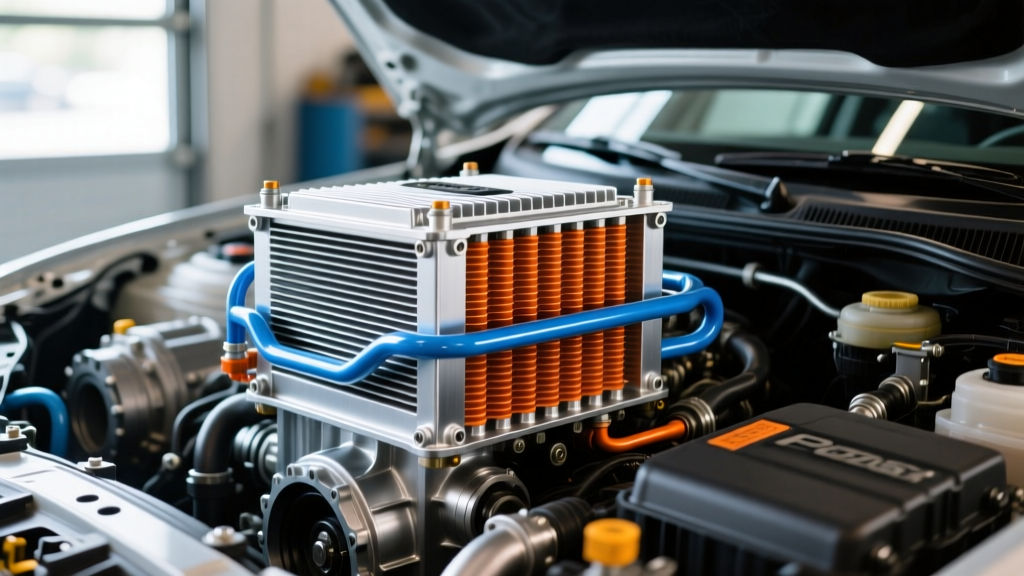
For performance applications, a brazed aluminum stacked-plate cooler is the only viable option. Stacked-plate designs, such as the Derale Hyper-Cool series (Part #15960), offer up to 30% greater thermal transfer efficiency and can safely handle working pressures exceeding 300 PSI without core ballooning. The internal fins create massive surface area turbulence, ensuring rapid heat dissipation even at low vehicle speeds.
Hardware Selection: Hoses, Fittings, and Routing
Eliminating a transmission cooler leaking issue requires abandoning standard hardware store components in favor of aerospace-grade plumbing.
PTFE vs. Synthetic Rubber
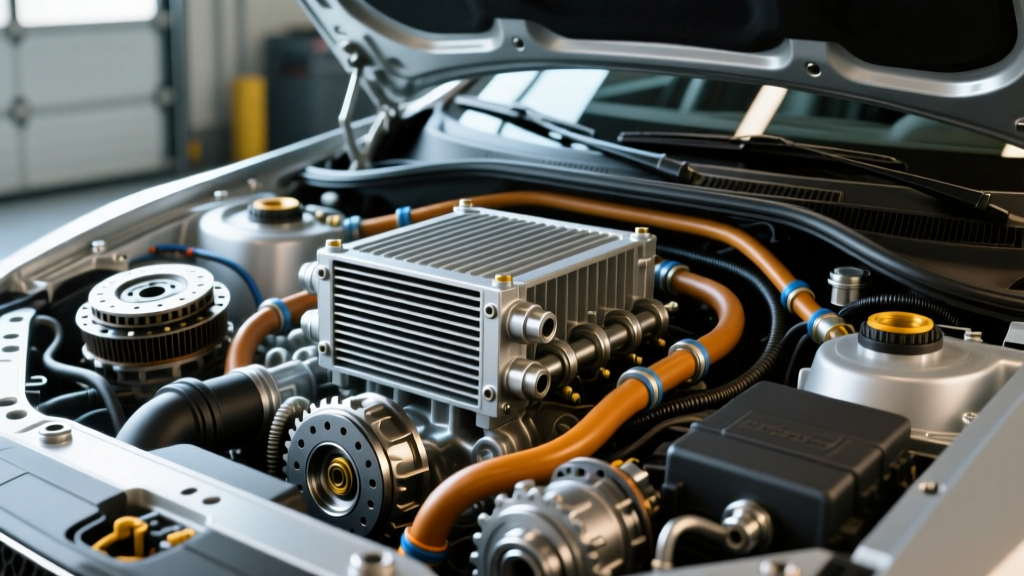
Never use standard rubber transmission hose for a performance build. Rubber degrades rapidly when exposed to modern synthetic ATFs (like Dexron ULV or Mercon LV) at high temperatures. Instead, use PTFE (Teflon) inner-lined hoses wrapped in a stainless steel or nylon braid. PTFE is chemically inert, handles temperatures up to 450°F, and will not expand under 300 PSI of line pressure. Brands like Fragola Performance Systems offer exceptional PTFE hose and reusable AN fittings that guarantee a leak-free seal when properly assembled.
Sizing: AN-6 vs. AN-8
- AN-6 (3/8" I.D.): The standard for 90% of street, pro-touring, and road course builds. It flows approximately 4.5 GPM, which is more than sufficient for the cooler circuit volume of a 4L60E, 6L80, or ZF 8HP.
- AN-8 (1/2" I.D.): Reserved for heavy-duty towing, drag racing with trans-brakes, or high-volume systems like the Allison 1000. It flows up to 7.5 GPM but adds weight and requires larger, heavier fittings.
Precision Assembly: Torque Specifications and Leak Prevention
The most common cause of a transmission cooler leaking at the AN fittings is improper assembly. Aluminum threads gall easily, and overtightening will warp the fitting seat, creating a permanent weep path.
Expert Warning: Never use Teflon tape or liquid thread sealant on AN flare fittings or JIC 37-degree flared seats. The seal is made entirely at the metal-to-metal flare contact point. Shredded Teflon tape will travel through the cooler lines and lodge inside the transmission valve body, destroying solenoids and check balls.
Target Torque Specifications
When assembling your cooler lines, use a high-quality assembly lube on the threads and a calibrated inch-pound or foot-pound torque wrench. Adhere strictly to the following specifications for aluminum-to-aluminum AN fittings:
- AN-6 Aluminum Flare Nut: 10 to 12 ft-lbs (120 to 144 in-lbs)
- AN-8 Aluminum Flare Nut: 20 to 25 ft-lbs (240 to 300 in-lbs)
- AN-10 Aluminum Flare Nut: 35 to 40 ft-lbs
- OEM Banjo Bolts (if retained): 18 to 22 ft-lbs (Always use new crush washers)
For the transmission case adapters, always use a high-temperature thread sealant rated for ATF, such as Permatex High-Temperature Thread Sealant, on the NPT threads that screw into the transmission case. Torque these adapters to the manufacturer's specification (typically 15-20 ft-lbs for 1/4" NPT into an aluminum case) to avoid cracking the transmission housing.
System Bleeding and Fluid Verification
After installing a high-capacity stacked-plate cooler and new PTFE lines, the system will hold an additional 1 to 2 quarts of fluid. Failing to properly bleed the cooler lines can lead to aeration. Aerated fluid is compressible, leading to spongy shifts, delayed engagement, and foaming that can blow fluid out of the dipstick tube or vent—often misdiagnosed by novices as a transmission cooler leaking from the top of the case.
The Proper Bleed Procedure:
- Fill the transmission pan to the correct cold level with the specified fluid (e.g., Amsoil Signature Series or OEM Dexron VI).
- Start the engine and let it idle. Cycle the shifter through every gear, pausing for 3 seconds in each to fill the respective clutch drums and valve body circuits.
- With the engine still idling and the vehicle on a level surface, check the fluid level. Add fluid until it reaches the "Cold" mark on the dipstick.
- Drive the vehicle gently for 10-15 minutes to bring the transmission up to operating temperature (160°F - 180°F).
- Re-check the fluid level at operating temperature and adjust to the "Hot" mark. Inspect all AN fittings with a clean white paper towel to check for micro-weeps that only appear under full thermal expansion.
Final Thoughts on Drivetrain Reliability
Upgrading your transmission cooling system is one of the highest-ROI modifications you can make for a performance vehicle. By abandoning brittle OEM plastics and cheap rubber hoses in favor of PTFE lines, stacked-plate cores, and precision-torqued AN fittings, you completely eliminate the risk of a transmission cooler leaking under extreme track or towing conditions. For further data on line pressure dynamics and valve body upgrades, consult the engineering resources at Sonnax Industries. Protect your drivetrain investment with aerospace-grade plumbing, and your transmission will survive the punishment of the 2026 track season and beyond.