The OEM Radiator Bottleneck: Why Performance Builds Demand External Cooling
Modern performance automatic transmissions, such as the GM 6L80/6L90 and the ZF 8HP70, are engineering marvels capable of handling immense torque. However, they are also incredibly sensitive to thermal degradation. Factory tuning often allows transmission fluid temperatures (TFT) to creep past 200°F (93°C) to optimize fuel economy, but in a high-horsepower, track-driven, or heavy-towing application, this is a recipe for premature clutch pack failure and fluid shearing.
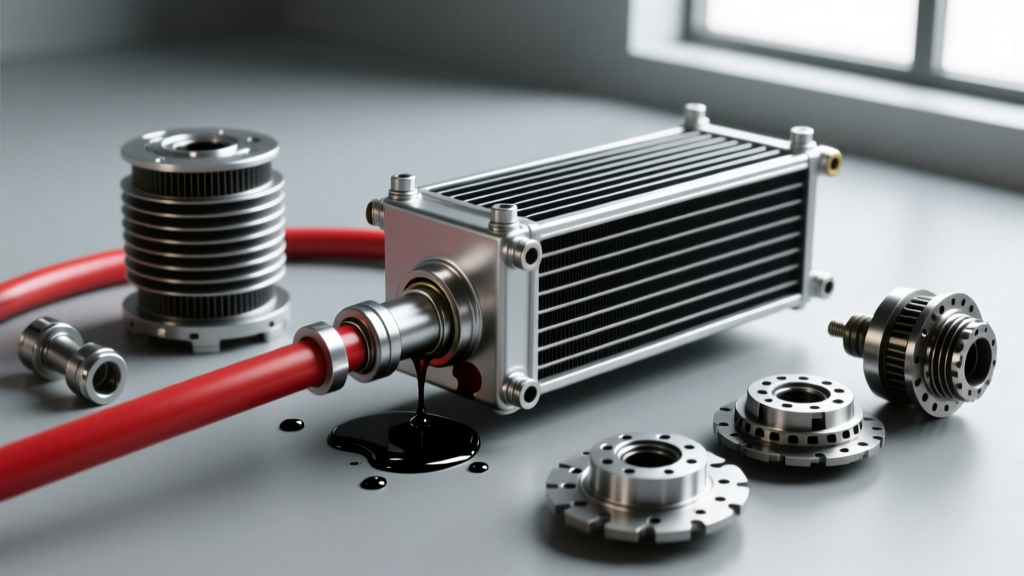
The factory cooling solution typically routes hot automatic transmission fluid (ATF) to a heat exchanger integrated into the vehicle's main radiator. While adequate for stock commuter duty, this design introduces a critical vulnerability. When enthusiasts push these platforms with aggressive tuning and higher stall torque converters, a common and catastrophic failure point emerges: a transmission cooler line leak at radiator connections, or worse, an internal end-tank rupture that cross-contaminates the engine coolant and ATF.
In this 2026 performance upgrade guide, we will dissect how to properly diagnose and repair radiator-side cooler line leaks, and more importantly, how to bypass the OEM radiator entirely in favor of a dedicated, high-flow external stacked-plate cooler.
Diagnosing and Repairing the Radiator Connection Point
Before you can upgrade your cooling system, you must address the integrity of your current lines. A transmission cooler line leak at the radiator is rarely caused by the aluminum line itself; it is almost always a failure of the connection hardware or the radiator's plastic end-tank.
Quick-Connect Failures and O-Ring Degradation
Most modern OEMs use plastic quick-connect fittings at the radiator end-tank. Under the hood of a performance vehicle, ambient temperatures and radiant exhaust heat bake the internal EPDM O-rings, causing them to flatten and lose their sealing tension. Furthermore, engine harmonics and drivetrain movement create micro-vibrations that wear the O-ring against the metal line collar.
- GM 6L80/6L90 Applications: These utilize 3/8-inch and 1/2-inch quick-connects. If the collar is scored, replacing just the O-ring is a temporary band-aid. You must replace the line collar or use a repair sleeve.
- ZF 8HP Applications: Often use metric banjo bolts or specific push-lock clips. Ensure the retaining clip (e.g., OEM equivalent to AC Delco 24225292) is fully seated and locked.
The Brass Adapter Upgrade and Torque Specifications
If you are retaining the OEM radiator for a daily-driven performance build, the best way to eliminate the quick-connect failure point is to cut off the factory plastic barbs and install brass threaded adapter fittings. However, you must be incredibly precise with your torque specifications.
Expert Warning: The plastic end-tanks on OEM radiators are bonded to the aluminum core using high-temp epoxy. Over-torquing a brass adapter fitting into the plastic tank will fracture this epoxy seal, resulting in an external coolant leak or internal fluid mixing. Always torque brass adapter fittings into plastic radiator tanks to exactly 15-18 lb-ft. Use a calibrated 1/4-inch drive torque wrench, and never use an impact gun.
The "Strawberry Milkshake" Failure Mode
If your transmission cooler line leak at the radiator is actually an internal leak—where the internal aluminum tubes inside the radiator tank crack—coolant will mix with the ATF. This creates a thick, pink emulsion colloquially known as the "strawberry milkshake of death." Coolant destroys the friction modifiers in the ATF and causes the paper-based clutch linings in the 6L80 and ZF 8HP to delaminate within miles. If you suspect internal cross-contamination, the radiator must be replaced, the transmission flushed using a specialized solvent (like Lubegard Kooler Kleen), and the torque converter must be hot-flushed or replaced.
Bypassing the Radiator: Sizing a Performance External Cooler
For dedicated track cars, drag builds, or heavy-duty towing applications, the ultimate fix is to bypass the radiator's transmission cooler entirely and plumb the ATF directly to a front-mounted external cooler. This eliminates the risk of coolant cross-contamination and provides vastly superior thermal rejection. According to Sonnax Industries, maintaining consistent, lower ATF temperatures is critical for preserving valve body clearances and solenoid longevity in high-line-pressure performance builds.
Flow Rate vs. Pressure Drop Matrix
When selecting an external cooler, ignore marketing terms like "Gross Vehicle Weight Rating" (GVW). Instead, focus on the cooler's core design, BTU/hr rejection, and most importantly, its pressure drop. The GM 6L80 and ZF 8HP rely on specific cooler circuit pressures to feed the lube-to-cooler circuits. If your external cooler creates too much restriction, the transmission will starve for lubrication, leading to catastrophic planetary gear failure.
| Cooler Model | Core Type | Pressure Drop @ 1.5 GPM | BTU/hr Rejection | Estimated Price (2026) |
|---|---|---|---|---|
| Tru-Cool LPD4739 | Stacked-Plate (Turbulator) | ~2.5 PSI | 28,000 | $140 - $160 |
| Derale Series 8000 (15960) | Plate-and-Fin | ~4.0 PSI | 24,000 | $110 - $130 |
| Mishimoto MMTC-U | Tube-and-Fin (Universal) | ~8.5 PSI | 18,000 | $180 - $210 |
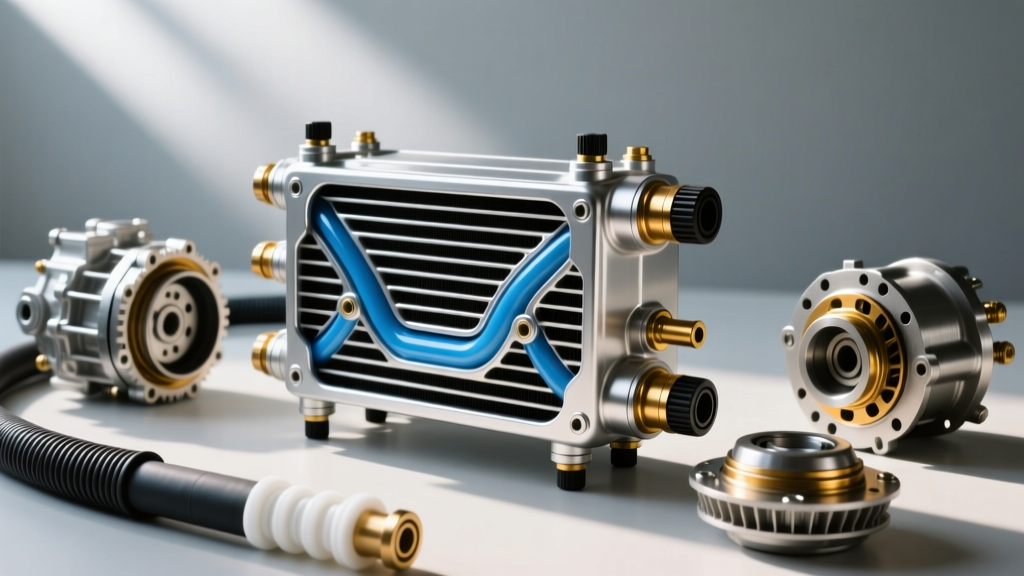
The Verdict: For performance automatics, the stacked-plate design (like the Tru-Cool LPD4739) is mandatory. Stacked-plate coolers force fluid through turbulent, S-shaped channels that maximize heat transfer to the outer plates while maintaining a very low pressure drop. Tube-and-fin coolers, while aesthetically pleasing, create too much flow restriction for modern electronically controlled transmissions.
Step-by-Step External Cooler Installation & Line Routing
Upgrading to an external cooler requires careful attention to plumbing hardware. The days of using cheap rubber push-lock hose and worm-gear clamps on a 600-horsepower build are over. Modern performance plumbing demands secure, high-pressure fittings.
AN6 vs. 3/8-Inch Push-Lock
The standard OEM cooler line diameter is 3/8-inch. When transitioning to an external cooler, you have two primary routing options:
- 3/8-Inch Push-Lock Hose with EFI Clamps: Acceptable for budget builds, but you must use fuel-injection style constant-tension clamps, not standard worm-gear clamps, to prevent slicing the hose under high-pressure spikes during torque converter lockup.
- AN6 Braided PTFE Hose: The gold standard for 2026 performance builds. PTFE (Teflon) inner liners handle ATF temperatures up to 350°F without degrading. Use reusable AN6 socketless fittings or professionally crimped ends. Expect to spend $8-$15 per AN fitting and roughly $7 per foot for high-quality nylon-covered PTFE hose.
Routing and Thermal Clearances
Always route the cooler lines away from exhaust headers and catalytic converters. ATF is highly combustible, and a leak onto a 1,200°F exhaust pipe will result in an under-hood fire. Use high-temp silicone fire sleeves over your AN6 hoses wherever they must cross within 6 inches of exhaust components. Furthermore, mount the external cooler with the fittings facing upward or to the side to allow trapped air to bleed out of the system during the initial fill.
Thermal Management: Deleting the OEM Bypass Valve
Many modern transmissions, including the GM 6L80 and 8L90, feature a thermal bypass valve inside the transmission case or on the cooler lines. This valve blocks fluid flow to the cooler until the ATF reaches roughly 185°F (85°C) to "warm up" the fluid quickly for emissions purposes. In a performance or track environment, this delay is detrimental. Transmission Digest frequently highlights how localized hot-spotting can occur in the torque converter before the bypass valve opens. Installing a thermal bypass delete kit (or drilling out the OEM valve and installing a solid plug) ensures 100% of the ATF flows through your high-capacity external cooler from the moment you leave the pits.
Fluid Selection for High-Flow Cooling Systems
When upgrading your cooling capacity and running lower average temperatures (160°F - 180°F), you must select an ATF that maintains proper viscosity and friction characteristics at these cooler operating points. Synthetic fluids like Amsoil Signature Series Fuel-Efficient Synthetic ATF or Red Line D6 provide superior shear stability and ensure that the ZF 8HP's mechatronic unit receives consistent hydraulic pressure, even when the external cooler is aggressively dropping fluid temperatures during winter track sessions.
By systematically eliminating the OEM radiator as a failure point and installing a properly sized stacked-plate cooler with high-grade plumbing, you ensure your performance transmission survives the immense thermal loads of modern high-horsepower tuning.