The Stick-Slip Phenomenon in High-Torque Drivetrains
In the modern performance landscape of 2026, engine outputs routinely exceed 800 lb-ft of torque, demanding aggressive friction materials like sintered iron and carbon-ceramic composites. While these materials provide the clamping force necessary to prevent slip under wide-open throttle, they introduce a severe side effect: clutch chatter. Chatter is fundamentally a stick-slip friction phenomenon. As the clutch disc engages the flywheel, the high coefficient of friction (COF) causes the disc to momentarily grab, halt, and then slip repeatedly in a matter of milliseconds. This rapid oscillation transfers torsional violence through the input shaft, manifesting as a violent shaking of the chassis during first-gear engagement.
Understanding the physics of this engagement is critical for tuners and track-day enthusiasts. Organic street clutches typically operate with a COF of 0.30 to 0.35, allowing for smooth, progressive slip. In contrast, full-face sintered iron clutches push the COF to 0.55 or higher. When paired with a rigid-hub race disc and a lightweight single-mass aluminum flywheel, the lack of rotational inertia and dampening creates the perfect storm for low-frequency drivetrain oscillation.
Don't Confuse Drivetrain Chatter with Accessory Failures
Before pulling the transmission, it is vital to isolate the source of the vibration. Many enthusiasts mistake high-frequency accessory rattling or harmonic balancer degradation for transmission issues, leading them down the expensive and unnecessary path of an ac clutch repair or alternator pulley replacement. The air conditioning compressor clutch can indeed rattle when the magnetic coil fails or the pulley bearing wears out, creating a vibration that resonates through the engine block at idle.
However, true drivetrain clutch chatter occurs precisely at the friction engagement point—usually between 1,200 and 1,800 RPM when releasing the pedal under load. If the vibration persists while the vehicle is stationary and the clutch is fully depressed, you are likely chasing an engine harmonic issue, a failing dual-mass flywheel (if equipped), or an accessory drive problem, rather than a friction engagement fault.
Diagnostic Matrix: Chatter vs. Vibration vs. Resonance
Use the following diagnostic table to isolate the exact nature of the oscillation before ordering replacement parts.
| Symptom Profile | RPM Range | Load Condition | Primary Culprit |
|---|---|---|---|
| Violent chassis shudder upon takeoff | 1,200 - 1,800 RPM | Clutch pedal release (engagement zone) | Flywheel runout, aggressive friction material, or engine mount deflection. |
| High-frequency metallic rattle at idle | 600 - 900 RPM | Clutch fully depressed or neutral | Accessory drive failure (requires ac clutch repair or tensioner check) or input shaft gear rattle. |
| Mid-range harmonic resonance | 2,500 - 3,200 RPM | Cruising / Steady State | Driveshaft imbalance, pinion angle misalignment, or rigid-hub disc torsional vibration. |
| Pedal pulsation during engagement | Variable | Clutch release | Warped pressure plate diaphragm fingers, worn pilot bearing, or hydraulic release bearing (HRB) misalignment. |
Precision Measurement: Runout and Bellhousing Alignment
If you have confirmed the issue is true engagement chatter, the next step is verifying the mating surfaces. In performance applications, tolerances that are acceptable for a daily driver will destroy a sintered clutch disc in a matter of weeks.
Flywheel Runout Specifications
Mount a magnetic base dial indicator (such as the Mitutoyo 2046S) to the engine block and rest the needle on the friction surface of the flywheel. Rotate the crankshaft 360 degrees. The maximum allowable Total Indicator Reading (TIR) for a performance single-mass flywheel is 0.005 inches (0.127mm). If runout exceeds this, the clutch disc will engage unevenly, causing one side of the friction material to grab before the other, instantly initiating the stick-slip chatter cycle. Resurfacing a steel flywheel typically costs between $150 and $250, while replacing a warped aluminum flywheel (like the Fidanza or McLeod units) will run $400 to $900.
Bellhousing Concentricity
Bellhousing misalignment forces the transmission input shaft to bend slightly to mate with the pilot bearing. This creates a binding effect on the clutch disc hub, preventing it from sliding smoothly along the splines during engagement. Using a dial indicator on the bellhousing bore, verify that the TIR does not exceed 0.005 inches. If it does, you must install offset dowel pins (available in 0.007, 0.014, and 0.021-inch offsets from manufacturers like Lakewood or RobbMc) to re-center the bellhousing relative to the crankshaft centerline.
Mount Deflection and Drivetrain Geometry
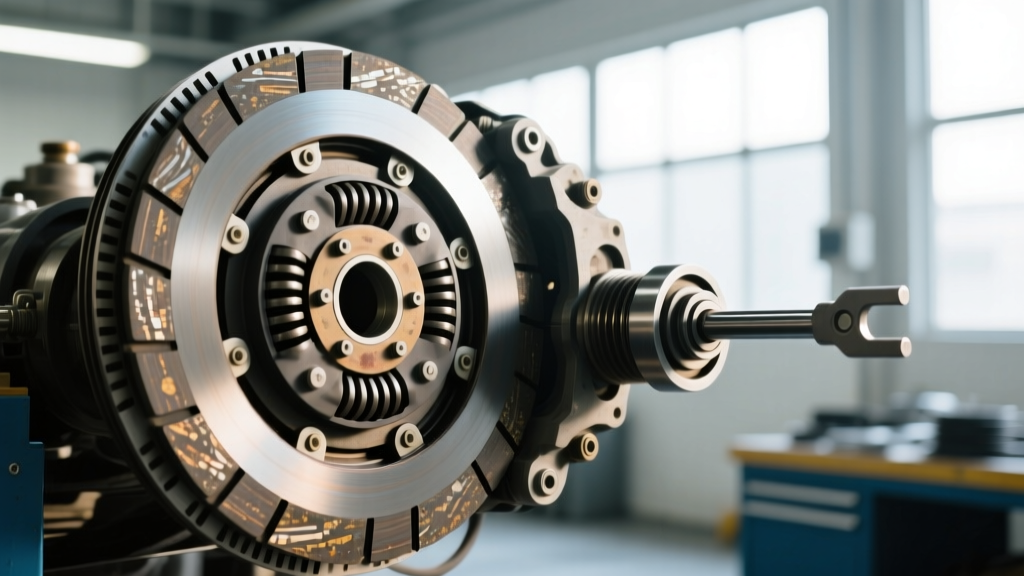
High-horsepower builds often utilize solid polyurethane or billet aluminum engine and transmission mounts to prevent wheel hop. While excellent for traction, solid mounts eliminate the dampening of engine torsional vibrations. When a rigid-hub race clutch engages, the shockwave travels through the input shaft, into the transmission case, and directly into the chassis. Upgrading to a dampened clutch disc—such as the ACT HDSS (Heavy Duty Sprung Street) or a McLeod Street Twin with organic/ceramic hybrid friction—can absorb these micro-oscillations before they reach the chassis. Furthermore, inspecting your hydraulic release bearing (HRB) clearance is paramount; maintaining exactly 1/8-inch to 3/16-inch of air gap between the HRB face and the pressure plate fingers prevents premature diaphragm wear and inconsistent clamping pressure.
Performance Upgrade Paths to Mitigate Chatter
If your build demands the holding power of a ceramic or sintered iron clutch but daily drivability is suffering, consider the following upgrade paths to tame the chatter:
- Hybrid Friction Twins: Upgrading to a dual-disc setup where the primary disc is organic and the secondary is sintered (e.g., McLeod RXT series, approx. $1,300). This stages the engagement, smoothing out the initial bite point.
- Heavy-Duty Sprung Hubs: Utilizing a clutch disc with a multi-stage dampened hub (using both coil springs and polyurethane bump stops) to absorb idle rattle and engagement shock. Note that these require thicker flywheels to accommodate the protruding hub.
- Lightweight Steel over Aluminum: While aluminum flywheels save 10-15 lbs of rotational mass, they lack the thermal mass to absorb the heat generated during slip. A lightweight chromoly steel flywheel (approx. 15 lbs) provides a broader engagement window, significantly reducing chatter in stop-and-go traffic.
- Precision Torque Sequences: Always use a calibrated torque wrench for installation. For GM LS applications using ARP 200-2802 flywheel bolts, torque to 75 lb-ft with ARP lube. For the pressure plate, torque to 25-30 lb-ft in a strict star pattern to ensure even diaphragm loading.
By respecting the physics of high-COF friction materials and adhering to motorsport-grade measurement tolerances, you can eliminate drivetrain chatter without sacrificing the torque capacity required for modern performance builds. For further technical specifications on friction compounds and installation tolerances, consult resources from Advanced Clutch Technology (ACT) and the engineering guidelines provided by Tremec for manual transmission alignment.