The Terminology Shift: Throw-Out Bearings vs. PDK CSCs
When enthusiasts and technicians discuss "throw-out bearing noise" in modern sports cars, they are usually referencing a mechanical release bearing found in traditional manual gearboxes. However, when diagnosing a pdk dual clutch transmission (Porsche Doppelkupplung), the architecture is fundamentally different. The Porsche PDK—engineered in collaboration with ZF Friedrichshafen—utilizes a hydraulically actuated Concentric Slave Cylinder (CSC) with an integrated release bearing assembly.
Whether you are working on the ZF 7DT45 found in the 991.1 Carrera, the heavy-duty 7DT50 in the 991 Turbo, or the newer 8DT series in the 992 generation, there is no mechanical clutch fork or pivot ball. Instead, hydraulic pressure pushes the CSC forward to engage the clutch packs. When owners report "throw-out bearing noise" in a PDK, they are actually experiencing CSC bearing seizure, hydraulic seal degradation, or internal clutch pack chatter masquerading as bearing failure.
Symptom Matrix: Isolating the PDK Release Bearing Noise
Diagnosing NVH (Noise, Vibration, and Harshness) in a rear-engine or mid-engine Porsche requires isolating the source from the dual-mass flywheel (DMF), the exhaust heat shields, and the actual CSC bearing. Use the following diagnostic matrix to pinpoint the failure:
| Symptom / Noise Profile | When It Occurs | Probable Culprit | Diagnostic Verification |
|---|---|---|---|
| High-pitched metallic whine or squeal | During clutch engagement (pulling away from a stop or crawling in traffic) | CSC Release Bearing Seizure / Wear | Stethoscope on the bellhousing; noise correlates with clutch slip RPM. |
| Heavy rotational grinding or crunching | During gear shifts or when the vehicle is in Park/Neutral at idle | Dual-Mass Flywheel (DMF) Failure | Remove PDK inspection cover; check for excessive radial play and metallic debris. |
| Rhythmic shudder or low-frequency chatter | Under light throttle acceleration in 2nd or 3rd gear | Clutch Pack Contamination / Glazing | Check PDK fluid for friction material; perform PIWIS clutch slip test. |
| Harsh "clunk" upon engaging Drive or Reverse | When shifting from Park to Drive/Reverse while stationary | Driveline lash or DMF spring collapse | Inspect engine and transmission mounts; verify DMF torque-to-yield bolts. |
Failure Modes: Why PDK CSC Bearings Seize and Leak
The internal environment of a pdk dual clutch transmission is exceptionally hostile. The ZF 7DT and 8DT units operate with wet clutches bathed in specialized fluid (Pentosin FFL-4 or FFL-5), while the CSC operates in the dry bellhousing cavity. The primary failure modes for the PDK release bearing assembly include:
- Thermal Degradation of the Seal: The CSC features a high-temperature internal hydraulic seal. Over years of heat cycling from the exhaust and friction materials, this seal hardens and extrudes.
- Bearing Grease Washout: If the CSC seal weeps, hydraulic fluid sprays onto the release bearing's roller elements, washing out the high-temp synthetic grease and leading to rapid metallic seizure.
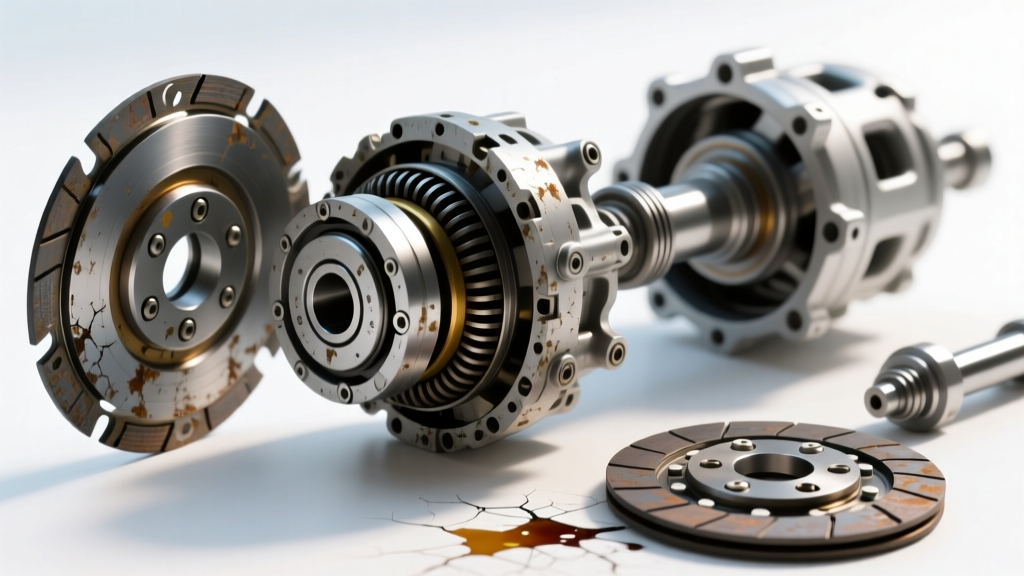
- The Contamination Catastrophe: This is the most critical failure mode. If the CSC blows its seal entirely, Pentosin hydraulic fluid is sprayed directly onto the dry friction surfaces of the dual clutch packs. Because PDK clutch friction materials are highly sensitive to contamination, any hydraulic fluid leak onto the clutches mandates a complete dual-clutch assembly replacement—a $4,000+ part alone.
Model-Specific Repair Protocol: ZF 7DT45 (991.1 Carrera)
Replacing the CSC release bearing on a 991.1 Carrera requires dropping the entire PDK unit. The ZF 7DT45 weighs approximately 165 lbs (75 kg), necessitating a specialized transmission jack and a secondary support strap to prevent the unit from tipping off the jack pad.
Step 1: Teardown and Extraction
After safely lifting the vehicle and removing the rear wheels, exhaust system, and driveshaft, disconnect the PDK wiring harness and hydraulic cooler lines. Cap all lines immediately; the PDK hydraulic circuit is highly sensitive to moisture and particulate contamination. Support the engine from above using an engine support bar, as the rear crossmember must be removed to lower the transmission.
Step 2: CSC Removal and Bellhousing Inspection
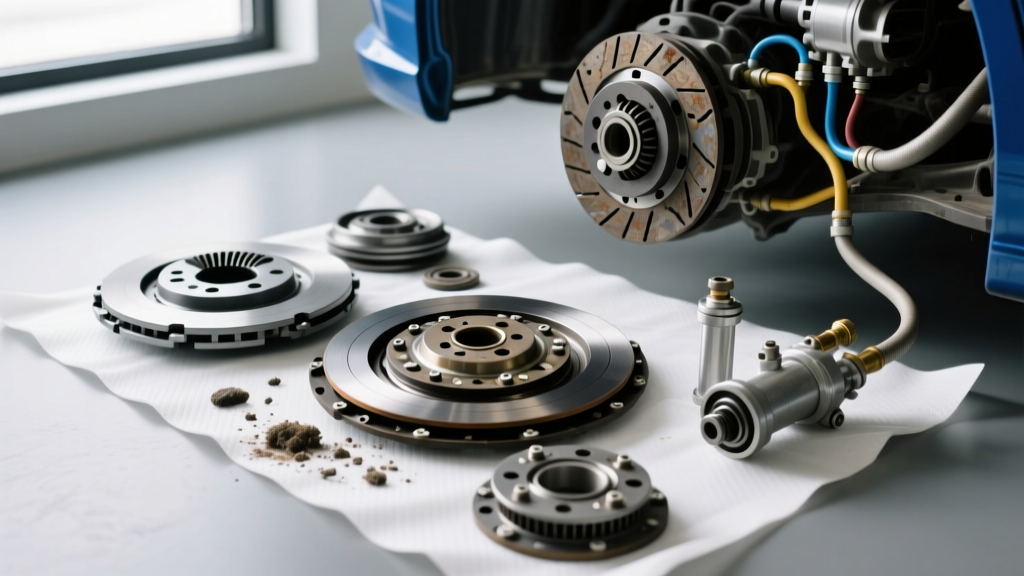
Once the PDK is on the bench, remove the bellhousing bolts. Before separating the bellhousing from the main transmission case, note the alignment marks. Inside, you will find the dual clutch pack and the CSC. The CSC is retained by three M6 bolts. Inspect the bellhousing cavity for signs of Pentosin FFL-4 fluid (which has a distinct, slightly sweet chemical odor and greenish/brown tint). If fluid is present on the clutch splines or friction surfaces, the dual-clutch assembly is ruined and must be replaced.
Crucial Torque Specifications and Part Numbers
Reassembly requires strict adherence to Porsche factory torque specifications to prevent bellhousing warping or catastrophic driveline failure.
| Component | Fastener / Spec | Torque Specification | OEM Part Number (Reference) |
|---|---|---|---|
| CSC to Bellhousing | M6 x 1.0 Bolts (x3) | 10 Nm (7.5 ft-lbs) | 9A6.307.551.00 (CSC Assembly) |
| Bellhousing to Engine Block | M10 x 1.25 Bolts | 65 Nm (48 ft-lbs) | N 107.328.01 |
| Bellhousing to Engine Block | M12 x 1.25 Bolts | 100 Nm (74 ft-lbs) | N 107.329.01 |
| Dual Clutch to Input Shafts | Spline Alignment Tool | N/A (Requires ZF Alignment Mandrel) | ZF 9794.101.001 (Tool) |
| PDK Fluid (ZF 7DT) | Capacity: ~8.5 Liters | Fill to overflow at 40°C | Pentosin FFL-4 (000.043.20) |
PIWIS Adaptation: The Step You Cannot Skip
Replacing the mechanical components is only half the battle. Because the new CSC has different hydraulic volume characteristics and the clutch packs have different wear depths, the Transmission Control Module (TCM) must relearn the clutch touch-points. Attempting to drive the vehicle without performing a PIWIS (Porsche Integrated Workshop Information System) adaptation will result in violent gear engagements, limp mode, and immediate destruction of the new clutch packs.
Using a PIWIS III or PIWIS IV tester, navigate to Transmission > Maintenance/Repairs > Clutch Adaptation. The software will cycle the clutches through a series of slip-tests while the vehicle is on a lift with the rear wheels free to spin. This process maps the exact hydraulic pressure required to achieve the "kiss point" (the moment the friction material contacts the steel plates). According to Rennlist technical archives, failing to perform the touch-point learning procedure is the number one cause of premature PDK failure following bench repairs.
2026 Cost Analysis: Dealership vs. Independent Specialist
As the 991 and early 992 generations age out of factory warranties, owners are increasingly turning to independent Porsche specialists for PDK repairs. The cost disparity is significant:
- Dealership CSC Replacement: $4,500 - $6,500. Dealerships rarely replace just the CSC; standard protocol often dictates replacing the entire bellhousing assembly or the complete PDK unit to mitigate liability.
- Independent Specialist CSC Replacement: $2,200 - $3,400. This assumes the dual-clutch packs are NOT contaminated. If the clutches are contaminated by a blown CSC seal, add $4,500 - $6,000 for the ZF dual-clutch module and specialized alignment tooling.
For a comprehensive overview of ZF's dual-clutch architecture and service intervals, technicians should consult the ZF Friedrichshafen passenger car transmission documentation. Additionally, Pelican Parts' Porsche 991 technical library offers excellent visual references for PDK extraction and driveline support procedures.
Final Diagnostic Takeaway
When a customer complains of throw-out bearing noise in a PDK-equipped vehicle, do not treat it as a simple $50 bearing swap. It is a complex hydraulic and mechatronic system requiring specialized fluid handling, precision alignment tooling, and factory-level software adaptation. Catching a weeping CSC early—before it contaminates the dual-clutch packs—is the difference between a routine maintenance repair and a catastrophic five-figure transmission rebuild.