The Thermal Reality: Open vs. Limited Slip Differentials
When planning a rear axle upgrade for a truck, SUV, or track car, the debate between an open differential and a limited slip differential (LSD) usually centers on traction, cornering grip, and off-road capability. However, as we navigate the 2026 aftermarket landscape, professional drivetrain builders are focusing on a secondary, often overlooked consequence of this choice: thermal management. The friction dynamics of your chosen differential directly dictate the internal pressure of the axle housing, making your rear differential vent just as critical as the gear set itself.
Choosing between an open differential and an LSD is not just about how power is distributed to the wheels; it is about how heat is generated, how gear oil degrades, and how internal air expansion is managed. Failing to match your differential type with the correct breather setup and fluid chemistry is a primary cause of premature axle seal failure and clutch-pack burnout.
Open Differentials: Baseline Heat and Pressure
An open differential, such as the standard GM 8.5-inch 10-bolt or a base Dana 35, operates on a simple spider-gear mechanism. Because the spider gears only rotate relative to the side gears during a turn, internal friction is minimal. Under normal highway or street driving, an open differential housing rarely exceeds 150°F to 180°F.
At these temperatures, the expansion of the air volume inside the axle tube is modest. The factory-installed rear differential vent—typically a small, press-fit plastic cap with a baffled labyrinth on the top of the axle tube—is perfectly adequate to equalize pressure. For open diffs running standard 75W-90 GL-5 mineral gear oil, the stock venting system remains a reliable, zero-maintenance component.
Clutch-Type LSDs: The Heat Generation Problem
Clutch-type limited slip differentials, such as the Eaton Positraction or the Ford Traction-Lok, utilize stacked friction discs and preload springs to bias torque to the wheel with traction. When one wheel loses grip, the clutch packs slip against each other to transfer power. This slip generates immense localized heat.
During aggressive track use, heavy towing, or low-traction off-road crawling, internal housing temperatures in a clutch-type LSD can easily spike past 250°F. This extreme heat causes the trapped air inside the axle housing to expand rapidly. If the stock vent is restrictive, clogged with road grime, or simply too small in diameter, internal pressures can exceed 15 to 20 PSI. Since standard nitrile rubber axle seals are not designed to hold back pressurized gas, the expanding air forces its way past the seal lips, atomizing the gear oil and pumping it directly onto your brake rotors.
Why the Rear Differential Vent is Your Upgrade's Lifeline
The physics of gas expansion (Charles's Law) means that as the differential fluid and housing heat up, the air pocket inside must escape. Conversely, when the axle is submerged in cold water or cools rapidly after a heavy load, the contracting air creates a powerful vacuum.
Expert Insight: If your vent is submerged during a water crossing, the cooling vacuum will suck water directly into the housing. Water mixed with GL-5 gear oil creates sulfuric acid and sludge, while water mixed with LSD friction modifiers causes immediate clutch chatter and catastrophic pack failure.
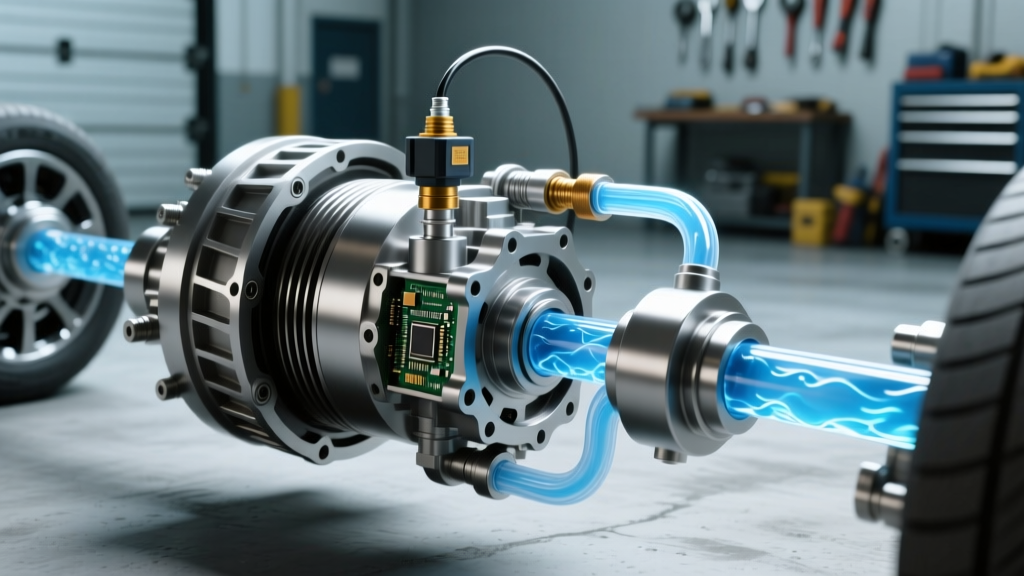
For any vehicle transitioning from an open diff to a clutch-type LSD, or any vehicle that sees water fording, upgrading the rear differential vent to a remote, frame-mounted breather is a mandatory step in the build process. Remote breather kits utilize a 3/8-inch or 1/2-inch polyurethane hose routed high into the engine bay or bed, capped with a filtered roll-over valve to prevent dust and water ingestion while allowing the housing to breathe freely under extreme thermal loads.
Buyer’s Matrix: Matching the Diff to the Vent and Fluid
To make an informed purchasing decision, you must evaluate the entire ecosystem of the differential. Below is a comparison matrix to guide your 2026 drivetrain build, factoring in traction needs, thermal output, and fluid requirements.
| Differential Type | Heat Profile | Recommended Fluid | Vent Upgrade Req. | Est. Upgrade Cost |
|---|---|---|---|---|
| Open Differential | Low (150°F - 180°F) | 75W-90 Conventional GL-5 | None (Stock is fine) | $0 (Stock) |
| Gear-Type LSD (e.g., TrueTrac) | Medium (180°F - 220°F) | 75W-90 Synthetic GL-5 | Recommended for Off-Road | $60 - $120 |
| Clutch-Type LSD (e.g., Eaton Posi) | High (220°F - 280°F+) | 75W-140 Synthetic + Modifier | Mandatory Remote Breather | $120 - $250 |
Gear-Type vs. Clutch-Type: A Note on Wear
Gear-type limited slips, like the Detroit TrueTrac or Torsen, use helical gears rather than friction clutches. While they generate more heat than an open diff, they do not suffer from the same extreme friction spikes as clutch-types. Furthermore, they do not require specialized friction modifiers, making their fluid maintenance closer to that of an open differential. However, because they are often deployed in heavy off-road or high-horsepower applications, a remote rear differential vent is still highly recommended to prevent water ingestion.
Step-by-Step: Upgrading Your Rear Differential Vent
If your buyer's guide analysis points toward an LSD or an off-road application, follow this procedure to upgrade your venting system safely:
- Locate and Remove the Stock Vent: Clean the axle tube thoroughly around the factory vent to prevent metal shavings or dirt from entering the housing.
- Drill and Tap the Housing: For cast-iron center sections (like the Dana 44 or Ford 8.8), drill a 11/32-inch hole and tap it to 1/4-inch NPT. For stamped steel covers, it is safer to weld a 1/4-inch NPT steel bung onto the cover before painting and reinstalling.
- Install the Fitting and Hose: Thread in a brass barbed hose fitting using high-temperature PTFE thread sealant. Do not use standard Teflon tape, as shreds can break off and clog the internal oil pickup or gear teeth.
- Route the Breather Line: Run the 3/8-inch hose upward along the frame rail, securing it away from exhaust components. Terminate the line with a high-flow, filtered breather cap (e.g., ARB or Spicer breather kits) mounted above the maximum water fording depth.
Fluid & Friction Modifier Protocols for 2026
The choice between an open and limited slip differential fundamentally changes your fluid maintenance schedule. Modern synthetic lubricants, such as those detailed in AMSOIL's Severe Gear lineup, offer superior film strength at the 250°F+ temperatures generated by clutch-type LSDs.
The Friction Modifier Balancing Act
Clutch-type LSDs require a specific friction modifier (like GM EOS or Ford XL-3) to alter the coefficient of friction between the clutch discs. Without it, the differential will 'chatter' or bind during low-speed turns, rapidly glazing the friction surfaces. However, adding too much modifier reduces the locking bias, effectively turning your expensive LSD back into an open differential.
Standard Protocol: Start by filling the housing with your chosen 75W-90 or 75W-140 GL-5 synthetic gear oil. Add exactly one half-bottle (approx. 2 oz) of LSD friction modifier. Drive the vehicle in a parking lot, performing 10 tight, slow-speed figure-eights to circulate the fluid into the clutch packs. If chatter persists, add another 1 oz. Never exceed 4 oz total, or you will compromise the locking mechanism.
Torque Specifications for Service
When servicing the fluid and upgrading the vent, always adhere to precise torque specifications to prevent housing warpage and leaks:
- Dana 44 Cover Bolts: 25 - 30 lb-ft
- GM 8.5-inch 10-Bolt Cover: 25 lb-ft
- Ford 8.8-inch Cover Bolts: 28 - 38 lb-ft
- Spicer Trac-Lok Carrier Bearing Cap Bolts: 70 - 85 lb-ft (Always use new stretch bolts or apply red Loctite if reusing aftermarket hardware).
Final Verdict: Sizing Your Drivetrain Investment
Choosing between an open differential and a limited slip is a compromise between cost, daily drivability, and ultimate traction. Open differentials remain the undisputed kings of low-maintenance, low-heat highway cruising. But the moment you demand traction in the dirt, snow, or on the track, an LSD becomes mandatory.
As a buyer, you must look beyond the carrier itself. Budgeting for a high-quality synthetic gear oil, the correct friction modifiers, and a properly routed remote rear differential vent will ensure your axle survives the brutal thermal realities of modern performance driving. Consult the engineering specs from Spicer Drivetrain or your specific axle manufacturer to verify housing breathability before your first off-road excursion or track day.